
Reworked postcard hearing process, other tax measures advance
Lawmakers gave first-round approval March 30 to a package of tax-related bills that includes a measure intended to ensure earlier public engagement in local taxing and spending decisions.
The Revenue Committee introduced LB803 as a shell bill. A committee amendment, adopted 37-0, replaced it with provisions of four other measures considered by the committee this session, including LB575, sponsored by Syracuse Sen. Bob Hallstrom.
The Property Tax Request Act, passed by the Legislature in 2021, requires counties, cities, school districts and certain other political subdivisions to hold a public hearing and pass a resolution or ordinance to increase their property tax request from one year to the next.
Under the amended provisions of LB575, such a measure would have to pass by a two-thirds majority vote.
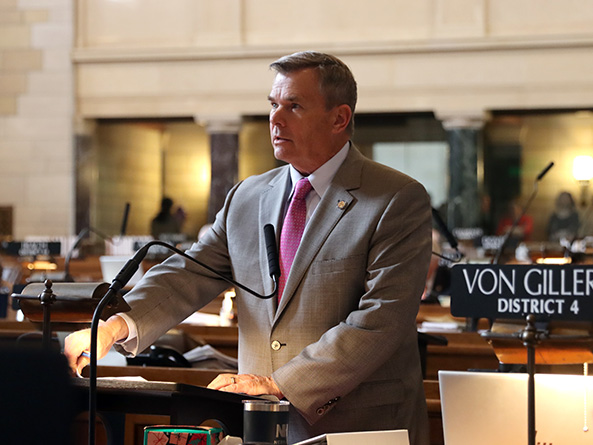
Elkhorn Sen. R. Brad von Gillern introduced an amendment, adopted 39-0, under which a successful override measure would require a four-sevenths majority vote for political subdivisions with seven-member boards.
The act also requires counties, cities and school districts to participate in a joint public hearing if they seek to increase their property tax request by more than an allowable growth percentage. Hallstrom’s measure would require those political subdivisions to participate regardless of whether they seek to increase their property tax request.
The hearing would focus on each political subdivision’s budget and property tax request, as well as factors that might affect the current year’s budget.
Joint public hearings currently must be held between Sept. 14 and 24. Under Hallstrom’s measure, hearings would be held on or after July 1 and prior to July 15 and before any of the participating political subdivisions files its adopted budget statement.
Hallstrom said public officials and taxpayers are frustrated with the current process, which leaves little time for political subdivisions to adjust their budgets in response to public concerns. Holding the hearings earlier in the year would allow for more “meaningful” public engagement, he said.
Currently, counties are required to send postcards notifying property owners of a joint public hearing. Under the amended provisions of LB575, the state Department of Revenue instead would send property owners a postcard that includes a website where a county would post the time and place of the joint public hearing as well as the first county, city and school district budget hearings.
Hallstrom’s measure also would update a provision requiring counties to notify property owners of valuation changes. The updated notice would include certain tax information similar to what is included on the current postcard.
Hallstrom introduced an amendment, adopted 32-0, under which the provisions of LB575 would go into effect Jan. 1, 2027, rather than three calendar months after the Legislature adjourns. He said the change is intended to give political subdivisions enough time to implement the new hearing process.
Among other technical changes, Hallstrom said, the amendment would exclude educational service units from the The Property Tax Request Act’s requirements.
Also included in the committee amendment are the provisions of LB938, also sponsored by Hallstrom. They would allow Nebraskans to receive an income tax deduction for contributions to accounts that could be used for the down payment and closing costs related to a beneficiary’s purchase or construction of a primary residence in Nebraska.
A beneficiary would have to be a first-time home buyer — an individual who has never owned or purchased a single-family, owner-occupied home.
Contributions would be limited to $5,000 per tax year for individuals and $10,000 per tax year for those who file a joint return. An account holder’s federal adjusted gross income would be reduced by the amount contributed as well as any interest and other income earned.
Total contributions per account would be capped at $25,000 for individuals and $50,000 for joint filers.
The provisions of LB1116, introduced by Sen. Teresa Ibach of Sumner, would update the Sports Arena Facility Financing Assistance Act. Under her proposal, state assistance could be used for a sports complex located in a second class city or village for up to 10 years rather than five.
Currently, a five-member board that includes the governor and state treasurer is required to hold a public hearing on an application for assistance after reviewing it. Ibach said her proposal would make the current process more efficient by requiring the board to hold a hearing within 30 days after completing a review.
The proposal also would require the board to approve or deny an application within 30 days after a hearing.
Finally, the measure would eliminate a requirement that the governor be among the majority of members voting on board actions. Under the provisions of LB1116, all board actions would require a majority vote of members present at the board meeting.
The provisions of LB1154, sponsored by Ralston Sen. Merve Riepe, would update the Property Tax Growth Limitation Act.
Under the act, passed by the Legislature in 2024, a county’s, city’s or village’s property tax request may not exceed its property tax request authority.
That figure is calculated using the preliminary property tax request authority, which is the amount of property taxes requested and approved by the political subdivision in the prior fiscal year, minus the sum of certain exceptions used.
Under Riepe’s proposal, one of those factors — the amount of a political subdivision’s unused property tax request authority — would no longer be excluded from the preliminary property tax request authority. He said the change would remove an incentive for political subdivisions to use their full taxing authority each year rather than carry it forward to future years.
Sen. Bob Andersen of Omaha introduced an amendment, adopted 39-0, to include provisions of his LB882. They would repeal homestead exemption reapplication requirements for veterans with a 100% service-connected disability rating and their surviving spouses who are unmarried or remarry after turning 57.
Andersen said the measure also would eliminate reapplication requirements for surviving spouses of service members who died on active duty or because of a service-connected disability.
Under the amendment, veterans who qualify for a 100% service-connected temporary disability, as well as their surviving spouses, would have to reapply for a homestead exemption every five years rather than annually.
Finally, Andersen’s amendment would require surviving spouses who have been granted or applied for an exemption and who remarry before turning 57 to notify the county assessor within 30 days after the remarriage.
After adoption of the amendments, senators advanced LB803 to select file on a vote of 42-0.

