
Session Review: Business and Labor
Lawmakers considered several proposals this session relating to the state’s minimum wage, workers’ compensation provisions and workforce development.
Wages and benefits
A measure that limits scheduled increases to the state’s minimum wage and establishes youth and training wages was approved by lawmakers this session.
Nebraskans voted at the November 2022 general election to increase the state minimum wage incrementally to $15 an hour by Jan. 1, 2026. The minimum wage then was scheduled to adjust annually based on the Midwest Consumer Price Index to account for cost-of-living increases.
LB258, introduced last session by Sen. Jane Raybould of Lincoln, instead increases the state minimum wage by 1.75% annually.
The bill also establishes a youth minimum wage of $13.50 an hour for employees ages 14 and 15, and adjusts the 90-day training wage for new employees under age 20 to $13.50 an hour through Dec. 1, 2026. The training wage then increases by 1.5% annually.
The youth minimum wage, which does not apply to emancipated youth, also will increase by 1.5% every fifth year beginning Jan. 1, 2030.
LB258 passed on a 33-16 vote.
Lawmakers also approved a bill that makes certain workers’ compensation first injury report information confidential.
Currently, employers or insurers are required to file a first injury report with the Workers’ Compensation Court for any injury resulting in death, lost time, loss of consciousness or medical treatment beyond first aid. Such reports are considered public records and can be accessed through a public records request.
LB455, introduced by Syracuse Sen. Bob Hallstrom last session, requires that an employee’s identifying information included in such reports remain confidential for 60 days after filing, except as necessary to administer and enforce other provisions of the Nebraska Workers’ Compensation Act.
An injured employee may waive confidentiality. Access to the confidential report otherwise is restricted to the involved parties and their legal counsel, insurers and treating physicians, state and federal agencies for investigations or statistical research and nonprofit organizations that provide services to families of deceased employees.
The Workers’ Compensation Court is required to send a letter to an injured employee notifying them of their right to seek legal advice or representation once a report is filed.
The measure also includes provisions of Plymouth Sen. Tom Brandt’s LB1077.
Those provisions update how workers’ compensation claims data is reported to the National Council on Compensation Insurance for purposes of calculating the experience modification factors used to set a business’s insurance premium, which is based on its workers’ compensation claim history compared to the industry average.
Beginning Jan. 1, 2027, Nebraska businesses may use a net reporting system rather than a gross reporting system to allow for the exclusion of deductible payments in the determination of their experience modification factor.
LB455 passed on a 37-12 vote.
A measure that would have provided workers’ compensation benefits to certain firefighters who develop some cancers stalled after a failed cloture vote on general file.
LB400, sponsored by Fremont Sen. Dave Wordekemper, would have amended the Nebraska Workers’ Compensation Act to include cancer experienced by firefighters as a result of on-the-job exposure to known carcinogens.
As introduced last session, the bill would have established a rebuttable presumption that cancer experienced by a firefighter arose out of the course of employment.
The measure would have applied to professional and volunteer firefighters who have served for at least five years. Retired firefighters would have needed to be diagnosed within 60 months of retiring and would have been eligible for medical benefits only.
During first-round debate, lawmakers adopted an amendment offered by Kearney Sen. Stan Clouse that was meant to address concerns about the inclusion of coverage for volunteer firefighters.
Under the amendment, a volunteer firefighter would have been eligible for benefits only after serving for 10 years, during which time they must have actively participated in a minimum of 40% of the department’s drills and 25% of emergency calls received.
After eight hours of debate spanning several days, Wordekemper offered a motion to invoke cloture, which ends debate and forces a vote on the bill and any pending amendments. The motion failed on a 32-15 vote. Thirty-three votes were needed.
Workforce development
Senators passed two omnibus measures that update a variety of labor and workforce programs.
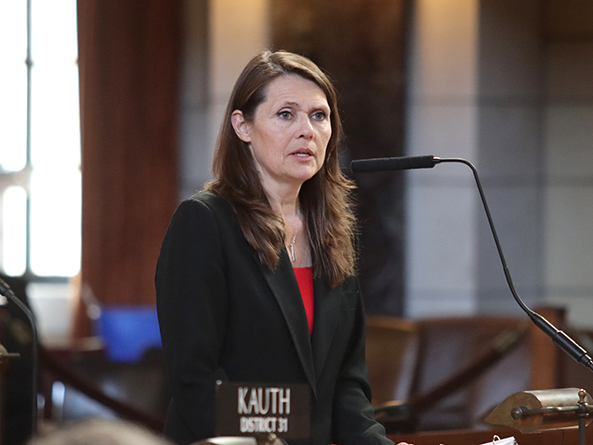
LB847, sponsored by Sen. Kathleen Kauth of Omaha, creates the Nebraska Office of Registered Apprenticeship within the state Department of Labor to serve as the state apprenticeship registry. The bill also creates the Nebraska Apprenticeship Council to advise the office and provide community outreach and education regarding the benefits of apprenticeship.
In addition, the measure increases from 20% to 50% the amount of the unemployment combined tax rate that can be transferred to the Workforce Development Program Cash Fund to invest in workforce development initiatives.
LB847 includes provisions of five other bills:
• LB747, introduced by Elkhorn Sen. Tony Sorrentino, which establishes uniform enforcement authority across multiple programs managed by DOL, including changing youth employment certification procedures, removing an infraction for failure to provide a wage statement and expanding the department’s subpoena powers;
• LB864, sponsored by Sen. Jason Prokop of Lincoln, which transfers responsibility for awarding and disbursing grants under the InternNE program from the state Department of Economic Development to DOL;
• LB1015, introduced by Sumner Sen. Teresa Ibach, which creates the Business Innovation Cash Fund within DOL and establishes a mechanism to provide funding for the Business Innovation Act from a percentage of State Unemployment Insurance Trust Fund dollars, as designated by the commissioner of labor;
• LB1044, sponsored by Prokop, which appropriates $15 million in fiscal year 2026-27 from the Business Innovation Cash Fund for grants under the Business Innovation Act and requires that at least $4 million in grants be awarded annually; and
• LB1173, introduced by Kauth, which changes the name, filing fee and permitted uses of the Contractor and Professional Employer Organization Registration Cash Fund and allows DOL to assess fees annually on all employers under the Employment Security Act on a graduated scale based on gross wages paid out in the previous year, not to exceed a total of $15 million.
The measure passed on a vote of 44-4 and took effect immediately.
LB921, sponsored by Ibach, requires businesses that experience a closure or a mass layoff event lasting longer than six months to notify employees and DOL at least 90 days in advance of such event, if it will affect 100 or more full-time employees.
It also amends the Non-English-Speaking Workers Protection Act to require businesses to provide an interpreter and referral agent if 5% of their staff speaks the same non-English language. Referral agents are required to develop and maintain a list of community services and assist employees in attempting to obtain those services.
LB921 includes provisions of the following bills:
• LB308, introduced last session by Ibach, which requires DOL to create and maintain a registry of health care staffing agencies operating in Nebraska;
• LB544, introduced by Norfolk Sen. Robert Dover last session, which requires individuals receiving unemployment benefits to respond to an interview request or a job offer for suitable employment within one week or lose a week of benefits;
• LB813, introduced by Sen. Eliot Bostar of Lincoln, which classifies individuals who perform work at a physical business location operated by a marketplace network platform, such as DoorDash, as an independent contractor if such physical business is located in a metropolitan or primary class city; and
• LB1170, introduced by Wordekemper, which allows a county to file more than one state claim for a single correctional institution incident if the threshold amount is met for each claim, and expands the definition of what constitutes a qualifying death for purposes of the Line of Duty Compensation Act.
The bill passed on a 37-12 vote.
Other measures
Lawmakers approved a bill that seeks to combat human trafficking at Nebraska hotels and motels.
LB320, introduced last session by Sen. Rita Sanders of Bellevue, adds hotels and other lodging establishments to the list of public spaces required to display posters that include the Nebraska human trafficking hotline number and other information.
The bill also allows for optional training for employees on human trafficking issues specific to the lodging industry, which may be developed and provided through collaboration between the state attorney general, DOL and lodging establishments.
An owner, operator or employee of a hotel or similar public lodging establishment who implements the training and other policies will not be liable for any act or omission related to human trafficking committed by a third party at the establishment, unless they knowingly assist such action or fail to act in a reasonable manner.
LB320 passed 46-1.
A measure that eliminates an unfunded state program related to workplace safety for private employers also passed this session.
LB397, introduced by Columbus Sen. Mike Moser last session, repeals the Workplace Safety Consultation Program, which authorized DOL to conduct workplace inspections and consultations to determine whether employers are complying with standards issued by the federal Occupational Safety and Health Administration. It also removes the requirement for private sector employees to maintain a workplace safety committee.
Public sector employers subject to the Nebraska Workers’ Compensation Act still must establish workplace safety committees to allow oversight for employees not covered by OSHA. Public sector employers subject to collective bargaining agreements may establish safety committees through the collective bargaining process.
LB397 passed on a 35-13 vote.
Finally, a proposal heard by the Business and Labor Committee to update definitions, increase construction caps and extend the sunset dates of two workforce housing programs was advanced to general file.
LB819, sponsored by Sen. Bob Hallstrom of Syracuse, then was amended into LB768, an affordable housing measure out of the Banking, Commerce and Insurance Committee that lawmakers approved this session.

