
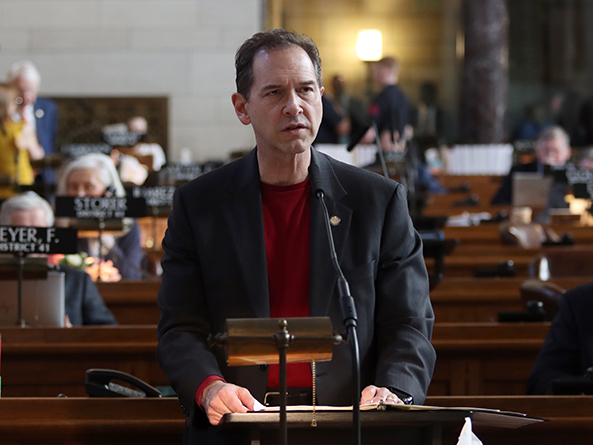
Session Review: Health and Human Services
Proposals impacting the state’s Medicaid program, health care licensure and child care subsidy eligibility were among those considered by the Health and Human Services Committee this session.
Medicaid
Lawmakers approved a measure that makes a number of changes to state Medicaid provision.
LB958, introduced by Sen. Machaela Cavanaugh of Omaha, requires that the assessment tool used by the state Department of Health and Human Services to determine functional eligibility, service needs and service tier assignments for Medicaid waiver participants be administered by an employee or contractor trained in clinical interviewing techniques.
Among other provisions, the measure requires that services authorized under a waiver must be based on individualized assessments of medical necessity, functional need and health and safety requirements as determined through a person-centered planning process in accordance with federal home and community based services waiver regulations.
If an assessment results in a reduction of a waiver participant’s service tier, authorized service hours or service provision, the department is required to conduct an immediate supervisory review of the assessment and determination prior to final implementation of the reduction.
The bill also includes provisions of four additional bills:
• LB701, introduced last session by Omaha Sen. Ashlei Spivey, which requires DHHS to reimburse Medicaid providers for trained doula services by Jan. 1, 2029, and establishes a group of stakeholders and experts to develop an implementation plan by Jan. 1, 2027;
• LB773, sponsored by Sen. George Dungan of Lincoln, which expands the state’s Prenatal Plus Program to include a minimum of two breastfeeding support sessions, eliminates the program’s scheduled sunset date and extends reporting requirements to 2034;
• LB777, introduced by Cavanaugh, which requires DHHS to provide the maximum amount of retroactive coverage for each Medicaid eligibility category authorized by federal law under the One Big Beautiful Bill Act of 2025, and requires the department to include information on work requirements, concurrent enrollment and cost sharing in the Medicaid and Long-Term Care annual report; and
• LB1033, sponsored by Spivey, which raises the maximum crisis assistant payment by DHHS under the federal low-income home energy assistance program from $500 to $800 per program year, while allowing higher payments in extenuating circumstances.
LB958 passed on a 48-1 vote and took effect immediately.
LB1091, introduced by Sen. Eliot Bostar of Lincoln and passed 49-0, requires DHHS to provide a carve-out from Nebraska’s Medicaid managed care program for services and supports for long-term care clients with special needs.
Under the bill, those services instead must be administered and reimbursed through a Medicaid fee-for-service or other delivery system authorized under state or federal law. The measure also prohibits a skilled nursing facility from being required to enroll in an MCO as a condition of eligibility to provide such services.
The bill requires DHHS to amend Medicaid managed care contracts, including revisions to enrollment processes, no later than six months after the bill’s effective date.
Managed care organizations would have been authorized to cover out-of-pocket expenses for Nebraska Medicaid enrollees under a bill vetoed by Gov. Jim Pillen.
LB929, introduced by Omaha Sen. John Fredrickson, would have allowed Medicaid managed care organizations to cover deductibles, co-insurance, copayments or similar cost-sharing charges on behalf of Medicaid enrollees to the extent allowed under federal law.
The bill passed on a 31-18 vote.
In his veto letter, the governor said that while the bill would not require managed care organizations to cover cost sharing, it would encourage Medicaid enrollees to “overuse the system without consequence” and create an expectation that public benefits are “handouts.”
An attempt to override the veto failed on a vote of 22-26. Thirty votes were needed.
Licensure
LB912, introduced by Sen. Brian Hardin of Gering, requires DHHS to establish a statewide process to endorse community health worker training programs that meet minimum quality standards and ensure services provided by community health workers are eligible for reimbursement by Medicaid and private insurers.
The bill includes provisions of 11 other measures considered by the committee this session:
• LB735, sponsored by Bellevue Sen. Victor Rountree, which adopts the Respiratory Care Interstate Compact;
• LB736, also sponsored by Rountree, which adopts the Athletic Trainer Compact;
• LB796, introduced by Sen. Barry DeKay of Niobrara, which clarifies engagement in the practice of pharmacy in Nebraska;
• LB825, sponsored by Lincoln Sen. Beau Ballard, which requires practitioners licensed under the Mental Health Practice Act to complete a minimum of two hours of continuing education in domestic abuse counseling every two years;
• LB887, introduced by Sen. Bob Hallstrom of Syracuse, which allows accredited pharmacy programs to determine the date and time of the jurisprudence examination for pharmacy students and clarifies that certified pharmacy technician requirements do not apply to interns under the supervision of a pharmacist;
• LB891, sponsored by Blair Sen. Ben Hansen, which updates the Child Care Licensing Act to align state law with federal background check regulations, clarifies how self-reported licensing investigations appear on public records, allows certain volunteers to be counted toward staff-to-child ratios and prohibits residency requirements for family child care homes;
• LB892, also sponsored by Hansen, which prohibits a massage therapist from practicing in a location other than a licensed massage therapy establishment, except as permitted by DHHS;
• LB914, introduced by Hardin, which repeals a state law that held physicians or physician groups liable for negligent acts or omissions by physician assistants acting under their supervision;
• LB936, sponsored by Ballard, which allows a licensed nurse practitioner who has completed the necessary education and training to perform fluoroscopy and allows a licensed medical radiographer to use fluoroscopy in collaboration with a qualified nurse practitioner;
• LB1012, introduced by Hansen, which allows a physical therapist to file a medical lien for damages awarded to an injured patient; and
• LB1211, sponsored by Sen. Merv Riepe of Ralston, which updates the Automated Medications Systems Act to allow licensed pharmacies to operate automated pickup kiosks that securely store and dispense prescription medications to patients and caregivers, beginning May 1, 2027.
LB912 passed on a 49-0 vote and took effect immediately.
Senators also approved a bill that creates a temporary event license for body artists visiting Nebraska from other states.
LB720, sponsored by Sen. Dan Quick of Grand Island, requires DHHS to create a temporary, nonrenewable event license for body artists licensed in other states to practice for no more than seven consecutive days at a Nebraska licensed body art facility.
The department also is authorized to conduct in-person inspections of the body art facility where an event will occur. A temporary event license will cost $50 and a body artist may obtain up to two temporary event licenses in a 12-month period.
LB720 passed on a vote of 46-0 and took effect immediately.
Internationally trained physicians will have an alternative licensure pathway to practice medicine in Nebraska under a bill approved this session.
LB1212, introduced by Riepe and passed 49-0, allows DHHS, with the approval of the Board of Medicine and Surgery, to issue a maximum three-year provisional license to a qualified internationally trained physician who enters into an agreement for full-time employment with a participating Nebraska health care entity, beginning Aug. 1, 2027.
The agreement requires a participating health care entity to conduct an initial formative needs assessment, develop an individualized learning and supervision plan and evaluate the physician’s familiarity with the standards appropriate for medical practice.
After successfully practicing under a provisional license, an internationally trained physician may apply for a transitional license for another three years. A holder of a transitional license may practice only in a designated health profession shortage area.
An internationally trained physician may apply for an unrestricted license to practice medicine in Nebraska after practicing for at least six years under provisional and transitional licensure with satisfactory assessment and evaluation.
LB1212 also includes provisions of Hastings Sen. Dan Lonowski’s LB899, which eliminates an exemption related to the practice of architecture by non-residents, updates language regarding use of a licensee’s seal and eliminates a requirement that a qualified candidate obtain approval from the Nebraska Board of Engineers and Architects to be eligible for the professional engineering examination.
Children and families
The state’s Child Care Subsidy program provides a subsidy directly to providers to cover a portion of child care expenses for low-income Nebraska families. Income eligibility guidelines were expanded in 2021 from 130% of the federal poverty level to 185%. That expansion was scheduled to expire Oct. 1.
LB304, introduced last session by Sen. Wendy DeBoer of Bennington, removes the sunset date and instead makes the current income eligibility level permanent. The bill states legislative intent that the Health Care Cash Fund be used to pay the state’s cost to implement the measure.
The bill passed on a vote of 43-6.
LB903, sponsored by Whitman Sen. Tanya Storer and passed 47-0, allows child welfare case managers to refer at-risk families with children under age two to home visiting services under the Family Home Visitation Act. It also allows case managers to refer at-risk families with children age three or younger to early intervention services.
The measure includes provisions of Sen. Jane Raybould of Lincoln’s LB792, which repeals a section of state law specifying that the Family Home Visitation Act does not apply to a program that provides a single home visit or infrequent visits.
A measure that would have required Nebraska school districts to develop a cardiac emergency response plan stalled this session.
LB463, introduced by Ballard last year, would have required districts to create a cardiac emergency response plan template and provide plan grants from the Medicaid Managed Care Excess Profit Fund.
Lawmakers advanced the proposal to the second round of consideration on a 25-15 vote, but the bill was not scheduled for further debate.
Programs and services
LB867, sponsored by the Health and Human Services Committee, updates several programs administered by DHHS. Among other provisions, the measure clarifies eligibility for the Bridge to Independence Program and prohibits transfer penalties for individuals who establish or fund an individual account in a pooled special needs trust in compliance with federal law.
The bill included provisions of Hardin’s LB1143, which require DHHS to submit an application to the federal Centers for Medicare and Medicaid Services, no later than Dec. 31, to establish a Money Follows the Person Program to assist qualifying individuals in transitioning from an institutional setting to a community setting while continuing to receive long-term care.
The measure also prohibits the average weighted Medicaid nursing facility daily rate from falling below the average weighted daily rate as of Jan. 1, 2026, unless directed by the Legislature or during a state of emergency proclaimed by the governor.
LB867 also includes provisions of six additional bills:
• LB603, introduced by Ballard last year, which removes a requirement for care management clients to pay a fee for service and allows DHHS to reimburse Area Agencies on Aging for any costs not paid by clients;
• LB733, sponsored by Riepe, which renames the Division of Developmental Disabilities to the Division of Disability and Aging;
• LB845, introduced by the committee, which combines the Alzheimer’s Disease and Other Dementia Advisory Council with the Division of Medicaid and Long-Term Care Advisory Committee on Aging to create a new 14-member Aging, Alzheimer’s and Dementia Advisory Council, and changes the name of the State Advisory Mental Health Committee to the State Advisory Mental Health and Substance Use Committee;
• LB959, sponsored by Riepe, which requires DHHS to create a youth afterschool eligibility letter for individuals age 16 and 17 who are seeking employment in school-age or temporary nonresidential child care programs;
• LB1144, introduced by Hardin, which expands the definition of a Medicaid health plan to establish application, submission and denial proceedings and to include service benefit plans, managed care organizations, pharmacy benefit managers and any party responsible for claims payment for a health care item or service; and
• LB1217, also introduced by Hardin, which allows any Nebraska accredited or approved public, private, denominational or parochial school to maintain FDA-approved epinephrine on campus to provide first aid to students who experience an allergic reaction.
LB867 passed on a vote of 49-0 and took effect immediately.
The state’s Intergenerational Care Facility Incentive program provides one-time startup grants of $100,000 for child care programs in nursing and assisted living facilities that are certified for Medicare or Medicaid, with priority given to facilities located in rural communities for applications filed on the same date.
LB721, introduced by Quick and passed 49-0, eliminates that priority designation and requires DHHS to award grants to both nonprofit and proprietary facilities. The bill also authorizes the use of grant funding for expansion costs and prohibits a facility from receiving more than one grant under the program.
LB913, sponsored by Sen. Dunixi Guereca of Omaha and passed 48-0, requires DHHS to appoint a dementia services coordinator. Among other responsibilities, the coordinator will collect and monitor data related to the impact of dementia disorders on Nebraska residents, recommend strategies for service and resource coordination among agencies and organize community stakeholders and resources.
Other measures
Senators passed a measure that puts constraints around community-wide directed health measures.
LB203, introduced last session by Omaha Sen. Kathleen Kauth, requires approval before implementation of a community-wide directed health measure, defined as a public health action or intervention by a local public health department involving a total population of the department’s jurisdiction when there are no known epidemiological links.
Under the measure, a public health director is required to receive written approval from a majority of the publicly elected representatives who are appointed to the city-county health department prior to a measure being issued. Such approval will expire seven days after issuance unless renewed by a vote of the local health board, and continuing approval will be required every seven days thereafter.
Emergency meetings may be called to vote on such measures and virtual conferencing may be used to carry out the bill’s provisions.
LB203 passed on a 35-12 vote.
The Nebraska Health Care Certificate of Need Act requires providers to demonstrate a need for their projects before opening new facilities, expanding existing facilities, increasing bed capacity or purchasing advanced technology.
Previously, applicants had one year to demonstrate certificate of need compliance with the option to appeal to DHHS for a one-year extension. LB437, introduced last session by Riepe and passed 47-0, extends the timeline for compliance to three years, while retaining the possible one-year extension.
Lawmakers also approved a bill that establishes an appeals process for individuals before their names are added to a state registry of those found responsible for abuse, neglect or exploitation of vulnerable Nebraska adults and children.
LB668, introduced last session by Storer and passed 47-0, requires notification by mail at least 14 calendar days prior to a person’s entry on the central registry, offering them an opportunity to contest the determination pursuant to the Administrative Procedure Act.
The bill also allows DHHS to provide information to families with prevention cases about community resources to assist them in situations that are alleged in a report but that an investigation has found do not require further action by the department.
LB737, sponsored by Rountree and passed 47-1, requires the Legislature’s Health and Human Services and Urban Affairs committees to conduct annual joint hearings to review progress on the state Olmstead Plan, which is mandated by a 1999 U.S. Supreme Court decision and requires states to ensure that people with disabilities are integrated into their communities.
A bill that would have provided legal protections for health care practitioners who recommend medical cannabis to qualified patients was passed over at the introducer’s request.
Under LB933, as introduced by Omaha Sen. John Cavanaugh, health care providers would have been protected from arrest, prosecution, penalty or denial of any right or privilege solely for recommending medical cannabis or stating a professional opinion that a qualified patient would benefit from medical cannabis to treat or alleviate a condition.
The Legislature passed over LB933 during second-round debate at Cavanaugh’s request following introduction of a Kauth amendment to include provisions of her LB732, which would have prohibited access to hormones and puberty blockers for Nebraskans younger than 19 who are experiencing gender dysphoria.
The bill was not scheduled for further debate this session.

