
Tribal customary adoption bill clears first round
A measure that would recognize tribal customary adoptions in Nebraska law received first-round approval March 31.

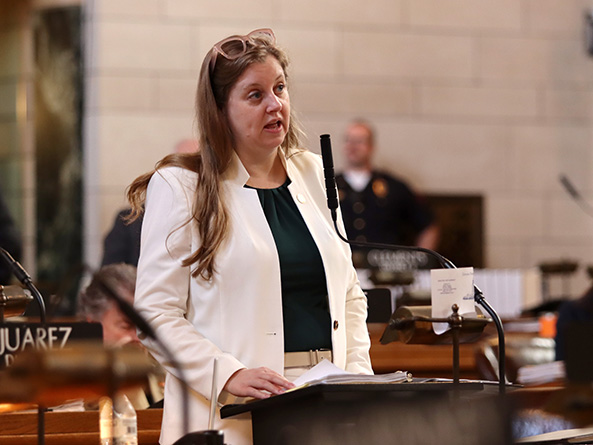
As introduced by Bennington Sen. Wendy DeBoer, LB1032 would update Nebraska adoption statutes, the Foster Care Review Act and the Nebraska Indian Child Welfare Act to implement a process for recognition and enforcement of tribal customary adoptions.
DeBoer said that although reunification of the original family is the ultimate goal in foster care situations, it is not always possible, and termination of the biological parents’ parental rights is a required step in the adoption process when reunification cannot be achieved. This requirement, however, conflicts with many tribal traditions, she said, which view children as the responsibility of the broader tribal community.
As a result, DeBoer said, many tribes, including Nebraska’s three recognized tribes — the Winnebago, Omaha and Ponca — practice tribal customary adoption, which allows a child to be adopted without having to permanently sever the relationship to their biological parents.
Tribal customary adoptions allow children to maintain connections to their biological family, tribe and culture, DeBoer said, by allowing retention of some rights, such as visitation, if agreed upon. Recognizing tribal customary adoptions, as many other states do, would improve permanency for Native American children, she said, while still prioritizing the best interest of the child.
“LB1032 is about respecting the cultures, customs and belief of our sovereign Native communities, ensuring that our laws, our statutes, aren’t structured in such a way that can cause undue harm to Native children and families,” DeBoer said.
A Judiciary Committee amendment, adopted 42-0, would make several modifications to the proposal. Lincoln Sen. Carolyn Bosn, committee chairperson, said the changes would make the bill “more workable” while ensuring that the best interest of Native American children is primary.
The amendment would remove a prohibition on the state filing a recommendation or petition for termination of parental rights if a case involves a child who may be eligible for tribal customary adoption and instead allow the state the option not to do so.
It also would clarify when the state court must consider tribal customary adoption as part of a permanency planning hearing, and require notification of a child’s tribe at least 20 days before the hearing if a recommendation is anything other than returning the child to the parent or home.
Bosn said the provisions would ensure that tribes have a meaningful opportunity to be heard in the permanency process.
Among other changes, the amendment also would make the following changes regarding the concurrent jurisdiction of a state juvenile court and a tribal court:
• require notice in writing to a child’s tribe when the state court grants temporary concurrent jurisdiction to the tribal court;
• require the state Department of Health and Human Services to provide the tribal court with a copy of the state court files within 30 days to ensure that the tribal court can make an informed decision;
• clarify that the authority of a tribal court that has been granted temporary concurrent jurisdiction is limited to finalizing the terms of a tribal customary adoption;
• clarify that the tribal court must finalize the tribal customary adoption in the child’s best interests;
• remove the authority of the child’s tribe to conduct the pre-adoptive medical assessment; and
• add a 120-day deadline for the tribal court to complete the tribal customary adoption.
Niobrara Sen. Barry DeKay, whose legislative district is home to both the Ponca Tribe and the Santee Sioux Nation, supported the bill. Nationally, he said, tribal customary adoptions have become the preferred pathway to permanency for Native American and Alaska Native children.
“Many states have already codified tribal customary adoption through state statutes and tribal codes,” DeKay said. “These measures ensure that Native youth may achieve permanency without severing cultural ties to their biological family and the tribal community.”
Following adoption of a technical amendment offered by DeBoer, lawmakers advanced LB1032 to select file on a 42-0 vote.

