
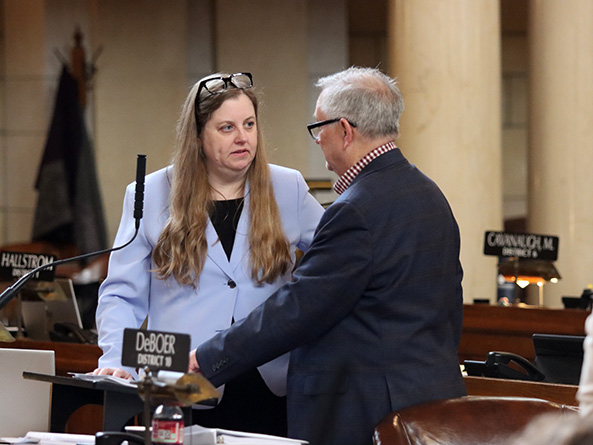
Permanent expansion of child care assistance clears first round
Lawmakers advanced a bill from general file March 30 that would eliminate a scheduled sunset date on expanded eligibility for the state’s Child Care Subsidy program.

The program provides a subsidy directly to providers to cover a portion of child care expenses for low-income Nebraska families. Income eligibility guidelines were expanded in 2021 from 130% of the federal poverty level to 185%. That expansion is scheduled to expire Oct. 1.
LB304, sponsored by Sen. Wendy DeBoer of Bennington, would remove the sunset date and instead make the current income eligibility level permanent. The bill became part of the Appropriations Committee budget package earlier this session, but was pulled from that proposal over concerns that substantive changes to state policy should not be considered within the budgeting process.
DeBoer said that if expanded eligibility ends this fall, only two other states would have stricter subsidy eligibility requirements. Nebraska has one of the highest workforce participation rates in the country, she said, and without the subsidy, many families could not afford to remain in the workforce.
“If you want Nebraska to succeed, you need a strong workforce,” DeBoer said. “If you want a strong workforce, you need a strong child care network, and that means you’re going to need to help some of these families pay for child care.”
A Health and Human Services Committee amendment, adopted 42-5, provides intent language that the Health Care Cash Fund, rather than state general funds, would be used to pay the state’s cost for the income eligibility change in the bill.
Lincoln Sen. George Dungan supported the proposal, relaying his experience of trying to find child care for his son, born three weeks ago. After finding a program they liked, Dungan said he and his wife were unable to afford the $1,300 a month it would cost for newborn care. They will instead take turns staying at home while looking for alternatives, he said.
“We are so lucky that that is an option,” Dungan said. “There are so many people in the state of Nebraska who don’t have that option.”
Also in support was Sen. Bob Hallstrom of Syracuse. If eligibility reverts to 130% of the federal poverty level, he said, many Nebraskans will lose their subsidies and access to the child care their families need. As a result, he said, many parents would be forced out of the workforce.
“LB304 is critical because it keeps child care assistance eligibility at current levels, ensuring working families can remain employed and children can access stable, quality care,” Hallstrom said. “Without it, eligibility will drop significantly, cutting off thousands of Nebraska families who are already working and contributing to our communities.”
Opposing the measure was Omaha Sen. Kathleen Kauth, who said affordable child care should be offered by businesses to attract employees. Using taxpayer dollars to provide a subsidy to low-income families fosters “dependence,” she said, and lawmakers instead should focus on reducing regulations to encourage growth in the child care sector.
“We’re seeing a very slow march of government intervention in business decisions and in business perks,” Kauth said. “The business community of course loves this, because if they can convince the state to pay for an employee perk, they don’t have to.”
She offered an amendment that instead would extend the sunset date to Oct. 1, 2029, and set income eligibility at 160% of the federal poverty level. She said sunsets are important when using tax dollars in order to ensure that programs are evaluated for effectiveness and efficiency on an ongoing basis.
Sen. Ben Hansen of Blair supported the Kauth amendment. The 160% threshold “feels like a good compromise,” he said, adding that more government involvement in child care reduces the involvement of parents, churches and communities.
“The more government takes care of our children, the less likely the parent will,” Hansen said.
DeBoer opposed the amendment. She agreed that more can be done to encourage and support child care options in Nebraska, but said ensuring access to the existing child care subsidy is key until those other solutions are found.
The Kauth amendment failed on a vote of 18-24. Twenty-five votes were needed. Lawmakers then advanced LB304 to select file on a vote of 39-8.

