
Firefighter work comp bill stalls after failed cloture vote
A measure that would provide workers’ compensation benefits to certain firefighters who develop some cancers stalled March 30 after an attempt to shut off debate and force a vote on the bill failed.

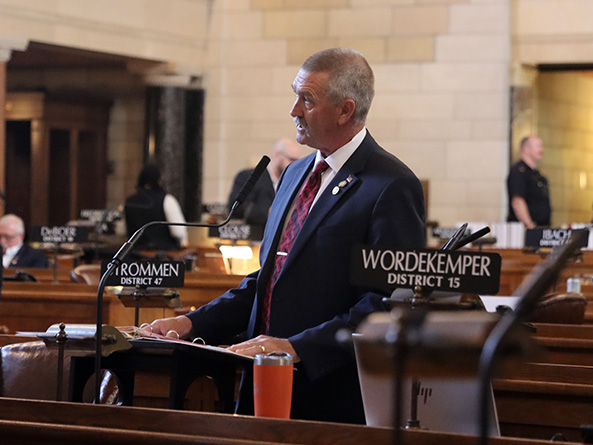
LB400, sponsored by Fremont Sen. Dave Wordekemper, would amend the Nebraska Workers’ Compensation Act to include cancer experienced by firefighters as a result of exposure to known carcinogens in the course of their employment.
As introduced last session, the bill would establish a rebuttable presumption that cancer experienced by a firefighter arose out of the course of employment. The measure would apply to professional and volunteer firefighters who have served for at least five years.
Retired firefighters would be eligible for medical benefits only and must be diagnosed within 60 months of retiring.
During previous first-round debate on the measure Jan. 23, lawmakers adopted an amendment offered by Kearney Sen. Stan Clouse meant to address concerns about the inclusion of coverage for volunteer firefighters.
Under the Clouse amendment, a volunteer firefighter would be eligible for benefits only after serving for 10 years, during which time they must have actively participated in a minimum of 40% of the department’s drills and 25% of emergency calls received. It also would change the bill’s operative date to Jan. 1, 2027.
At Wordekemper’s request, LB400 was passed over after five hours of debate to provide time for additional negotiations. When debate resumed March 30, lawmakers considered a pending Business and Labor Committee amendment that would replace LB400 with a modified version of the original bill.
The committee amendment would establish a rebuttable presumption only if two conditions are met: if a cancer was shown to be medically caused by employment-related exposure to cancer-causing substances, and if the firefighter’s previous physical examinations showed no evidence of cancer.
Wordekemper said current law places the burden on firefighters to prove their cancer was caused by their employment. LB400 would shift that burden away from firefighters who are fighting for their lives, he said, and instead place it on their employer.
He also cited research from the National Institute for Occupational Health and Safety that found firefighters face double the risk of developing mesothelioma and a 129% higher risk of dying from such cancer than the general population.
“Right now, the deck is stacked against [firefighters],” Wordekemper said. “Rather than requiring a sick firefighter to prove a connection that science has already established, [LB400] allows the employer to rebut it … [and] changes where the gathering of evidence starts.”
A series of amendments offered by North Platte Sen. Mike Jacobson that would have updated language and clarified the requirements for retired firefighters to qualify for the rebuttable presumption were rejected by lawmakers.
Jacobson said LB400 would place a financial burden on rural fire departments and municipal governments.
Sen. Bob Hallstrom of Syracuse disagreed. He said similar legislation in other states that provides a rebuttable presumption for certain workers’ compensation claims has not resulted in significant cost increases or led municipalities to file for bankruptcy.
Whitman Sen. Tanya Storer opposed LB400. She said the increased costs associated with providing cancer benefits likely would raise local property taxes and result in higher workers’ compensation benefit premiums for volunteer fire departments.
“It’s not [about] whether or not we support our volunteer firefighters … it’s whether or not this is a responsible mandate for … property taxpayer dollars to be used for,” Storer said.
Sen. Mike Moser of Columbus also opposed the bill, saying benefits for firefighters who develop cancer as a result of their job should be negotiated as a condition of their employment rather than set by the state.
He also expressed concern that the bill potentially would lead to rebuttable presumptions for other dangerous occupations, such as farming, law enforcement or sewage plant operators.
“The state should not be putting our thumb on the scale,” Moser said. “If we do this for firemen … where do we stop?”
After three additional hours of discussion, Wordekemper offered a motion to invoke cloture and cease debate. The motion failed on a 32-15 vote. Thirty-three votes were needed. A failed cloture motion ends debate on a bill for the day.

