
Bill seeks to restrict foreign adversary funding in higher ed
A measure that would bar Nebraska postsecondary institutions from accepting gifts, grants, contracts and other funding from certain foreign governments and entities that are deemed U.S. adversaries was considered Feb. 24 by the Education Committee.

LB1262, introduced by Omaha Sen. Bob Andersen at the request of Gov. Jim Pillen, would prohibit public and private colleges and universities, along with their affiliated foundations and research entities, from entering into funding relationships, partnerships or research agreements with foreign adversaries.
The legislation defines foreign adversaries as China, Russia, Iran, North Korea and Qatar, as well as affiliated entities such as Confucius Institutes, the Muslim Brotherhood and the Al Jazeera Media Network. Programs covered under the ban would have to conclude by Dec. 31, 2026, or when existing contracts expire.
Institutions in violation of the act would be required to forfeit the value of the prohibited funding and could lose eligibility for state research grants for up to five years and face civil penalties of up to $250,000 per violation. The bill also would authorize the state attorney general to investigate violations and require the state auditor to conduct annual compliance reviews of a sample of institutions.
Additionally, LB1262 would require colleges to report to the Coordinating Commission for Postsecondary Education within a year of receiving foreign gifts of $10,000 or more — down from the current threshold of $250,000 — and contracts totaling $50,000 or more, and to publish the source, amount, terms and conditions of such gifts and grants in a public online database.
Andersen described the bill as a “preventive and protective” measure intended to safeguard students, intellectual property and national security while also encouraging universities to strengthen ties with democratic allies rather than foreign adversaries.
“Institutions of postsecondary education play a vital role in research, national competitiveness, development of future leaders and nurturing core American liberties,” Andersen said. “They should be catalysts for strengthening ties with American allies who share our values, rather than adversaries who exploit them.”
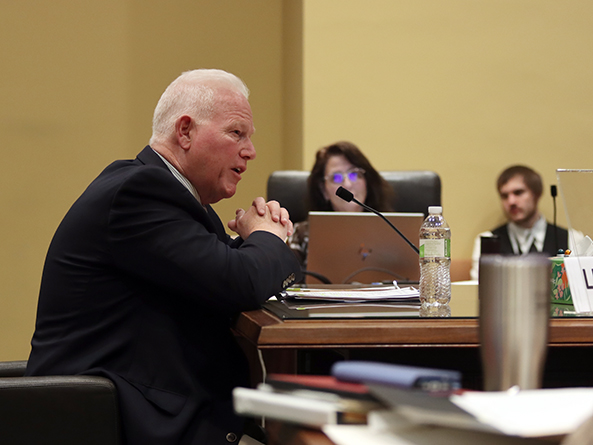
Kenny Zoeller, director of the Governor’s Policy Research Office, testified in support of the proposal, citing a 2020 federal investigation that found universities nationwide systematically underreported foreign gifts, with reporting thresholds too high and enforcement too weak to ensure transparency.
He said LB1262 would address the issue by tightening oversight of foreign funding, enhancing public transparency and giving the attorney general authority to investigate violations and impose penalties.
“By empowering the attorney general with specific authority to investigate and enforce these rules, we’re sending a clear message that securing our homeland starts at home, and we will not allow foreign adversaries to purchase influence in our state or harvest research funded by Nebraska taxpayers,” Zoeller said.
Also supporting the bill on behalf of the Combat Antisemitism Movement, David Soffer said antisemitic incidents have surged globally and in the U.S., particularly on college campuses, and often are reinforced by institutional influences rather than occurring organically.
He said large sums of foreign funding, especially when underreported or insufficiently monitored, can shape campus policies and narratives in ways that undermine accountability and contribute to hostile environments for Jewish students.
“Meaningful transparency and enforceable safeguards are essential to protecting academic integrity, national security and student civil rights,” Soffer said.
No one testified in opposition and the committee took no immediate action on LB1262.

