
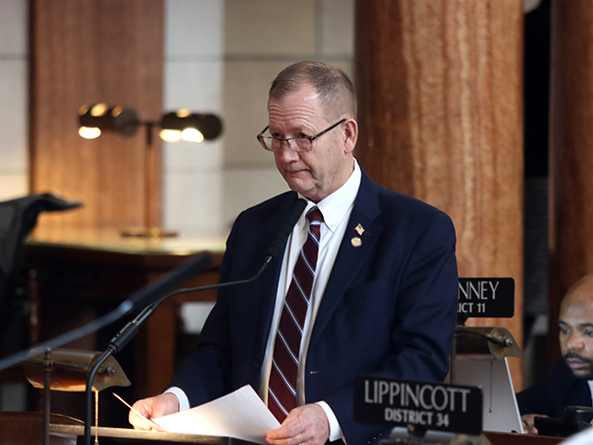
Grain dealer measure clears first round
Lawmakers amended and advanced a bill from general file Feb. 24 that would expand oversight of grain warehouses and dealers, revise payment timelines for producers and authorize regulators to adjust license fees.

Introduced by Niobrara Sen. Barry DeKay, LB894 proposes several changes to the Grain Dealer Act. An Agriculture Committee amendment, adopted 27-1, replaced the bill with a modified version that would make changes to both grain dealer and warehouse laws.
As amended, LB894 would eliminate an exemption that allows certain warehouses to avoid classification as grain dealers if grain was first unloaded at their facilities, subjecting those engaged in direct delivery transactions to licensing, bonding and oversight requirements.
The measure also would replace the current $100 annual grain dealer license fee with a fee established by the Nebraska Public Service Commission, capped at $1,500. Existing fees would remain in place until July 1, 2027, and the commission would be required to submit a proposed fee schedule to the Legislature by Dec. 1, 2026.
DeKay said the $100 statutory fee has not changed since 2003 and covers only about 15% of the Nebraska Public Service Commission’s grain regulatory costs. Allowing the commission to increase fees could enable it to reduce its general fund appropriation request in the next budget cycle, he said.
License revenue would continue to be deposited in the state’s General Fund until July 1, 2027, when it would be redirected to a newly created Grain Dealer and Grain Warehouse Cash Fund.
Additionally, LB894 would revise payment provisions to require dealers to pay within 10 business days after receiving a written demand with proof of delivery, unless a contract provides otherwise, with interest accruing after the deadline.
The measure also would repeal certain notice requirements and streamline claims against a dealer’s security, allowing unpaid producers to seek recovery during a commission administrative action while excluding obligations not yet due under deferred payment contracts.
The committee amendment also incorporates provisions of DeKay’s LB895, which would remove an exemption from licensure for federally licensed warehouses and instead provide that all federally licensed warehouses automatically qualify for state licensure.
Columbus Sen. Mike Moser spoke in support of the bill, calling it a “producer protection” measure. Dealers and warehouses handle large volumes of grain and can incur significant losses, he said, and the Nebraska Public Service Commission plays a key role in verifying inventory and financial capacity to help ensure farmers are paid.
Addressing the proposed fee increases, Moser said grain dealers and warehouses, not general taxpayers, should shoulder more of the industry’s regulatory costs.
“The fee is still only going to pay a portion of the cost, but there’s no reason why citizens from all across the state should pay to measure grain in grain warehouses when it’s an ag issue,” Moser said. “The grain dealer should pay some of that cost, and that’s what this bill does.”
Lincoln Sen. Danielle Conrad opposed LB894, saying the proposed fee hikes could negatively impact everyday Nebraskans. Past state fee increases have contributed to higher costs, she said, and the state’s agriculture sector already is facing financial challenges, including tariffs, rising health care costs and increasing bankruptcies.
“Whether its court fees, whether its garbage fees [or] whether it’s the fees put forward in LB894 — they have negative implications for Nebraskans,” Conrad said.
Sen. George Dungan of Lincoln also spoke in opposition to the measure. The proposal directs fee revenue to a dedicated regulatory fund, he said, but past Legislatures have swept similar cash funds during budget shortfalls, raising concern that the same could happen again.
Senators adopted a DeKay amendment 31-0 that would make technical changes to the creation and administration of the cash fund and clarify that the commission could not charge a state license fee to federally licensed warehouses.
Lawmakers then voted 27-6 to advance LB894 to select file.

