
Bill to prohibit certain weapons in Capitol amended, advanced
After debate spanning three days, lawmakers amended and advanced a bill from general file Feb. 24 that would prohibit entering the Nebraska State Capitol with a weapon or other banned substance.
LB1237, introduced by the Executive Board, would provide exceptions for individuals who have received prior approval from the Nebraska State Patrol and would allow possession of a weapon by law enforcement officers in the course of their official duties. It also would allow qualified law enforcement officers, including retired officers, to carry concealed handguns in the building.
An Executive Board committee amendment, adopted Feb. 23 on 36-6 vote, would add a fourth exception to allow carrying of a concealed handgun by an individual holding a current and valid permit issued pursuant to the Concealed Handgun Permit Act.
Under the bill, the Nebraska State Patrol would be charged with implementing procedures to provide for detection of weapons and controlled substances to prevent them from being brought into the Capitol by no later than Jan. 1, 2027.
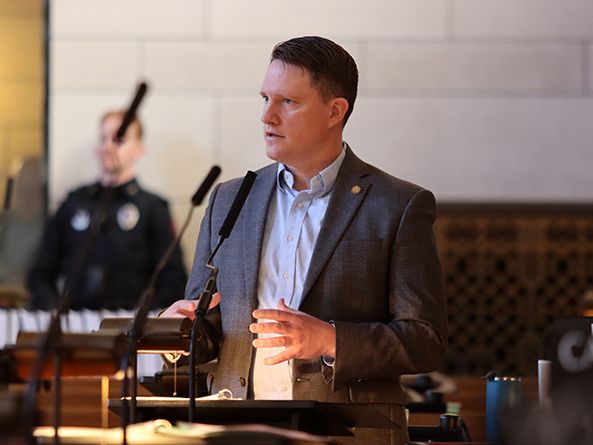
Sen. Ben Hansen of Blair, chairperson of the committee, said the measure was the product of extensive consultation among the three branches of government, who all have offices in the Capitol, as well as the State Patrol.
The goal, he said, is to implement appropriate security measures to ensure that all Nebraskans can safely enjoy the Capitol and participate in governmental functions that take place in the building.
“LB1237 is a commonsense measure to protect everyone who works in or visits our State Capitol — legislators, staff, visitors and the public — while respecting the rights of individuals,” he said.
Hansen said the committee heard concerns at the bill’s public hearing about the measure potentially limiting Second Amendment gun rights. Several firearms organizations indicated after the hearing, however, that allowing an individual with a permit to carry a concealed weapon in the Capitol would remove their opposition to the bill, he said.
Under the measure, weapons would include guns, knives, brass or iron knuckles, pepper spray, tasers and stun guns. Prohibited substances would include explosives, incendiary or other combustible devices, hazardous materials and paint and spray paint.
As introduced, violations of LB1237 would be a Class III misdemeanor.
Hansen said he was working on a possible amendment for the next round of debate that would either narrow or strike the language listing prohibited weapons. Tasers, brass knuckles and pepper spray likely would be allowed under the amendment, he said, because they are nonlethal devices.
Adams Sen. Myron Dorn supported the bill, saying his position on enhanced security has changed during his seven years in office. While there may be “growing pains” and future adjustments regarding implementation, he said, the bill is needed in light of the current political climate.
“I think the time has come for the people [in] the state of Nebraska, and particularly the state Capitol, to have some different security measures than what we’re used to,” Dorn said.
Sen. Stan Clouse of Kearney agreed. He supported moving the bill forward, despite “questions and concerns” about implementation. It’s important for the Legislature to create a “secure and safe” environment in the building, Clouse said, particularly for the many schoolchildren who visit the Capitol every year.
Several senators expressed concern regarding how the bill would comport with current “annotated hearing” guidelines. Under those guidelines, committee chairpersons may choose to have metal detectors outside of hearing rooms if large crowds are expected for controversial bills.
Bennington Sen. Wendy DeBoer noted that if members of the public are allowed to carry concealed weapons in the building with a permit, a committee chairperson who does not want guns inside a hearing on a politically heated topic would have no way to know if audience members were armed.
“I would be a little concerned about having folks, even though they’ve been through training, coming in with a weapon into those hearings, and I think we would be moving backwards on our security in those particular hearings,” DeBoer said.
Calling the proposal “at best half-baked,” Sen. Danielle Conrad of Lincoln argued that LB1237 could have a “chilling” effect on participation in the legislative process, without addressing the root causes of escalating political violence.
“In a free society, we need to think carefully about infringements on public participation and individual rights and liberties,” she said.
During the second day of debate, Conrad offered an amendment, adopted 30-8, to remove the criminal penalty for violation of the bill’s provisions. She said creating a new criminal penalty under the measure was “unwarranted and unworkable.”
Another amendment from Conrad to ensure that security procedures enacted under the bill would not provide any special, preferential or differential access to any registered lobbyists or their clients was defeated on a 15-22 vote. Twenty-five votes were needed.
Conrad argued the amendment was needed to ensure that the Capitol was not treated like a “country club” and that access was equitable for everyone entering the building.
“We want to make sure that there is no VIP pass now or moving forward,” she said.
Hansen said the amendment was unnecessary because lobbyists, who are not issued ID badges as senators and legislative staff are, would be required to use the same entrance as the general public.
Several lawmakers, including Omaha Sen. Megan Hunt, expressed concern that enhanced security measures would harm the Capitol’s “culture of welcome,” where there are no hindrances to entering the building to participate in the political process or simply enjoy the beauty of the architecture.
In addition, she said, the uncertainty of knowing who is carrying a concealed weapon — and whether or not they are authorized to do so under the bill — would create confusion and concern among others in the building.
“I trust the State Patrol to keep us safe,” Hunt said. “And that work is happening right now, every day, without the additional unanswered questions that this bill creates.”
Lawmakers advanced LB1237 to select file on a vote of 37-4.

