
Controlled substance cleanup bill amended to add fentanyl enhancement, advanced
After four hours of second-round debate, lawmakers advanced a cleanup bill to final reading Feb. 19 after amending it to provide a penalty enhancement for certain offenses involving fentanyl.
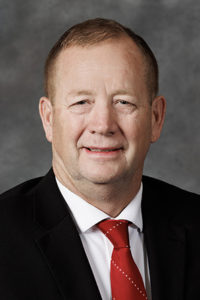
LB795, as introduced by Sen. Barry DeKay of Niobrara, would make a number of technical changes to the state’s Uniform Controlled Substances Act, including correcting the spelling in statute of three chemicals. It also would designate bromazolam as a Schedule 1 controlled substance under the act.
DeKay said bromazolam, a designer drug, has been designated as a Schedule 1 controlled substance by six states and that the U.S. Food and Drug Administration is in the process of doing the same at the federal level.
During select file debate Feb. 17, Whitman Sen. Tanya Storer offered an amendment to add provisions of her LB817 to the measure.
As introduced last session, the provisions would amend the Uniform Controlled Substances Act to add fentanyl to the list of controlled substances that if knowingly or intentionally manufactured, distributed, delivered, dispensed or possessed with the intent to distribute — either by itself, or in a mixture or substance containing a detectable amount of fentanyl — would be a violation subject to penalty depending on the quantity.
Under the proposal:
• 140 grams would be a Class IB felony;
• at least 28 grams but less than 140 grams would be a Class IC felony; and
• at least 10 grams but less than 28 grams would be a Class ID felony.
A Class IB felony is punishable by a mandatory minimum sentence of 20 years in prison up to a maximum of life imprisonment.

Storer said the measure simply would bring penalties for those who traffic fentanyl in line with existing penalties for similar substances.
“It is updating our … laws to treat fentanyl trafficking and distribution with the same clear, proportional and consistent penalty structure that we already apply to methamphetamine, heroin and cocaine,” she said.
Fentanyl is more deadly than any of those drugs, Storer said, but Nebraska law currently does not have a penalty enhancement for trafficking-level weights.
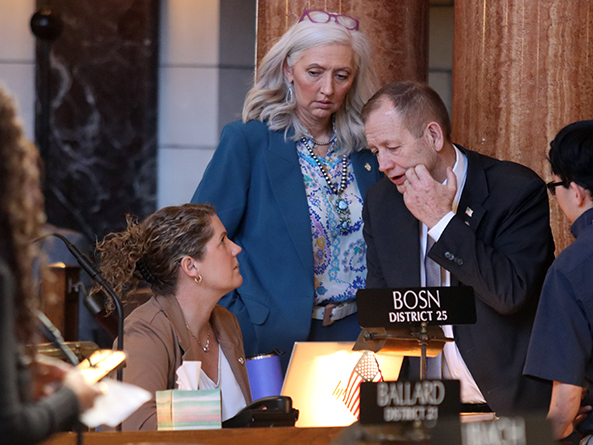
Sen. Carolyn Bosn of Lincoln agreed that fentanyl is an “exceptionally dangerous” drug that should be treated as such.
“Essentially, two granules of sugar is what is an amount of fentanyl that will kill you,” Bosn said. “Two granules of sugar is the equivalent of a death sentence when it comes to fentanyl.”
Hastings Sen. Brian Hardin said the proposal would target those who traffic in fentanyl, not simply those who are in possession of amounts meant for personal use.
“These quantities reflect trafficking — distribution at a scale that endangers entire communities,” he said. “By aligning penalties with the amount involved, the [bill] targets those who profit from this poison, not those struggling with addiction.”
Omaha Sen. Terrell McKinney objected to the inclusion of Storer’s amendment and offered a series of unsuccessful motions to extend debate on the proposal. He said penalty enhancements would only add to the state’s prison overcrowding problem and end up costing taxpayers more money.
“[The] solution to decreasing crime … is not more felonies, it’s helping people,” McKinney said. “It’s making sure people have a bite to eat, making sure people have lights on at home [and] making sure they have good jobs.”
Speaking in support of a motion from McKinney to bracket LB795, Lincoln Sen. George Dungan said he objected to the inclusion of a new penalty that could result in a life sentence. He said Nebraska lawmakers continue to “double down” on penalty enhancements in defiance of national trends.
Many states have started to focus on the root causes of substance use and abuse, Dungan said, calling this a smarter way to reduce prison overcrowding and promote safer communities.
After four hours of debate over three days, DeKay offered a motion Feb. 19 to invoke cloture, which ceases debate and forces a vote on the bill and any pending amendments. The motion succeeded on a 35-13 vote.
Lawmakers then adopted Storer’s amendment 36-13 and advanced LB795 to final reading on a vote of 35-14.

