
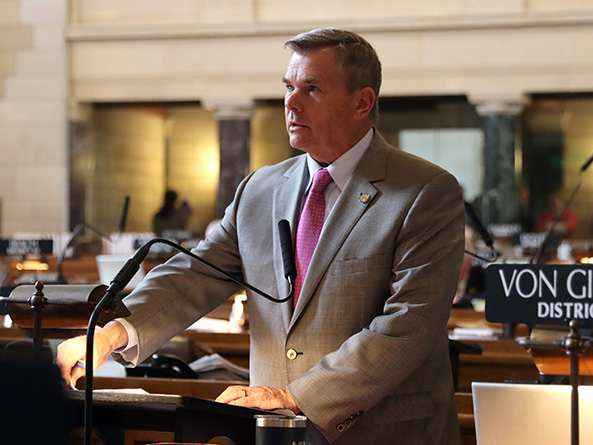
Session Review: Revenue
The Revenue Committee considered proposals this session that create retention and hiring incentives for merging businesses, rework a local property tax hearing process and increase the tax on real estate transfers to fund workforce housing programs.
Business incentives, economic development
The committee advanced a measure intended to give the state Department of Economic Development more flexibility when awarding certain grants of assistance to Nebraska municipalities.
Previously, cities were required to partner with a certified creative district to be eligible for state assistance under the Civic and Community Center Financing Act.
LB778, introduced by Lincoln Sen. George Dungan and passed 49-0, instead requires the department to give preference to any municipality that is partnered with a creative district when awarding grants of assistance under the act from July 1, 2027, to June 30, 2028.
LB883, sponsored by Sen. Bob Andersen of Omaha and passed 47-0, allows the department to provide grants to assist in the demolition of historic buildings or districts under the CCCFA.
Grant applications must include documentation showing that the applicant and the State Historic Preservation Officer have agreed to preservation-based mitigation strategies.
The bill also updates requirements for demolition grants awarded to first and second class cities or villages under the Revitalize Rural Nebraska Grant Program, which is administered by the state Department of Water, Energy and Environment.
If the State Historic Preservation Officer has determined that a property to be demolished is listed or eligible to be listed on the National Register of Historic Places, an applicant must demonstrate that:
● the property has been deemed a substandard and abandoned commercial property by a certified building professional with the approval of the State Historic Preservation Officer; or
● the city or village and the State Historic Preservation Officer have agreed to preservation-based mitigation strategies.
Finally, LB883 requires that the rural grant program’s fund be used to pay the costs incurred by the State Historic Preservation Officer in carrying out their duties under the new requirements.
The committee also advanced a measure intended to ensure that Nebraska companies do not lose certain tax incentives when they spin off part of their business operations.
LB954, introduced by Elkhorn Sen. R. Brad von Gillern and passed on a vote of 44-3, applies to companies that have met employment and investment requirements under Tier 6 of the Nebraska Advantage Act.
If a company sells or transfers part of its business to another entity, the state Department of Revenue is required to recalculate the company’s base-year employees by subtracting the number of employees at the sold or transferred business operation from the number of base-year employees calculated prior to the sale or transfer.
The recalculation is not allowed if the business operations that were sold or transferred cease operations within two years after the sale or transfer or if the primary business purpose of the sale or transfer was to close a location.
LB954 applies to agreements entered into after Dec. 31, 2016.
LB1165, sponsored by von Gillern at the request of Gov. Jim Pillen, creates the Grow the Good Life Act.
Under the proposal, a qualifying large employer that merges with an out-of-state company will receive tax credits of up to $50 million over 10 years if it retains its headquarters and most of its base-year employees in Nebraska.
The bill also creates a grant program to help with employee retention and recruitment during a merger and allows companies to use ImagiNE Nebraska Act credits to pay up to 50% of employees’ child care costs.
Additionally, LB1165 increases credit percentages for companies that meet certain job creation and investment thresholds under the ImagiNE Nebraska Act.
Under the bill, the credit percentages will increase by an additional point if a qualifying large employer hires 500 or more full-time employees within seven years of a merger. New employees must be paid an average annual wage of at least $100,000.
LB1165 allows the state Department of Economic Development to use the Site and Building Development Fund to award grants to an employer for capital improvements related to employee retention and recruitment following a merger.
The department also may award grants or interest-free loans to certain first class cities that have been affected by a “sudden and significant private-sector entity closure or downsizing.” A grant may be used to acquire land, infuse infrastructure or otherwise prepare large sites and buildings for industrial development.
Both types of grants are limited to $2.5 million per year for two fiscal years.
Also included in the bill are provisions of LB1191, introduced by Sen. Bob Hallstrom of Syracuse, and LB1192, sponsored by Lincoln Sen. Jason Prokop.
Under Hallstrom’s measure, companies with active agreements to receive tax incentives under Tier 6 of the Nebraska Advantage Act have up to nine years rather than six to meet required employment and investment levels.
For the extension to apply, a company must make a one-time election and pay a $90,000 fee. The provision applies only to projects approved on or after Dec. 1, 2020.
Under Prokop’s measure, facilities with a capacity of greater than 16,000 seats located in a primary class city are eligible for assistance under the Convention Center Facility Financing Assistance Act. Lincoln is the state’s only primary class city.
LB1165 passed on a vote of 42-7 and took effect immediately.
Property taxes
Lawmakers approved two measures modifying the Property Tax Request Act this session.
Established by the Legislature in 2021, the act had required cities, counties and school districts to participate in a joint public hearing before increasing their property tax request by more than an allowable growth percentage.
Previously, at least one elected official — or designated representative — from each participating political subdivision was required to attend.
LB384, introduced last year by Sen. Tanya Storer of Whitman and passed 49-0, instead requires the attendance of at least one voting member of the governing body of each participating political subdivision. The measure also requires the county assessor of the county hosting the hearing to attend.
LB803, introduced by the committee as a shell bill, was amended to include provisions of five other revenue-related measures, including Hallstrom’s LB575, which makes extensive changes to the Property Tax Request Act.
His proposal eliminates provisions tying the joint public hearing requirement to an allowable growth percentage and instead requires cities, counties and school districts to participate in the hearings regardless of whether they seek to increase their property tax request.
Although Hallstrom’s measure repeals the section of the Property Tax Request Act that LB384 had modified, LB803 incorporates LB384’s attendance requirements, ensuring the change remains in effect.
Under LB803, the joint public hearings must focus on each political subdivision’s budget and property tax request.
Hearings previously had to be held between Sept. 14 and 24. Under Hallstrom’s measure, hearings must be held on or after July 1 and prior to July 15 and before any of the participating political subdivisions files an adopted budget statement.
Previously, counties were required to send postcards notifying property owners of a joint public hearing. Under LB803, the state Department of Revenue instead will send property owners a postcard that includes a website where a county is required to post the time and place of the joint public hearing and the first city, county and school district budget hearings.
LB803 also updates an existing provision that requires counties to notify property owners of valuation changes.
The updated notice must include information similar to what was included on the previous version of the postcard, such as a parcel’s current valuation and the amount of taxes that would be levied against the parcel by each city, county and school district using the previous year’s levy rate.
The Property Tax Request Act also requires certain political subdivisions to hold a public hearing and pass a resolution or ordinance to increase their property tax request from one year to the next. Under LB803, such a measure must pass by a two-thirds majority vote — or a four-sevenths majority vote in political subdivisions with seven-member boards.
Also included in the bill are provisions of:
● LB882, sponsored by Andersen, which eliminates or modifies homestead exemption reapplication requirements for certain disabled veterans and their surviving spouses as well as for surviving spouses of service members who died on active duty or because of a service-connected disability;
● LB938, introduced by Hallstrom, which creates an income tax deduction for contributions to accounts that may be used for the down payment and closing costs related to a beneficiary’s purchase or construction of their first home;
● LB1116, sponsored by Sumner Sen. Teresa Ibach, under which state assistance may be used for a sports complex located in a second class city or village for up to 10 years rather than five; and
● LB1154, introduced by Sen. Merv Riepe of Ralston, which updates the calculation of county, city and village preliminary property tax request authority under the Property Tax Growth Limitation Act.
LB803 passed on a vote of 48-1 and took effect immediately.
Tax and fee increases
The committee advanced a bill intended to help Nebraska cigar shops compete with online retailers.
LB212, introduced last session by Fremont Sen. Dave Wordekemper and passed 49-0, requires remote retail sellers to collect and remit a 20% state excise tax on certain products like cigars and pipe tobacco sold directly to Nebraska consumers if they meet certain sales thresholds.
The bill also requires remote retailers of covered tobacco products to apply for a license from the state tax commissioner. License holders must submit monthly tax returns and keep accurate sales records.
The new requirements take effect Jan. 1, 2027.
LB901, introduced by the committee as a shell bill, was amended to include provisions of several measures aimed at increasing state revenue.
The provisions of LB873, sponsored by Hallstrom, impose a 10% state excise tax on the retail sale of kratom products beginning in 2027.
Hallstrom’s measure also prohibits the sale of any kratom product undergoing testing until the results verify that it is not adulterated. If an adulterated product is sold in violation of the state Kratom Consumer Protection Act, the state Department of Revenue is required to remove it from the list of registered products on its website.
The amended provisions of LB890, introduced by Sen. Stan Clouse of Kearney, update the Mechanical Amusement Device Tax Act.
Among other changes, the measure increases the application fee for a cash device from $500 to $650 and the annual decal fee from $250 to $350 beginning in 2027. It also increases the cash device tax from 5% to 10% of net operating revenue.
Another provision prohibits operators from making a cash device available for play at a retail establishment unless an attendant is physically present and capable of actively supervising play by visually confirming a player’s age and intervening to prevent play by anyone under 21.
The amended provisions of LB1109, introduced by von Gillern at the request of the governor, repeal several sales and use tax exemptions, including those for sales of mineral oil applied to grain as a dust suppressant and biochips used in certain activities.
The measure removes waste treatment and disposal facilities from the list of locations eligible for tax incentives under the ImagiNE Nebraska Act.
It also sunsets a renewable energy tax credit effective July 1 and modifies a tax credit available under the Nebraska Advantage Research and Development Act so that it is no longer refundable.
The provisions of von Gillern’s LB1110 expand the allowable uses of the Department of Revenue Enforcement Fund. They require the department to use money in the fund for the administration and enforcement of any activity or function administered by the state tax commissioner.
The measure also requires the department and the state Department of Health and Human Services to share confidential information about persons, businesses and state and local subdivisions with the other agency for the purpose of properly administering the law.
Finally, the proposal requires the state Department of Revenue to add a collection fee to delinquent tax claims in addition to the actual costs incurred by the department in collecting the taxes.
The amended provisions of LB1131, sponsored by Lincoln Sen. Eliot Bostar, require the department to distribute $3 million annually in refundable, transferable state income tax credits to nonprofits that provide services to victims of domestic violence and human trafficking.
To fund the credits, the measure repeals tax exemptions related to the assembly of certain data center equipment for use outside the state.
LB901 passed on a vote of 36-13 and took effect immediately.
The committee also advanced a measure intended to create a stable funding source for two Nebraska workforce housing programs.
LB1067, introduced by Hallstrom and passed 36-13, increases the documentary stamp tax on real estate transactions and splits the additional proceeds between the Rural Workforce Housing Investment Fund and Middle Income Workforce Housing Investment Fund.
The measure increases the documentary stamp tax from $2.32 to $3.32 for each $1,000 in value through Jan. 1, 2032, when it will return to the previous amount.
Beginning July 1, 2027, the bill also prohibits the transfer of money from the Affordable Housing Trust Fund to the state’s General Fund and certain other funds.
A measure that would have used additional cigarette tax revenue to help cover state Medicaid costs stalled on the first round of debate after a failed cloture motion.
LB1124, sponsored by Sen. Tony Sorrentino of Elkhorn, would have increased the state excise tax on a package of cigarettes from 64 cents to $1.64 beginning July 1. Most of the additional proceeds would have been used to pay for state Medicaid expenses.
As amended, the bill included provisions of LB712, introduced last session by Seward Sen. Jana Hughes. Her proposal would have taxed all vaping products based on their wholesale price at a rate of 30%.
After eight hours of first-round debate over two days, Sorrentino filed a motion to invoke cloture, which ends debate and forces a vote on the bill and any pending amendments. The motion failed on a vote of 31-10. Thirty-three votes were needed.
Other measures
LB834, introduced by Omaha Sen. Kathleen Kauth and passed 46-0, allows a county assessor, when authorized by the county board, to appoint one or more deputies who will perform the assessor’s duties in their absence.
Among several other technical updates, the bill also eliminates an annual $5 mobile home park permit fee and provides for delinquent taxes on mobile homes, cabin trailers and manufactured homes to be extinguished after 15 years.
LB834 also includes provisions of LB1230, sponsored by Sen. Paul Strommen of Sidney. The measure includes mobile homes under the state’s Disposition of Personal Property Landlord and Tenant Act, which governs how landlords handle abandoned personal property.
Under the bill, homes valued under $2,000 may be disposed of at a landlord’s discretion, while homes valued over $2,000 may be sold at public auction.
The committee also considered a measure to help counties cover the cost of collecting delinquent taxes.
County sheriffs collect a fee for distress warrants issued to collect delinquent taxes on personal property, plus a $1 levy fee, a mileage charge and a commission on any taxes collected.
LB900, introduced by Hastings Sen. Dan Lonowski and passed 33-14, increases the distress warrant fee from $2 to $20. The measure also eliminates the $1 levy fee as well as a requirement to prorate mileage among trips when sheriffs serve multiple warrants at the same time.
For taxes collected by distress and sale, counties may collect a 10% commission on amounts not exceeding $500, an increase from $100. An 8% commission applies to amounts exceeding $500, also an increase from $100.
Also advanced by the committee was a measure intended to encourage participation in the state’s Achieving a Better Life Experience program.
The program, administered by the state treasurer, provides tax-advantaged savings accounts used to pay for the qualified disability expenses of a designated beneficiary.
The state is prohibited from reclaiming money that remains in a beneficiary’s account after their death to pay for medical assistance received by the beneficiary or their spouse or dependent under the state’s Medicaid program.
LB1240, sponsored by Sen. Dave Murman of Glenvil and passed 49-0, expands that prohibition, ensuring that funds distributed from an ABLE account upon a beneficiary’s death may not be reclaimed.

