
Probation system misconduct bill expanded, advanced
A proposal aimed at preventing sexual relationships between probation officials and those under their supervision advanced from general file March 31 after lawmakers added provisions from six additional measures.
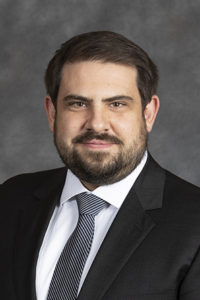
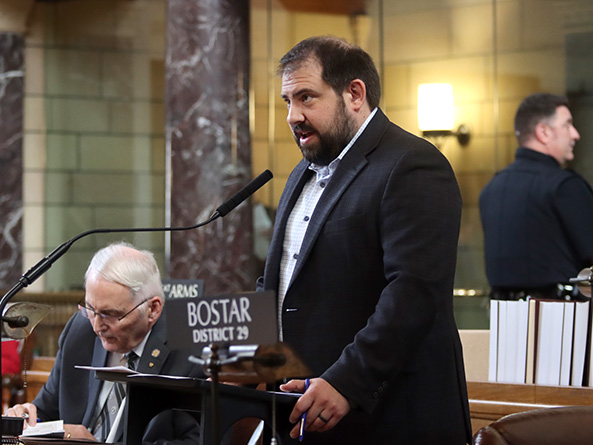
Under LB965, introduced by Sen. Eliot Bostar of Lincoln, individuals in positions of authority — including probation officers, problem-solving court employees, guardians, conservators, guardians ad litem, foster and adoptive parents and child welfare service providers — would be prohibited from engaging in sexual contact with those under their supervision or care.
The measure would establish penalties consistent with Nebraska law governing similar abuse-of-authority cases involving correctional staff, parole officers and school employees.
Sexual penetration would be a Class IIA felony, punishable by up to 20 years in prison, while sexual contact would be a Class IIIA felony, punishable by up to three years in prison, up to 18 months of post-release supervision, a $10,000 fine or both. Consent could not be used as a legal defense.
LB965 also would expand protections for minors under 19 who are receiving child welfare services by prohibiting sexual contact between those minors and service providers responsible for their care. Allegations of such misconduct would be referred to law enforcement rather than handled through alternative response, ensuring formal criminal justice review.
The bill would extend victim and witness assistance provisions, including those under Nebraska’s Sexual Assault Victims’ Bill of Rights, to individuals affected by such offenses and align sex offender registration requirements with similar statutes. It also would add adoptive and foster parents to the state’s incest statute.
Bostar said the bill would close current gaps in state law by prohibiting sexual relationships where power imbalances exist, particularly involving probation officers, guardians and others in positions of authority.
“LB965 is straightforward legislation to protect vulnerable Nebraskans from sexual abuse and exploitation by individuals in positions of trust, power and authority,” Bostar said.
Finally, LB965 would provide legal immunity for probation employees who, acting in good faith and in accordance with Office of Probation Administration policies, administer opioid overdose-reversal medication, such as naloxone, in emergency situations.
A Judiciary Committee amendment would incorporate provisions of six additional bills heard by the committee this session. Bennington Sen. Wendy DeBoer offered a successful motion to divide the question and consider each bill contained within the committee amendment separately.
The first component contained the underlying bill, Bostar’s LB965.
Sen. George Dungan of Lincoln offered an amendment to Bostar’s proposal to specify that prohibitions would apply only when there is a supervisory or coercive relationship — or a direct connection in which one person has authority, oversight or decision-making power over the other, such as a probation officer supervising a probationer.
The law should require a “clear nexus” of power and control, Dungan said, warning that without his amendment, the measure could unintentionally criminalize consensual relationships between adults who do not have a professional connection, resulting in felony charges.
Bostar opposed Dungan’s amendment, arguing it would weaken the measure by allowing potentially exploitative relationships in situations where one person’s position of authority is, by itself, enough to justify prohibiting such a relationship.
Senators rejected Dungan’s amendment 11-22 before voting 31-0 to adopt the first component of the divided amendment.
The second component of the divided committee amendment, adopted 33-0, includes provisions of LB908, introduced by David City Sen. Jared Storm. Those provisions would require courts to consider credible evidence showing increased intellectual and social growth in children who have equal access to both parents when determining custody and parenting arrangements.
Storm said judges currently weigh five statutory factors in custody decisions. The amendment would add a sixth factor requiring courts to consider evidence of the benefits of two-parent households, he said, while still considering existing best-interest standards.
“Ultimately, I believe it is in the best interest of children [to] have equal access to both parents as much as possible,” Storm said.
The third division, adopted 30-0, includes amended provisions of LB785, introduced by Sen. Bob Hallstrom of Syracuse. Those provisions would add postal receptacle keys and locks used for the deposit and delivery of mail to the list of burglar’s tools in state law when possessed with intent to commit a crime.
Hallstrom said the measure aims to address theft from communal mailbox units, where a single break-in can create multiple victims.
Containing amended provisions of LB859, introduced by Bostar, the fourth division of the committee amendment would create the position of “county conflict counsel” to allow counties to employ counsel to provide constitutionally required representation to indigent clients in matters in which the public defender cannot be appointed due to conflict or other good cause.
Lincoln Sen. Carolyn Bosn, chairperson of the Judiciary Committee, spoke in support of the measure, saying it would help counties better manage the cost of court-appointed counsel by creating optional systems to handle cases when public defenders are unavailable.
Sen. Danielle Conrad of Lincoln opposed the measure, saying it underscores the fiscal impact of criminal justice policy. Increasing penalties and creating new crimes carry costs for taxpayers, she said, including rising indigent defense expenses.
Senators adopted the amendment 28-1.
The fifth portion of the committee amendment, containing Lincoln Sen. Jason Prokop’s LB1000, would establish a graduated penalty structure for violations of domestic abuse and sexual assault protection orders by increasing the penalty for a third offense to a Class IIIA felony and for a fourth or subsequent offense to a Class IIA felony.
Prokop said protection order requests and violations are on the rise, noting that in Lincoln alone more than 1,500 orders were filed in 2024, along with more than 500 violations and hundreds of citations.
This trend reflects growing risks and underscores the need for stronger penalties, he said, adding that repeated violations — like other “pattern offenses” such as DUI or theft — should carry escalating consequences to deter continued misconduct.
Sen. Jane Raybould of Lincoln supported the amendment, pointing to data showing that 62 people in Nebraska have died in murder-suicide incidents tied to domestic violence since 2019. She said the trend underscores the need for stronger penalties to hold offenders accountable, prevent escalation and better protect victims.
“Protection orders are one of the most important tools we have, but the effectiveness depends on [orders] being fully enforced,” Raybould said.
Dungan offered an amendment to reduce the highest penalty level, scaling it back from a Class IIA felony to a Class III felony, while maintaining escalating consequences for repeat offenses.
He said the change would better align with evidence showing that harsher penalties do not necessarily deter crimes, particularly those committed in moments of passion. While repeat violations are serious, Dungan said, a lower penalty level still would hold offenders accountable without overcriminalizing conduct.
Omaha Sen. Ashlei Spivey spoke in support of Dungan’s amendment. Senators should look “upstream” at the root causes of domestic violence rather than relying primarily on harsher penalties, she said, emphasizing the need to address factors such as mental health and underlying social conditions.
Conrad also supported Dungan’s amendment, saying the state should prioritize prevention strategies, such as education about healthy relationships, economic stability and addressing underlying causes of abuse, rather than relying solely on punishment after violence occurs.
“The solution to every problem can’t be a felony,” Conard said.
Prokop opposed Dungan’s amendment, saying repeated violations clearly demonstrate escalation. He said families of domestic violence homicide victims he worked with while developing LB1000 told him they had followed recommended steps — obtaining protection orders, reporting violations and working with law enforcement — but those measures ultimately failed to prevent violence.
“We need to do whatever we can to prevent this from happening to other families,” Prokop said.
The Dungan amendment failed 12-26. Senators then voted 34-5 to adopt the amendment containing the provisions of LB1000.
A sixth division, adopted 29-2, incorporated provisions of LB818, introduced by Whitman Sen. Tanya Storer. Those provisions would increase penalties for serious domestic assault offenses and repeat or high-risk offenders, aligning first- and second-degree domestic assault penalties with comparable crimes and expanding the definition to include reckless conduct involving a dangerous instrument that causes injury.
Additionally, the proposal would require courts to consider prior out-of-state and federal convictions and enhance penalties for assault by strangulation or suffocation when an offender has a prior comparable conviction.
The final division includes provisions of LB1123, also introduced by Bostar, which would establish a formal process for handling Brady-Giglio disclosures related to law enforcement officers’ credibility in criminal cases.
Under the bill, officers must be given notice, an opportunity to respond and a review process before being placed on a Brady-Giglio list, which is used by prosecutors to track potential impeachment information.
The measure also would clarify that officers cannot be disciplined or terminated solely for being placed on such a list and set standards for how information is maintained and shared, while preserving prosecutors’ obligation to disclose relevant credibility issues in court.
Sen. Terrell McKinney of Omaha opposed the amendment, saying the measure could hinder fairness in the legal system, particularly regarding transparency and defendants’ rights. Creating additional procedural protections for officers could complicate disclosure requirements or limit access to important credibility information, he said.
Conrad also opposed the amendment. Disclosure decisions are a critical part of the justice system and should remain primarily within the discretion of prosecutors, she said, cautioning against creating processes that could undermine transparency or introduce uncertainty into how cases are handled in court.
Omaha Sen. John Cavanaugh offered an amendment, adopted 44-0, to ensure law enforcement officers have representation, either through an attorney or union representative, throughout the process of being considered for a Brady-Giglio disclosure list.
Cavanaugh said the amendment would ensure law enforcement officers have basic procedural protections when their credibility is evaluated, including representation and the ability to respond and seek review, while keeping those challenges separate from criminal cases to avoid interfering with prosecutions or defendants’ rights.
Following adoption of Cavanaugh’s amendment, senators adopted the final division 36-5. Lawmakers then advanced LB965 to select file on a 36-1 vote.

