
Main budget adjustment bill stalls after failed cloture vote, fund transfer measure advanced
After a failed cloture vote on the main budget adjustment bill, lawmakers advanced two other components of the Legislature’s mid-biennium budget adjustment package March 19.
Before the 2026 session began in January, senators were facing a $471.5 million budget shortfall. That hole got deeper following a February meeting of the Nebraska Economic Forecasting Advisory Board, which lowered revenue projections by another $175 million.
Amendments from the Appropriations Committee adopted on first-round debate closed all but $125 million of that gap.
Elmwood Sen. Robert Clements, chairperson of the committee, said members met daily to find additional savings before the second round of debate. Those efforts resulted in an amendment to the main budget adjustment bill that would reduce the shortfall to a little over $37 million, he said.
That bill, LB1071, introduced by La Vista Sen. John Arch at the request of Gov. Jim Pillen, would provide, change and eliminate provisions related to appropriations for state expenses for the biennium ending June 30, 2027.
Among the additional general funds “found” by the committee and included in the Clements amendment are a $5 million reduction in general fund appropriations to the state Department of Health and Human Services due to “efficiencies” identified by the department, $2 million from funds for mentorship grants at the state Department of Economic Development and $250,000 from the Legislature’s budget.
Senators adopted an amendment from Bennington Sen. Wendy DeBoer on a 39-0 vote that would provide a one-time General Fund appropriation of $450,000 in FY2026-27 for providers of domestic violence shelters and services.
DeBoer said the amendment would fill a short-term funding gap after it was determined that the Health Care Cash Fund did not have sufficient dollars this year to provide funding that the Legislature previously had approved for those providers.
Clements supported the DeBoer amendment, saying the Appropriations Committee lacked sufficient information on how the reduction in funding would have negatively impacted service providers.
Second-round debate on LB1071 was dominated, however, by opposition to a provision unilaterally included in the amendment by Clements and not voted on by the rest of the Appropriations Committee. That provision would remove “gap year” funding for private school scholarships that was adopted on general file.
The federal One Big Beautiful Bill Act of 2025 created a federal tax credit starting Jan. 1, 2027, that allows individuals a dollar-for-dollar, nonrefundable tax credit of up to $1,700 for donations to organizations that provide scholarships to students attending private and religious schools.
The governor’s proposed budget adjustments included $7 million in FY2026-27 to fund scholarships in Nebraska until the federal law takes effect.
An Appropriations Committee amendment adopted on general file lowered that number to $3.65 million, with $3.5 million for scholarships and $150,000 for administrative costs. Families would have to be at 185% of the federal poverty level or less to qualify for scholarship funds.
Plymouth Sen. Tom Brandt unsuccessfully attempted to remove those funds on the first round of debate and refiled that amendment on select file. Both he and Ralston Sen. Merv Riepe indicated that they would not support the budget moving forward with inclusion of the scholarship funds.
During select file debate, several senators said they would not support LB1071 unless the scholarship provision was reinstated.
Sen. Christy Armendariz of Omaha offered a series of amendments to extend debate, saying she had decided to “fight” to restore the private school scholarship funding.
Citing her own experience growing up poor in northeast Omaha, she said her parents struggled to send her younger brother to a Catholic school after he was bullied in public school — a change that she said “made a world of difference” in how his life turned out.
“Oftentimes, when you live in poverty, you need that stability,” Armendariz said, “and I’m not willing to take that away.”
Norfolk Sen. Robert Dover echoed those sentiments, saying children in households who are at 185% of the federal poverty level probably “don’t have the easiest home life.” Forcing students who have found an educational home in a private school to change schools because they can’t afford tuition would be disruptive, he said.
“One year in a child’s life in school is a long time,” Dover said. “I don’t know why we would do this.”
Sen. Ashlei Spivey of Omaha called the contention that private schools provide a pathway out of poverty “misguided.” She said senators should look for evidence-based ways to create positive outcomes for Black and impoverished youth through public policy.
“[Alleviating] the implications of poverty is not specifically tied to a student getting a voucher or a scholarship and going to a specific type of school,” Spivey said. “There is no data or correlation around that.”
Adams Sen. Myron Dorn urged his fellow lawmakers not to jeopardize the entire budget adjustment bill over one policy issue based on their personal beliefs. He said the impasse could have been avoided if the governor had not included the controversial scholarship policy in the state budget.
“I don’t know if you people understand all the implications of all of this,” Dorn said. “This is a budget. This is what we need to do. This is what we are required to do.”
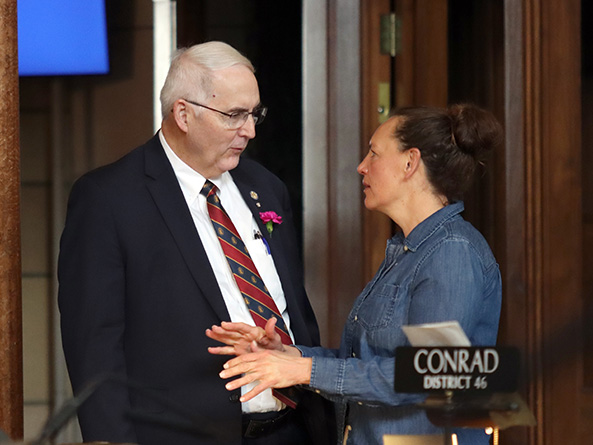
Sen. Danielle Conrad of Lincoln agreed, saying inclusion of contentious policy issues had temporarily derailed the state budget in the past.
“The tension — the anxiety, the consternation, the chaos — that is infused in this process because of that issue is exactly why we don’t inject policy into the budget,” Conrad said.
Omaha Sen. John Fredrickson said senators on both sides of the debate were guilty of protecting their favored policies “at all costs” and finding “the hill we’re willing to die on” rather than doing the hard work of finding agreement and making sure that the burden of the budget deficit doesn’t fall on any one group of Nebraskans.
After four hours of debate and the rejection of three other attempts to amend the proposal, Speaker John Arch of La Vista offered a motion to invoke cloture, which ceases debate and forces a vote on the bill. The motion failed on a vote of 19-10. Thirty-three votes were needed.
A failed cloture motion ends debate on a proposal for the day. A bill that has failed once on cloture must be debated for an additional two hours before another attempt to cease debate can be made.
Later in the day, Arch said LB1071 would be scheduled for debate again March 23 to allow continued time for negotiations, adding that he was “quite disappointed with the outcome” of the day’s discussions and lawmakers’ failure to advance the bill.
“Senator Clements has been one of the staunchest supporters of school choice, but his actions today to exclude that provision in his select file amendment was a display of true statesmanship,” he said. “He put his duties and the budget before his personal beliefs on a single issue.”
Fund transfers
LB1072, also introduced by Arch at the request of the governor, would provide for and change transfers from the Cash Reserve Fund and make a number of changes to other fund transfers, agency powers and duties and a variety of programs.
An Appropriations Committee amendment offered on select file and adopted 35-8 would authorize new and adjusted transfers from various agency funds to the General Fund of $83.2 million, including an additional $22 million from the Cash Reserve Fund.
In addition, the amendment would move $38.7 million in various fund transfers from fiscal year 2026 to FY2027. Clements said the amendment would reduce the state’s budget shortfall to approximately $41.8 million.
“[The amendment] is going to help us get a lot closer to balancing our budget,” Clements said.
Senators adopted three small changes to fund transfers in the committee amendment, including one from Omaha Sen. Machaela Cavanaugh. The amendment would delay until June 1, 2027, a $6.5 million transfer from the Homeless Shelter Assistance Trust Fund to the General Fund.
Cavanaugh said the amendment, adopted 35-1, would ensure the sustainability of a grant program for homeless services.
A Clements amendment, adopted 33-0, would lower a transfer from a Nebraska Library Commission fund to the General Fund from $250,000 to $75,000. He said the commission recently notified him those funds were obligated and that sweeping them would create a hardship for the commission.
Another amendment, offered by Lincoln Sen. Beau Ballard and adopted 39-0, would reduce a transfer from the Wildlife Conservation Fund to the General Fund by $362,000. Ballard said that portion of the fund balance came from voluntary contributions, donations and checkoffs and should not be swept to the General Fund.
“The majority of these funds do not come from excess state revenue,” Ballard said, “they come directly from Nebraskans.”
Senators rejected a series of additional amendments from Lincoln Sen. Jane Raybould that would have stricken a variety of fund transfers from LB1072.
An amendment offered by Blair Sen. Ben Hansen would impact LB304, a bill from Bennington Sen. Wendy DeBoer included in the budget adjustment measure.
Her proposal would permanently extend expanded eligibility for the state’s Child Care Subsidy program, which provides a direct subsidy to providers to cover a portion of child care expenses for low-income families.
Income eligibility guidelines were expanded in 2021 from 130% of the federal poverty level to 185%. That expansion is scheduled to expire Oct. 1.
Hansen’s amendment instead would sunset the expanded eligibility Oct. 1, 2028. He said the change would allow future lawmakers a chance to determine if the state could continue to afford expanded eligibility.
“I think it’s a responsible way to govern,” Hansen said.
Sen. Dan Quick of Grand Island opposed the amendment. The uncertainty it would create for child care providers who rely on subsidies likely would cause even more facilities to close, he said, further hampering the state’s economic development efforts.
“If we don’t have some stability with child care in our communities across Nebraska, I guess you really don’t want businesses to come here,” Quick said.
Hansen withdrew his amendment and lawmakers adopted a cloture motion from Arch on a vote of 35-12. They then advanced LB1072 to final reading 35-12.
State claims
Finally, lawmakers advanced a bill that would provide for payment of claims against the state. If a person sues the state of Nebraska, he or she files a claim with the State Claims Board. Approved claims exceeding $50,000 must be reviewed by the Legislature.
LB1133, sponsored by Business and Labor Committee chairperson Sen. Kathleen Kauth of Omaha, would approve $695,507 in settled claims; six Workers’ Compensation Court claims totaling $1.17 million and a variety of state agency write-offs totaling $2.84 million.
The measure advanced to the final round of debate by voice vote.

