
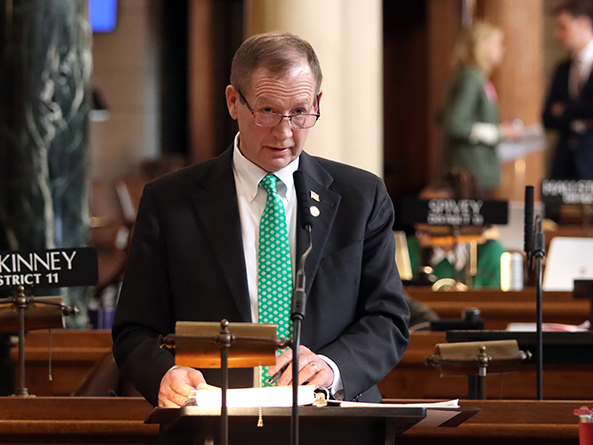
Eminent domain carve-out for private power plants clears first round
Nebraska’s public power utilities could not use eminent domain to acquire privately owned power plants built to serve certain large-scale electricity users under a bill advanced from general file March 18.
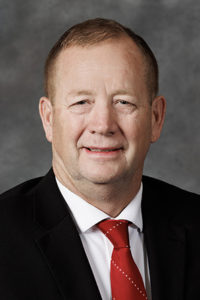
Niobrara Sen. Barry DeKay, who sponsored LB1261 at the request of Gov. Jim Pillen, said it would allow utilities to partner with private developers to build dedicated power plants for data centers, manufacturers and other customers whose power demands exceed the peak load of Lincoln’s electric utility.
DeKay said the “narrowly defined” exception to utilities’ eminent domain authority would ensure that developers can finance a project of that size, spurring economic development while also preserving Nebraska’s public power model.
The bill would prohibit a consumer-owned utility from using eminent domain to acquire a privately owned electric generation facility under certain conditions. The exception would apply only to a facility that is built to provide electric service to an industrial customer at a single site with projected new electric load greater than 1,000 megawatts.
A Natural Resources Committee amendment, adopted 39-0, struck “projected” from the proposed requirement.
The facility would have to be co-located with the industrial customer, have an electrically equivalent point of grid interconnection to the customer and be approved by the Nebraska Power Review Board.
Under the proposal, the privately owned electric supplier would have to have executed a long-term power purchase agreement or other contract with a consumer-owned utility.
A contract would preserve the utility’s exclusive right to serve retail customers in the relevant service area, prohibit the industrial customer from reselling electricity and include a waiver of the utility’s authority to exercise eminent domain to acquire the private generation assets for the duration of the contract.
LB1261 also would require the industrial customer to pay a utility for any electric system upgrades or other costs needed to provide its service.
The bill’s requirements would apply to contracts entered into on or before Dec. 31, 2031.
Sen. Mike Moser of Columbus supported the measure, saying it would create an “essential” framework for responding to the needs of large electricity users. Without the proposed exception, he said, utilities would have to raise rates on all customers to pay for the required generation.
If a private project fails under the proposed model, Moser added, utilities and ratepayers would be insulated from losses on the unused infrastructure.
Omaha Sen. John Cavanaugh opposed LB1261, saying it threatens to undermine the state’s public power system to benefit a single project that might not come to fruition.
He cited recent reporting by the Flatwater Free Press, which found that the bill likely is designed to enable a potential Google data center project in Nebraska that includes a co-located natural gas power plant built by Tenaska, an Omaha-based energy company.
Also opposed was Omaha Sen. Terrell McKinney, who said other states have seen “harmful impacts” from large data centers. He said the facilities use large amounts of water and electricity but support few permanent jobs.
Sen. Danielle Conrad of Lincoln also opposed the bill and questioned whether it contains sufficient safeguards for public power, ratepayers and the state’s natural resources.
She introduced an amendment, adopted 39-0, under which any contract between a utility and a privately owned electric supplier would have to be approved by a utility’s board of directors.
Conrad offered another amendment, adopted 38-0, under which a utility’s board also would have to approve any waiver allowing a privately owned electric generation facility to serve customers other than the industrial customer.
She said the changes would increase transparency and public engagement by ensuring that key decisions are made by locally elected board members rather than unelected managers.
After adoption of the amendments, senators voted 34-7 to advance LB1261 to select file.

