
Urban Affairs omnibus amended, advanced
A package of bills heard by the Urban Affairs Committee this session advanced from general file March 20 after lawmakers amended it to remove requirements for certain public housing agencies related to bed bug infestations.
LB1114, introduced by the committee, would revise eligibility provisions allowing for the expedited review of community redevelopment plans under Nebraska’s Community Development Law.
Under the proposal, a redevelopment plan would be eligible for expedited review if the project involves a structure that has been within the corporate limits of the city for at least 25 years rather than 60. Plans involving vacant platted or nonconforming lots also would be eligible for expedited review.
A committee amendment, adopted 35-0, incorporated provisions of five other bills, including LB850, sponsored by Omaha Sen. John Cavanaugh.
They would allow metropolitan and primary class cities to use an economic development program for the purpose of building or rehabilitating affordable housing, workforce housing or housing for persons of low or moderate income under the Local Option Municipal Economic Development Act.
The act currently allows only first and second class cities and villages to create a program for those purposes.
Lincoln is the state’s only primary class city, and Omaha is the only metropolitan class city.
The amended provisions of LB915, introduced by Sen. Loren Lippincott of Central City, would update the Municipal Inland Port Authority Act. They would increase the number of inland port districts that may be designated from five to eight and revise eligibility requirements for counties.
Lippincott said the changes would allow Grand Island, as well as Seward, Otoe and other counties, to apply for a designation.
North Platte Sen. Mike Jacobson introduced an amendment that would have removed Lippincott’s proposal from the committee amendment.
He said the Legislature should wait until the state’s five current inland port districts — in Bellevue, Fremont, North Platte, Omaha and South Sioux City — are fully operational before allowing more to be designated.
The amendment failed on a vote of 15-15. Twenty-five votes were needed.
The provisions of LB976, sponsored by Sen. Bob Andersen of Omaha, would change provisions related to sanitary and improvement district elections.
The proposal also would require an SID board or administrator to let certain contracts of more than $50,000 to the lowest responsible bidder, an increase from $20,000.
The provisions of LB981, introduced by the committee, would update the Nebraska Housing Agency Act to require a housing agency in a metropolitan class city to take certain actions related to bed bug infestations.
The measure also would require an agency submit a report to the city and the Urban Affairs Committee every six months. The report would include information on pest control management activities, the number of eviction filings and the number and nature of complaints filed during the reporting period, in addition to current vacancy rates and relevant updates from the agency’s board meetings.
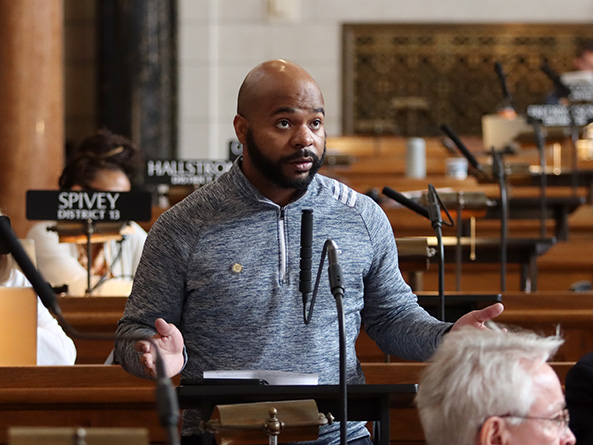
McKinney introduced an amendment, adopted 38-0, to remove the bed bug-related provisions of LB981 from the committee amendment. He said the proposal is a compromise with Gov. Jim Pillen, who last session vetoed a similar proposal intended to address bed bug complaints from Omaha Housing Authority tenants.
As introduced, the committee amendment would allow metropolitan class cities to, by ordinance, require any housing agency in the city to meet certain requirements related to inspections and code enforcement.
McKinney’s amendment instead would allow a metropolitan class city to regulate any housing agency. Regulations could provide for code enforcement and pest control as well as regular inspections of housing agency properties.
The amended provisions of LB1130, sponsored by Jacobson, would create the Community Improvement District Act. It would allow property owners to propose the formation of a community improvement district within a city or village for the construction, maintenance and repair of public infrastructure.
A city or village would have to pass an ordinance approving the formation of a CID, which would be governed by a five-member board of trustees.
A CID could levy taxes and special assessments on property within the district and use those funds to pay off outstanding bonds. Paying for infrastructure in this way would help reduce upfront costs for developers, property owners and municipalities, Jacobson said.
Norfolk Sen. Robert Dover offered an amendment to include provisions of his LB1129. They would allow a city to use tax-increment financing to develop underdeveloped parcels that have been within the city’s extraterritorial zoning jurisdiction for more than 25 years.
Currently, federal unemployment and poverty data is used to determine whether an area is eligible for an extremely blighted designation under the Community Development Law.
Dover said federal data for smaller communities may fail to accurately reflect local conditions. Under his proposal, he said, a city’s governing body could use other credible information to make a blight determination if federal data for the area is unreliable.
After voting 27-0 to adopt Dover’s amendment, senators advanced LB1114 to select file on a 32-0 vote.

