
Bill to codify state maternity leave narrowed, advanced
Lawmakers gave first-round approval March 17 to a bill that would codify current practice for state employee maternity leave in Nebraska law, effectively expanding coverage to certain contract employees. The bill also would extend maternity leave to adoptions.

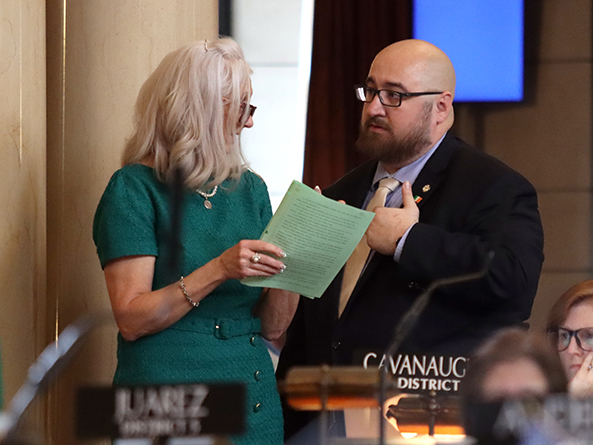
Under LB878, sponsored by Omaha Sen. Dunixi Guereca, eligible state employees would be entitled to six weeks of paid maternity leave. The leave could commence no earlier than the date of birth or adoption and must be used within six months.
In addition, 30 days’ notice would be required from an employee intending to take maternity leave unless such notice is not practicable.
The bill would prohibit taking intermittent leave unless agreed upon by the state and employee or certified as medically necessary by the employee’s health care provider. Maternity leave would not be charged against the employee’s sick or vacation leave.
Upon return, the employee would be entitled either to resume their previous position or be placed in a position with similar status, seniority, pay and benefits. Employees using maternity leave also would be protected from employer retaliation.
Guereca said the state’s largest union successfully negotiated six weeks of paid maternity leave for state employees last summer and that his bill would ensure that all employees receive that same benefit. While the benefit automatically extended to nonunion permanent state employees, it did not apply to three groups of contract employees, he said.
LB878 would extend benefits to members of the State Patrol, the Fraternal Order of Police and educators who work in institutions within the state Department of Correctional Services and the state Department of Health and Human Services.
Guereca said research consistently shows that employees are more likely to join and stay with companies that provide maternity leave. Extending benefits to members of the State Patrol in particular would allow the agency to recruit and retain top talent, he said.
“I’m incredibly grateful for our state employees and the sacrifices they are making to help our state function and flourish,” he said. “These employees are fiercely loyal to our state and in return we should be providing them with the stability and security they deserve.”
Sen. Ashlei Spivey of Omaha supported the proposal, noting that most child care providers will not accept infants younger than six weeks of age. Not everyone has a support system to help provide care during that postpartum time, she said, and having a parent at home is important.
“[This] is absolutely the minimum of what we should be doing,” Spivey said.
Several senators raised concerns about the bill’s anticipated fiscal impact, which Guereca acknowledged could be confusing. Most state employees who previously took time off following childbirth used other forms of leave, he said, so the assumption is that the majority of the bill’s impact would be limited to employees’ leave balances and not agency budgets.
Sen. Kathleen Kauth of Omaha offered an amendment to replace the bill with a modified version of the proposal that, among other technical changes, would limit leave to women as defined in state law by passage of her LB89 last session.
The bill as introduced would have provided leave to employees in adoptive situations who are “assuming a parental role,” which would apply to adoptive fathers as well.
Guereca opposed Kauth’s amendment, saying the definition included in it is not part of the state Department of Administrative Services’ existing maternity leave policy and could raise practical and legal concerns.
He said he was preparing a select file amendment to address the technical issues DAS had with the bill and that he saw Kauth’s amendment as part of a “political game” tied to defining women in state law by their sex assigned at birth.
Omaha Sen. John Fredrickson said he did not know the intention behind Kauth’s amendment, but that the result would be the exclusion of single dads who adopt. Regardless of who adopts a child, he said, both parents and children deserve time to bond.
“This is a serious bill … that’s meant to help Nebraskans, that’s meant to help families, and I think it’s a shame if we’re going to try and be kind of cheeky here and throw out … a political hot-button issue to score political points,” Fredrickson said.
Kauth said the bill could be expanded on the next round of debate to change the policy to “parental” leave and apply to both male and female employees, although that likely would significantly increase the proposal’s fiscal impact.
Following adoption of the Kauth amendment 27-9, lawmakers advanced LB878 to select file on a 29-5 vote.

