
Municipal development package advanced
Lawmakers gave first-round approval March 17 to a slate of proposals related to municipalities.
LB1135, introduced by the Urban Affairs Committee, would modify land bank membership and reporting requirements under the Nebraska Municipal Land Bank Act.
A committee amendment, adopted 42-1, replaced the bill with a modified version of the original measure as well as provisions of four other bills considered by the committee this session.
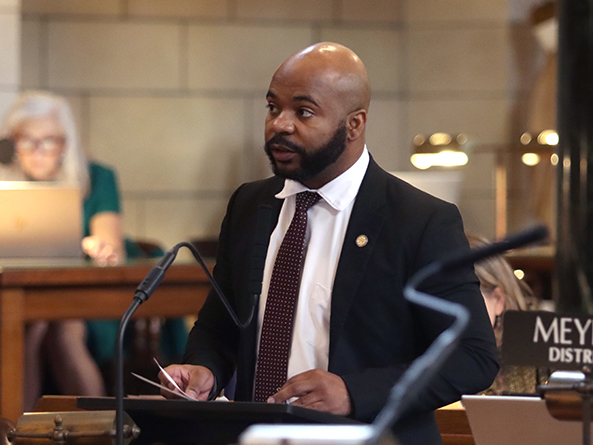
Omaha Sen. Terrell McKinney, committee chairperson, said the proposals are intended to help municipalities manage growth and development.
Under the amendment, land banks created by a single municipality would include an odd number of voting members totaling at least seven, rather than a total of seven as is currently required.
Voting members currently are required to live in the municipality that created the land bank. Under the amendment, voting members could live within three miles of the municipality, but a majority would have to reside in the municipality.
As introduced, LB1135 would have eliminated requirements that boards include voting members in certain professions such as banking and real estate development. Under the amendment, the board of a land bank created by a single municipality would include those individuals to the extent that they can reasonably be found.
Under the amendment, land bank boards would have to include members with experience in fields relevant to land bank operations, including community development, real estate and housing.
McKinney offered an amendment, adopted 42-0, that also would require a land bank created by a single municipality to include at least one member who resides in a qualified census tract within the municipality, if there is one.
The committee amendment also would prohibit a land bank from temporarily holding real property on behalf of a private entity for more than one year unless the entity has entered into a community benefits agreement with the land bank and local community groups.
Finally, the measure would revise land bank reporting requirements, requiring boards to submit reports at least quarterly rather than monthly.
The provisions of LB799, introduced by the committee, would create the Service Contract Reporting Act.
The proposal would require a metropolitan class city, counties with a population of more than 500,000 and state agencies to submit an annual report to the materiel division of the state Department of Administrative Services that contains information on service contracts awarded during the prior year.
Omaha is the state’s only metropolitan class city.
The division would compile the information and submit it in an annual report to the governor, the clerk of the Legislature and the Urban Affairs Committee.
The proposal would require the state treasurer to suspend distributions of state aid to a city or county that fails to submit the report.
The provisions of LB842, introduced by Bellevue Sen. Victor Rountree, would allow first and second class cities and villages to enter into contracts with private entities for the operation, maintenance, management or enforcement of municipal parking facilities.
Contracts could authorize private entities to issue parking citations and collect fines, provided that the city or village retains final authority over adjudication and appeals.
The provisions of LB1163, sponsored by Sen. John Fredrickson of Omaha, would update how liens against delinquent assessments are recorded under the Nebraska Property Assessed Clean Energy Act.
The program allows property owners to finance energy efficiency upgrades through a special assessment on their property tax bill. When assessments on qualifying property other than single-family residential property become delinquent, they constitute a lien against the property until they are paid.
Currently, a municipality must record a notice of a lien within 14 days after an assessment becomes delinquent. Under the provisions of LB1163, the 14-day clock also could start when a municipality receives notice of the delinquency from a third-party lender financing the project.
Fredrickson’s proposal also would require a municipality to certify the amount of the delinquency and lien to the county treasurer. The lien would be treated as a special assessment and subject to existing collection processes for property taxes and special assessments.
Fredrickson said the change is needed to clarify the authority of cities and counties to enforce a lien in the case of a delinquency.
Fremont Sen. Dave Wordekemper said the provisions of his LB1168 would give cities another way to structure tax-increment financing projects.
Under a traditional TIF project, new tax revenue that is generated by a property’s increased value after development is dedicated to repaying bonds used to finance the project for a period of up to 20 years.
Wordekemper’s proposal would allow a city’s redevelopment authority to enter into a contract under which it issues conduit revenue bonds. Under the contract, an authority could pledge a percentage of the annual excess tax revenue toward bond repayment rather than the full amount, as required in a traditional TIF project.
When an authority has pledged less than 100% of the new tax revenue, Wordekemper said, the unpledged portion would flow immediately to property taxing entities, including schools and counties, that under a traditional TIF project would not receive new tax revenue for up to 20 years.
Wordekemper said the proposal also would allow an authority that issues a conduit revenue bond to enter into an agreement that requires the project developer to cover any shortfall in real property taxes pledged to repay the bonds if the project underperforms.
LB1135 advanced to select file on a vote of 43-1.

