
Work comp injury report confidentiality amended, advanced
After approximately six hours of debate spanning three days, lawmakers reached a compromise March 3 and advanced a bill that would make workers’ compensation first injury reports confidential.
Currently, employers or insurers are required to file a first injury report with the Workers’ Compensation Court for any injury resulting in death, lost time, loss of consciousness or medical treatment beyond first aid. Such reports are considered public records and can be accessed through a public records request.

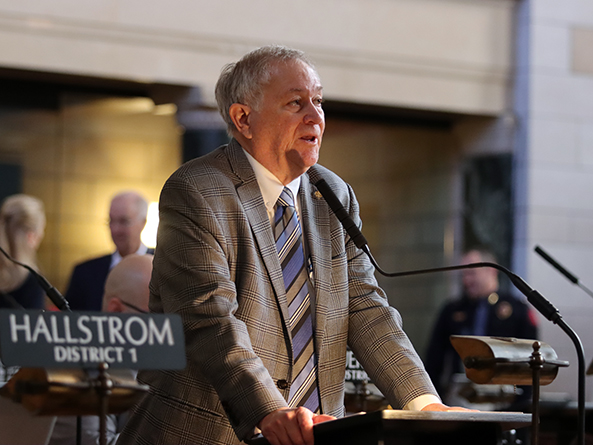
LB455, as introduced last session by Syracuse Sen. Bob Hallstrom, would require those reports be confidential by default and closed to public inspection except as necessary for the court to administer and enforce other provisions of the Nebraska Workers’ Compensation Act.
Under the bill, report access would be restricted to the involved parties and their legal counsel and insurers, state and federal agencies for investigations or statistical research and nonprofit organizations that provide services to the families of deceased employees. An injured employee also could waive confidentiality.
Hallstrom said the measure would offset the “avalanche” of solicitations that injured employees receive from attorneys once a first injury report is filed and made public.
“The communications by lawyers pursuant to information contained within the first injury report produce unnecessary conflict and needless litigation,” Hallstrom said, “thereby increasing the cost of [the] workers’ compensation system and reducing the net benefits received by an injured employee.”
A Business and Labor Committee amendment would replace the bill with a modified proposal that would clarify the manner in which entities could access the report and allow access to a treating physician who provided care to the injured employee.
The amendment also includes provisions of a measure heard by the committee last session that would update the distribution structure for subrogation claims, which allow an employer or their insurer to seek reimbursement from a third party that is liable for an employee’s work-related injury.
Currently, the court determines a “fair and equitable” distribution of a subrogation settlement proceeds in cases in which a prior written agreement was not obtained.
The amended provisions of LB313, sponsored by Sumner Sen. Teresa Ibach, instead would distribute subrogation settlement proceeds based on a statutory formula. After deducting the reasonable expenses of making a recovery, the employee would receive one-third of the remaining settlement. The employer or workers’ compensation insurer would be reimbursed for payments already made and the employee would receive the remaining balance.
Ibach said the change would provide certainty to both employers and employees by implementing clear distribution standards.
“We’re just seeking to define what is fair and equitable,” Ibach said. “It shouldn’t adversely impact the workers at all.”
Sen. Jane Raybould of Lincoln offered an unsuccessful procedural motion to allow for extended debate on LB455. She noted that injured workers have several avenues to find and connect with attorneys beyond direct solicitation, including search engines, commercials, billboards and information hotlines.
“It’s not like we’re restricting access to any legal counsel,” Raybould said. “The majority of workers’ compensation cases are resolved amicably between the employer and the employees.”
Omaha Sen. Megan Hunt opposed the bill and committee amendment, saying the proposal would make it more difficult for injured Nebraskans to access and understand their legal options. She said litigation does not occur simply due to attorney involvement, but rather because a claim was denied, delayed or disputed.
The amount of litigation won’t be reduced by preventing attorney outreach, she said, but by ensuring that claims are processed correctly, efficiently and transparently.
“That first injury report can be the only moment when outreach happens … to ensure these people understand their options before deadlines pass or mistakes are made,” Hunt said. “This bill asks us to believe that reducing legal resources for injured workers will somehow produce better outcomes for them.”
Speaking in opposition to LB455 and the committee amendment, Lincoln Sen. Danielle Conrad said privatization of first injury reports would serve as a “problematic shield” against identifying unsafe patterns and practices that result in recurrent workplace injuries.
She also questioned the benefit of moving to a subrogation reimbursement formula that would not account for the unique circumstances of each workers’ compensation case.
“Uniformity and certainty isn’t always fair and equitable,” Conrad said. “A change from a fair and equitable rule … ensures that there will be less fairness and less equity in these complex issues that require a fact specific case-by-case determination.”
Sen. John Cavanaugh of Omaha also opposed the proposal. He said the subrogation change in the committee amendment would allow an employer to seek reimbursement through an injured employee’s insurance if the third party at fault for the injury were uninsured or underinsured.
“This bill … hurts working people and asks them to pay for insurance companies to have less loss,” Cavanaugh said. “It’s more money out of the pockets of working people to cover big insurance companies so they have less risk.”
The Legislature adjourned for the week Feb. 27 without voting on LB455. When debate resumed March 3, Hallstrom offered an amendment to the committee amendment that he said would address concerns from the opposition and replace the measure with a modified proposal.
The Hallstrom amendment would remove the provisions of LB313 from the committee amendment and maintain the current “fair and equitable” distribution standard for subrogation claims in workers’ compensation cases.
It also would require first injury reports be confidential for 60 days after a report is filed. The workers’ compensation court would be required to send a letter to the injured employee notifying them of their right to seek legal advice and representation.
Conrad supported the Hallstrom amendment, calling it a “straightforward” compromise. The 60-day “cooling off period” still would allow injured workers to get the information they need, she said, and the amendment would ensure that workers receive a fair and equitable recovery in subrogation cases.
Finally, the Hallstrom amendment includes provisions from Plymouth Sen. Tom Brandt’s LB1077.
Those provisions would update how workers’ compensation claims data is reported to the National Council on Compensation Insurance for purposes of calculating the experience modification factors used to set a business’s insurance premium based on its workers’ compensation claim history compared to the industry average.
Under the amendment, Nebraska businesses could use a net reporting system rather than a gross reporting system to allow for the exclusion of deductible payments in the determination of their experience modification factor.
Brandt said approximately 43% of states that utilize NCCI services — including Colorado, Iowa, Kansas and Missouri — operate on a net reporting system. He said Nebraska businesses currently are at a disadvantage with competitors with lower EMF scores due to their ability to subtract deductible amounts from their losses.
“This legislation would level the playing field with our neighboring states and give businesses a means to control their [EMF and reduce] premiums,” Brandt said.
Lawmakers voted 37-1 to adopt the Hallstrom amendment before adopting the committee amendment 37-0. LB455 then was advanced to select file on a 36-1 vote.

