
Bills would restrict mask usage by on-duty law enforcement
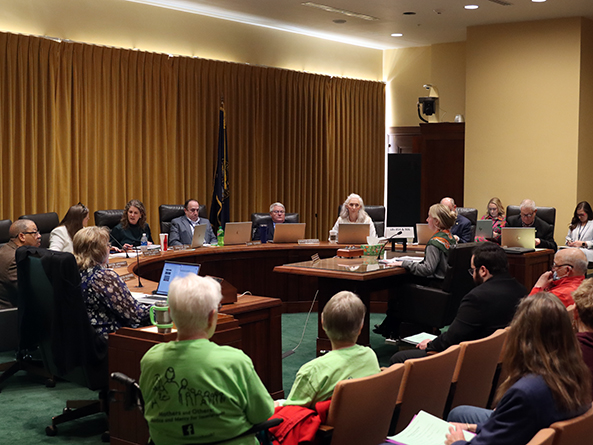
Two measures aimed at prohibiting on-duty law enforcement officers from concealing their identities were considered Feb. 27 by the Judiciary Committee.
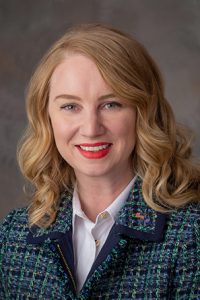
LB854, introduced by Omaha Sen. Megan Hunt, and LB906, sponsored by Sen. Margo Juarez of Omaha, would bar law enforcement officers, including local, state and federal authorities, from wearing facial coverings or personal disguises that obscure their identities while on duty.
Under both measures, officers could wear translucent face shields or clear masks. Additionally, officers could wear face coverings — including masks, helmets, respirators and protective eyewear — in certain circumstances, including when:
● protecting themselves from exposure to bodily fluids, smoke, airborne toxins, gas or other irritants that could impair health or trigger illness;
● protecting themselves from physical harm while engaged in high-risk situations such as a shootout, standoff, hostage situation or terrorist incident;
● protecting their eyes from retinal weapons such as lasers; or
● operating a motorcycle or other vehicle that requires a helmet for safe operation.
Both bills also would require on-duty law enforcement officers to wear “appropriate identification,” including visible information such as their name, badge number and agency affiliation.
Under both measures, an officer who violates the identification requirements or facial-covering prohibitions would be guilty of a Class III misdemeanor, punishable by up to three months imprisonment, a $500 fine or both.
Additionally, Juarez’s proposal would require Nebraska law enforcement agencies to adopt and publicly post masking policies by Oct. 1, 2026, prohibit supervisors from allowing violations and bar evidence or related testimony obtained in violation of the bill from being used in court, with limited exceptions.

Hunt and Juarez said they introduced the measures in response to issues involving U.S. Immigration and Customs Enforcement officers concealing their identities during operations in Nebraska and elsewhere.
Juarez cited an ICE raid last year at Glenn Valley Foods in her legislative district — where masked agents arrested and detained more than 70 workers — saying the face coverings officers used intensified fears.
She said masks make it harder to distinguish legitimate officers from impostors and limit facial visibility, hindering nonverbal communication and increasing the risk that residents might misinterpret an officer’s tone and intent.
“As lawmakers, we share a collective obligation to ensure that law enforcement is conducted responsibly and in a way that builds and fosters trust with the community,” Juarez said.
Hunt echoed that sentiment, saying requiring officers to display ID is essential to maintaining public trust and accountability. Nebraskans should not have to wonder whether the person attempting to detain them is an actual officer or an impersonator, she said.
“Requiring identification for any law enforcement makes sense and it’s an important civil liberty protection for our citizens, whether they come in contact with a city police officer, a county sheriff or an ICE officer,” Hunt said. “They deserve to know that an officer that might be giving them instructions, pulling them over, entering their home, arresting them or detaining them is a legitimate officer.”
Holly Burns, a mental health professional, testified in support of both proposals. She said allowing officers to wear full facial masks during arrests can intensify trauma responses, heighten fear and anxiety and undermine the sense of safety that is essential to healthy community relationships.
Masks also can make officers appear unapproachable or threatening, she said, eroding public trust and reducing the likelihood that residents will cooperate with law enforcement or report crimes.
“This perception diminishes the possibility of community cooperation [and] open dialogue, which are vital for fostering safer neighborhoods,” Burns said.
Grant Friedman, representing the ACLU of Nebraska, also supported both bills. In his work involving alleged police misconduct, Friedman said, he historically has been able to assume that individuals identified as law enforcement officers were legitimate.
However, he said, the increased use of masks and concealed identities has made it more difficult to verify whether someone claiming to be an officer actually is one. Transparency is essential to accountability, he added, noting that public officials openly identify themselves when conducting official business and law enforcement officers should be held to the same standard.
Maria Arriaga supported both measures on behalf of the Nebraska Commission on Latino-Americans, saying the tactics of masked law enforcement disproportionately affect Latino communities. Requiring visible identification and limiting routine face coverings would reduce racial profiling concerns and deter impersonators, she said.
Also supporting both bills was Nick Grandgenett, a staff attorney with Nebraska Appleseed. He said immigrant community members increasingly face enforcement actions despite not having criminal records.
“[The bills] recognize the need for responsible guardrails and that the current no-holds-barred approach to immigration enforcement indiscriminately targets people and undermines the ability of law enforcement to build trust in Nebraska,” Grandgenett said.
No one testified in opposition to either bill and the committee took no immediate action on LB854 or LB906.

