
Medical cannabis changes clear first round
A measure that would create registries for medical cannabis patients and caregivers was amended to instead provide structure for the implementation of medical cannabis regulations and given first-round approval March 4.
As introduced by the General Affairs Committee, LB1235 would amend the Nebraska Medical Cannabis Patient Protection Act to require the Nebraska Medical Cannabis Commission to establish and maintain a registry of those seeking to become qualified patients and registered caregivers.
A committee amendment, adopted 40-0, replaced the bill. The amended proposal would remove the registry requirements and instead reorganize the NMCC’s structure and administration.
It would authorize the commission to establish a maximum fee of $50,000 for license applications, registrations and renewals and require a finger-print based national criminal history background check for initial applicants.
The amendment also would create the Nebraska Medical Cannabis Commission Cash Fund to receive fees, gifts, grants and other revenues to support administration and enforcement, including salaries, materials, equipment, education and training. Members of the commission would earn an annual salary of $12,500.
Speaking in support of the committee amendment, Omaha Sen. John Cavanaugh said the proposal would ensure that the commission has adequate resources and provide important protections to both patients and caregivers by removing the commission’s ability to maintain a registry.
He also noted that the measure does not give the commission more authority than was provided under the ballot initiative passed by 71% of Nebraska voters.
“It is … a small step in the right direction,” Cavanaugh said. “It is just creating a little bit more structure around the commission.”
Also included in the committee amendment were provisions of LB1085, sponsored by Kearney Sen. Stan Clouse.
Those provisions would revise the definition of a “bottle club” under state law to clarify that alcohol may be consumed “in or upon” a premises. The provisions also would require the Nebraska Liquor Control Commission to consider if an applicant is delinquent in any federal, state or local taxes when determining licensure.
Finally, it would expand existing criminal penalties to apply to the unlicensed retail sale of alcoholic liquor, bringing those penalties in line with those for unlicensed manufacture of spirits.
Clouse said the current definition of a “bottle club” excludes establishments where individuals gather for purposes other than consuming alcohol, such as card or strip clubs.
“The intent of this [proposal] is to clarify that if there is a private club that allows individuals to congregate and consume alcohol, then it needs to be licensed,” he said.
The committee amendment also would add the amended provisions of LB1128, introduced by Sen. Robert Dover of Norfolk.
Those provisions would create a consumption-only option under state entertainment district licensure. Under the amendment, local governing bodies could designate areas within an entertainment district where alcohol could be consumed, but not sold, for a $25 license fee. Such businesses would be required to comply with all applicable laws including prohibitions on underage drinking.
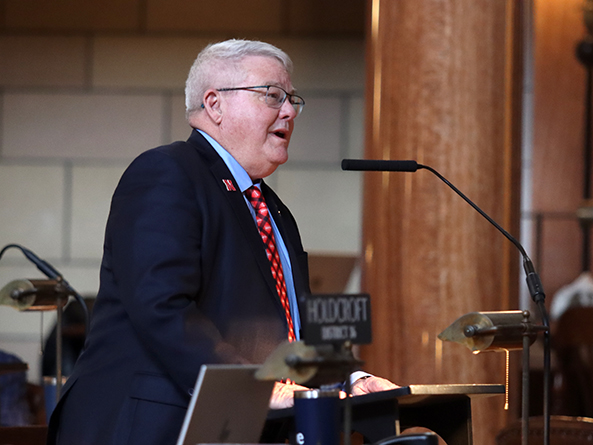
Sen. Rick Holdcroft of Bellevue, committee chairperson, said the comprehensive proposal would provide flexibility to local communities, strengthen compliance with liquor laws and clarify implementation of medical cannabis regulations.
“Together, these provisions promote regulatory clarity, public safety and responsible governance in areas that directly affect communities across Nebraska,” Holdcroft said.
Following adoption of the committee amendment, senators voted to advance LB1235 to select file on a vote of 40-0.

