
Bill seeks to roll back SNAP work requirements for certain groups
The Health and Human Services Committee considered a bill Feb. 26 that seeks to opt Nebraska out of recent federal changes to the Supplemental Nutrition Assistance Program.

LB734, sponsored by Omaha Sen. Megan Hunt, would require the state Department of Health and Human Services to submit an application to the U.S. Department of Agriculture by Oct. 1 to waive SNAP work requirements for unhoused individuals, veterans and youth aging out of foster care who are between ages 18 and 24.
If approved, the waiver would restore SNAP work requirement exemptions for the three groups as they existed in Nebraska before passage of the federal One Big Beautiful Bill Act of 2025.
The measure also would eliminate a provision in state law, enacted last year, that prohibits DHHS from applying for any waiver of SNAP work requirements unless required by federal law.
Hunt said the OBBB contains stricter requirements than previously existed in Nebraska’s food assistance program at a time when everyone is struggling with food affordability. In addition, she said, the groups that would be impacted by LB734 previously were exempt from work requirements because they face specific challenges that increase their risk of food insecurity.
For example, Hunt said, veterans have higher rates of cognitive impairments, often tied to their service, and unhoused individuals often struggle with mental health issues and substance use disorders.
Perhaps the most vulnerable, she said, are young people aging out of foster care. Even with the state’s Bridge to Independence Program, many former state wards have great difficulty overcoming unstable, sometimes abusive, pasts and lack the support and opportunities that other Nebraskans take for granted.
“They’ve had the deck stacked against them in one way or the other their whole life, through no fault of their own,” Hunt said, “and the least we can do is remove a completely new barrier to meeting one of their most basic needs.”
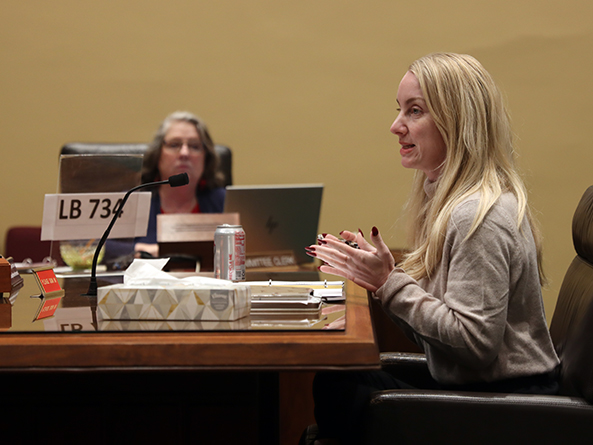
Testifying in support of the proposal, Robin Nolte said she and her children were homeless for 10 months after she lost her job amid a health crisis. Access to SNAP benefits without work requirements provided her the stability to find housing and full-time employment, she said.
“SNAP work requirements can prevent struggling families from getting the food they need to survive,” Nolte said. “When life changes in an instant, like it did for me, these programs are not just support, they’re survival.”
Also supporting LB734 was Bre Grandstaff of No More Empty Pots. The Omaha nonprofit is a certified SNAP E&T provider and partners with DHHS to help individuals who have difficulty meeting the program’s work requirements to gain the skills and training necessary to find employment, she said.
The training can be crucial for success, Grandstaff said, but it is not available in many rural parts of the state and does not address root causes of food insecurity, such as severe mental health disorders, chronic substance abuse and domestic violence.
“Unfortunately, simply securing employment will not solve all of the struggles that these groups face,” she said.
Alynn Sampson, executive director of Matt Talbot Kitchen and Outreach in Lincoln, said people experiencing homelessness spend most of their time managing crises. Requiring them to work does not help them build stable lives, she said.
“When someone does not know where they will sleep, how they will eat or how they will stay safe, employment becomes exponentially more difficult,” Sampson said. “It is hard to prepare for a job interview when you’ve not slept. It’s hard to maintain employment when you have no reliable transportation, no permanent address, no secure place to store your belongings and no consistent access to showers, clean clothes or communication.”
Katie Nungesser of Voices for Children in Nebraska also spoke in favor of the proposal, saying young people aging out of foster care face some of the highest barriers to stability of any group in the state. In 2025, she said, 179 youth aged out of the Nebraska foster care system and that rate has doubled in the last decade.
Youth who do not achieve permanency have had, on average, four times more placements than other foster children, she said, and are much more likely to have mental health issues and lack support systems, reliable transportation and solid financial foundations.
“If SNAP is unavailable to certain young people through these new requirements and intensive reporting systems, the result is not going to end up being employment,” Nungesser said. “It will be hunger and desperation.”
No one testified against LB734 and the committee took no immediate action on the bill.

