
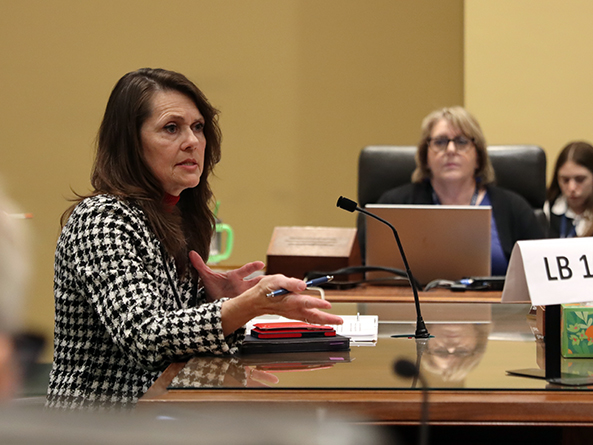
Changes proposed to involuntary commitment process
A bill that would allow concerned individuals to seek court-ordered mental health commitments in Nebraska was considered by the Judiciary Committee Feb. 25.

LB1040, introduced by Omaha Sen. Kathleen Kauth, would amend the Nebraska Mental Health Commitment Act to allow “interested parties” — including a spouse, parent, sibling, adult child, close adult friend, guardian, conservator or another person acting in the individual’s best interests — to file a petition directly with a court alleging that someone is mentally ill and dangerous.
Currently, such concerns must be routed through a county attorney.
Petitioners would be required to provide detailed allegations describing specific behaviors, acts or threats and sign the petition under penalty of perjury. Filing a petition in bad faith would be a Class IV felony, punishable by up to two years in prison and 12 months of post-release supervision, a $10,000 fine or both.
The bill also would expand the definition of “mentally ill and dangerous” to include not only those who pose a substantial risk of serious harm to themselves or others, but also those exhibiting signs of recent physical or mental deterioration or who have demonstrated that they pose a substantial and immediate risk of significantly damaging another person’s property.
Kauth described LB1040 as an effort to modernize Nebraska’s mental health commitment laws so that families and law enforcement may intervene before a tragedy occurs.
Current law requires proof of imminent harm or violence, she said, leaving families and law enforcement powerless when a person clearly is unable to care for themselves or is exhibiting escalating destructive behavior.
“By expanding the grounds for commitment to include a profound failure to meet basic human needs and allowing interested parties to petition for help, we are providing a lifeline before a crisis becomes a catastrophe,” Kauth said.
Chris Sharp testified in support of the measure on behalf of Cicero Action. He said data shows a rising number of unsheltered people with mental illness or addiction, fewer available psychiatric beds and more individuals with mental illness in jails and forensic facilities.
The bill would allow earlier intervention, he said, and help people access treatment before cycling deeper into homelessness, incarceration or crisis.
“LB1040 reopens the door to meaningful treatment options for the seriously mentally ill and chronically addicted by recognizing both psychiatric deterioration and property damage as a measure of dangerousness to create a true continuum of care,” Sharp said.
Dave Miers, senior director of Behavioral Services at Bryan Medical Center, opposed the measure on behalf of Bryan Medical Center, the Nebraska Association of Behavioral Health Organizations and the Nebraska Hospital Association. Miers said the bill could result in unnecessary loss of liberty for people whose behavior stems from developmental disabilities, trauma or substance use rather than psychiatric crisis.
Additionally, he said, the proposal could allow civil commitment to be based on relationship status or proximity rather than clinical evaluation by licensed professionals and established judicial safeguards, which would place hospitals and providers in a difficult position.
“[LB1040] puts clinicians in the middle of family conflicts, forces providers to navigate competing obligations and exposes hospitals and behavioral health providers to heightened legal and ethical risks, without improving access to care or expanding system capacity,” Miers said.
Daniel Zak testified in opposition on behalf of the Stephen Center, an Omaha nonprofit that provides emergency shelter, addiction treatment and transitional housing for individuals and families experiencing homelessness, poverty and addiction.
Involuntary commitment can be highly traumatic and can damage trust, he said, which may leave individuals unwilling to seek voluntary help in the future.
Representing the Nebraska Association of County Officials, Elaine Menzel also opposed the measure, citing funding and system capacity concerns. While counties support efforts to address mental health needs, she said, LB1040 could strain courts, regional behavioral health systems and county infrastructure without providing additional resources.
The committee took no immediate action on the measure.

