
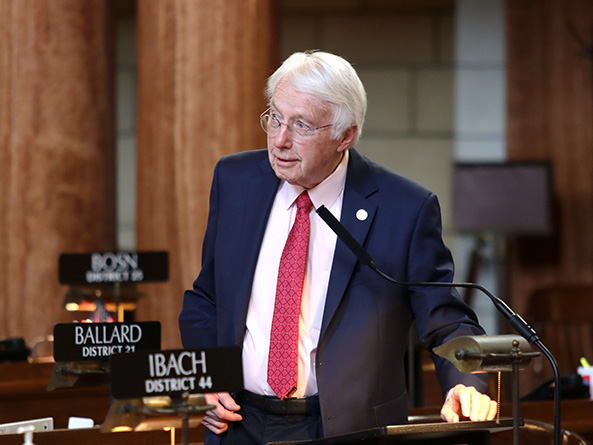
Licensure advanced for internationally trained physicians
Lawmakers gave first-round approval March 24 to a bill that seeks to create an alternative licensure pathway for internationally trained physicians to practice medicine in Nebraska.
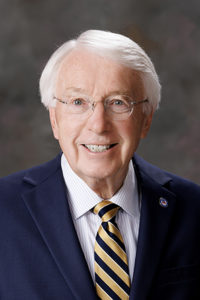
LB1212, as introduced by Ralston Sen. Merv Riepe, would allow the state Department of Health and Human Services, with the approval of the Board of Medicine and Surgery, to issue a maximum three-year provisional license to an internationally trained physician who enters into an agreement for full-time employment with a participating Nebraska health care entity.
The agreement would require a participating health care entity to conduct an initial formative needs assessment, develop an individualized learning and supervision plan and evaluate the physician’s familiarity with the standards appropriate for medical practice.
Riepe said more than 20 states, including Colorado, Iowa, Massachusetts and Texas, have adopted similar licensure pathways for internationally trained physicians who demonstrate the necessary training and skills required for full licensure.
Many internationally trained physicians serve as primary care providers in rural and underserved communities across the country, he said, but those same physicians currently would be required to start over and complete a medical residency program to provide care in Nebraska, regardless of their experience practicing safely and independently abroad.
“LB1212 [recognizes] emerging best practices while tailoring details — like time-limited licenses, explicit reporting and Nebraska-specific shortage designations — to our [existing] regulatory framework,” Riepe said.
After successfully practicing under a provisional license, an internationally trained physician could apply for a transitional license for another three years. A holder of a transitional license could practice only in a designated health profession shortage area.
An internationally trained physician could apply for an unrestricted license to practice medicine in Nebraska after practicing for at least six years under provisional and transitional licensure and with satisfactory assessment and evaluation.
The bill would take effect Aug. 1, 2027.
A Health and Human Services Committee amendment, adopted 35-0, would replace the bill with a modified version to specify that an individual must meet the following criteria to be considered an internationally trained physician:
• have a medical degree or its equivalent from a legally chartered medical school outside the U.S.;
• be a U.S. citizen or legally authorized to work by the U.S. federal government;
• have completed a graduate medical education training program that is substantially similar to a U.S. graduate medical education or residency program;
• be licensed or otherwise authorized to practice medicine in another country;
• have practiced medicine for at least three of the last five years; and
• be in good standing with no pending discipline related to any previous medical licensing or regulatory institution during the most recent three years of practice.
Sen. John Fredrickson of Omaha supported the bill and the committee amendment. He said the proposal would create not only a licensure pathway for individuals who grew up and attended medical school outside the U.S., but also those born in the U.S. who chose to pursue their education abroad.
“This is a really important piece of legislation that will open the door for folks who are wanting to practice medicine, specifically … in areas of our state where we need more and more physicians to have a pathway,” Fredrickson said.
Senators voted 38-0 to advance LB1212 to select file.

