
Judiciary omnibus given first-round approval
A bill aimed at deterring frivolous or harassing litigation against Nebraska political subdivisions received first-round approval March 25 after being amended to become an omnibus judiciary measure.

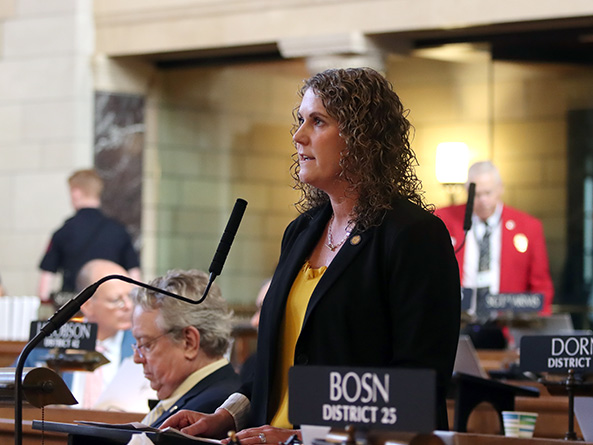
LB935, introduced by Lincoln Sen. Carolyn Bosn, would allow a political subdivision to recover attorney fees and court costs if it must defend against a claim that a court finds to be frivolous or primarily intended to harass the subdivision or its public officials.
Bosn said frivolous lawsuits create significant costs for government entities, especially political subdivisions, which ultimately fall on taxpayers. Such claims can drain public resources and place an unfair burden on communities, she said, making safeguards necessary to discourage misuse of civil litigation while preserving the right to bring legitimate cases.
“LB935 does not diminish anyone’s right to bring a meritorious claim,” Bosn said. “This bill is about protecting the integrity and fairness of civil litigation and limiting abusive or distorted claims practices.”
A Judiciary Committee amendment would incorporate provisions of seven additional bills heard by the committee this session.
Omaha Sen. Terrell McKinney offered a successful motion to divide the question and consider each bill contained within the committee amendment separately.
The first component, adopted 46-0, includes provisions of LB978, introduced by Sen. Tanya Storer of Whitman. The measure would allow individuals depicted in or exposed to obscene material, child sexual abuse material or content promoting child sexual exploitation to sue entities that intentionally distribute such content on publicly available websites.
It also would prohibit the sale or distribution of child sexual exploitation devices, defined as anatomically correct mannequins, robots, dolls or similar items designed to resemble a minor and intended for sexual use.
Internet service providers would be held liable only if they actively create, develop or intentionally distribute illegal content, and not solely for providing access. The state attorney general could bring civil actions for violations and impose civil penalties of up to $10,000 per violation.
Storer said the measure is intended to protect children and sexual assault victims by giving survivors recourse and encouraging websites to remove abusive material.
“This bill creates a clearer path to justice,” Storer said. “It gives survivors a voice, it creates real incentives for websites to remove illegal content and it ensures that those who facilitate abuse cannot simply look the other way.”
Lawmakers voted 44-1 to adopt the second component of the divided amendment, which contained the underlying bill, Bosn’s LB935.
A third division, adopted 31-0, incorporated the provisions of Syracuse Sen. Bob Hallstrom’s LB876, which would establish a statewide 72-hour “no-contact period” to automatically take effect when a person is arrested for certain domestic or sexual assault offenses.
During that period, the accused would be required to avoid all contact with the alleged victim. Law enforcement would be required to notify both parties, and victims could waive the restriction in writing. Violations would be punishable as a Class I misdemeanor for a first offense and a Class IV felony for subsequent offenses.
Hallstrom said victims are most vulnerable immediately following an incident and that the measure would provide protection during a critical period before a court can issue a formal order.
The fourth component of the divided committee amendment, also adopted 31-0, includes provisions of Hallstrom’s LB1139. Under current law, child and spousal support debts act as ongoing liens on a person’s property until formally removed. LB1139 instead would apply liens only when a payment is missed and remove them automatically once payment is made.
Containing provisions of Bosn’s LB789, the fifth division would prevent defendants from benefiting if they intentionally make a witness unavailable, allowing a witness’s prior statements to be admitted in court. Senators adopted the amendment 29-0.
Lawmakers also approved a division of the committee amendment containing LB1020, introduced by Sen. Eliot Bostar of Lincoln, on a 31-0 vote. The proposal would make it a Class IIIA felony to use a mobile tracking device — such as a GPS tracker or Bluetooth tag — to monitor a person or their property without consent, including failing to remove the device after consent is revoked.
The measure includes exceptions for law enforcement with proper authorization, parents or guardians monitoring minor children, caregivers tracking vulnerable adults and businesses using the technology for legitimate purposes, such as logistics.
LB1020 also would create a criminal offense for “swatting,” or making a false report of an emergency to trigger an immediate law enforcement response. Penalties would vary based on the outcome, ranging from misdemeanors to a Class II felony — punishable by up to 50 years imprisonment — if serious injury occurs.
If a swatting incident results in death, it would be a Class IB felony, punishable by up to life imprisonment. Courts also could order restitution to victims and responding agencies.
Finally, the proposal would regulate drone use by defining restricted airspace and prohibiting operation in such areas without Federal Aviation Administration approval and prior notification of state and local authorities. Violations could result in a Class III misdemeanor, punishable by up to three months imprisonment, a $500 fine or both.
Bostar said the measure is intended to modernize Nebraska’s criminal code to address emerging threats related to evolving technology, including digital surveillance and false emergency reports.
“Nebraskans deserve laws that recognize those threats and respond to them clearly, proportionally and effectively,” Bostar said.
The seventh portion of the committee amendment, from Sumner Sen. Teresa Ibach’s LB1199, would expand eligibility for the Legal Education for Public Service and Rural Practice Loan Repayment Assistance Act by increasing the population threshold from 15,000 to 75,000 residents and providing additional funding.
The proposal is intended to address the growing shortage of attorneys in rural Nebraska by allowing more communities to qualify for assistance, Ibach said, adding that expanding eligibility and funding would help attract and retain lawyers in underserved areas and ensure residents have access to legal services.
Sen. Dan Quick of Grand Island offered an amendment to Ibach’s proposal, adopted 39-0, to extend eligibility to larger communities with attorney shortages, such as in Hall County, which otherwise would be excluded because they include a U.S. Census metropolitan statistical area. Senators then approved that division of the committee amendment on a 39-0 vote.
The final division includes provisions of LB1228, introduced by Bellevue Sen. Rick Holdcroft at the request of Gov. Jim Pillen. The proposal would establish a new docket fee assessed as court costs in civil cases and traffic misdemeanors or infractions filed in district and county courts and create a $10 case-management system software fee.
Holdcroft said the measure is needed to help modernize the state’s outdated JUSTICE case management system, describing it as “clunky,” difficult to use and long overdue for an upgrade.
Sen. Wendy DeBoer of Bennington opposed the proposal, arguing that court fees should not be used to fund a basic function of government. She said that while some view court costs as a user fee, the court system serves everyone — not just those directly involved in cases — because it underpins things like contracts, property rights and business transactions.
While the JUSTICE system needs significant updates, DeBoer said, relying on fees to pay for it is the wrong approach because access to the courts should not depend on a person’s ability to pay.
Omaha Sen. Machaela Cavanaugh also opposed the provisions, saying reliance on court fees instead of state general funds shifts costs onto individuals and creates an unstable funding model, placing an unfair burden on people who already may be struggling financially.
“It’s not sustainable or predictable, and a lot of times these people don’t have the resources to pay these fees,” Cavanaugh said.
Senators adopted the amendment 30-10.
DeBoer then offered an amendment, adopted 42-0, to adjust the proposed docket fees for civil cases filed in county court. Rather than eliminating the fee structure entirely, she said, the amendment would modify how those fees are applied to ease the financial burden on court users while preserving a funding source for needed technology updates.
Following adoption of DeBoer’s amendment, senators voted 35-4 to advance LB935 to select file.

