
Workforce omnibus bill amended, advanced to final round
Lawmakers amended an omnibus workforce measure March 24 to tighten apprenticeship requirements before advancing the bill to the final round of debate.

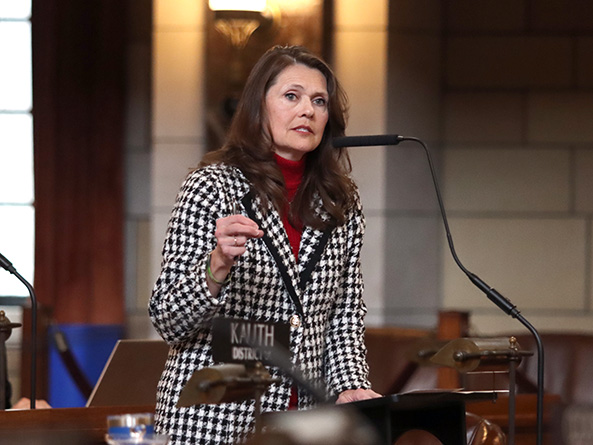
LB847, sponsored by Omaha Sen. Kathleen Kauth, would create the Nebraska Office of Registered Apprenticeship within the state Department of Labor to serve as the state apprenticeship registry.
The bill also would create the Nebraska Apprenticeship Council to advise the office and provide community outreach and education regarding the benefits of apprenticeship.
Kauth brought an amendment on select file that would retain those provisions but modify other aspects of the original proposal. She said the clarifying changes were the result of a collaboration between the state and federal labor departments and her staff regarding concerns raised on the previous round of debate by Omaha Sen. John Cavanaugh.
Cavanaugh supported the amendment, which he said would ensure that Nebraska’s registered apprenticeship program requirements meet the same “gold standard” as federally registered programs. The new provisions also would ensure reciprocity with apprenticeship programs in other states, he said, and address recertification concerns for existing programs.
“A lot of what we did was make sure that the language in Nebraska is as rigorous as the national regulations [while] empowering the state Department of Labor to certify new programs that meet those requirements,” Cavanaugh said.
As amended on general file, LB847 also would increase from 20% to 50% the amount of the unemployment combined tax rate that can be transferred to the Workforce Development Program Cash Fund to invest in workforce development initiatives.
During select file debate, Seward Sen. Jana Hughes offered a floor amendment as a placeholder to an amended that was being drafted to add provisions of her LB1089 related to the Nebraska Healthy Families and Workplaces Act.
When voters approved the act by initiative petition in 2024, it included a four-year window during which an employee denied paid sick leave could bring a civil action seeking restitution. When lawmakers amended the act last year that provision was removed.
Hughes’ amendment would change the act to allow employees one year to bring a civil action. Currently, she said, a bad actor could pay less in fines for an initial violation of the act than it would cost them to provide a week of paid sick leave to a minimum wage worker.
The amendment also would include provisions of Elkhorn Sen. Tony Sorrentino’s LB1249, which would exempt from the Nebraska Healthy Families and Workplaces Act individuals with a 10% or more ownership interest in a company, nonresidents who work in Nebraska for less than 90 days a year and private and parochial elementary, secondary and postsecondary schools.
Sen. Danielle Conrad of Lincoln opposed the amendment, calling the one-year lookback a “crumb” compared to the ballot initiative’s original provisions. Conrad said she would be willing to work with Hughes on restoring the right for employees to bring a civil action, but that she would not support any attempt to exempt more entities from the state’s paid sick leave requirements.
Hughes withdrew the amendment.
As amended on general file, LB847 includes provisions of five other measures considered by the committee this session, including:
• LB747, sponsored by Sorrentino, which would establish uniform enforcement authority across multiple programs managed by DOL, including changing youth employment certification procedures, removing an infraction for failure to provide a wage statement and expanding the department’s subpoena powers;
• LB864, introduced by Sen. Jason Prokop of Lincoln, which would transfer responsibility for awarding and disbursing grants under the InternNE program from the state Department of Economic Development to DOL;
• LB1015, sponsored by Sumner Sen. Teresa Ibach, which would create the Business Innovation Cash Fund within DOL and establish a mechanism to provide funding for the Business Innovation Act from a percentage of State Unemployment Insurance Trust Fund dollars, as designated by the commissioner of labor;
• LB1044, introduced Prokop, which would appropriate $15 million in fiscal year 2026-27 from the Business Innovation Cash Fund for grants under the Business Innovation Act and require that at least $4 million in grants be awarded annually; and
• LB1173, sponsored by Kauth, which would change the name, filing fee and permitted uses of the Contractor and Professional Employer Organization Registration Cash Fund and allow DOL to assess fees for all employers under the Employment Security Act annually on a graduated scale based on gross wages paid out in the previous year, not to exceed a total of $15 million.
After Hughes withdrew her amendment, lawmakers advanced LB847 to final reading by voice vote.

