
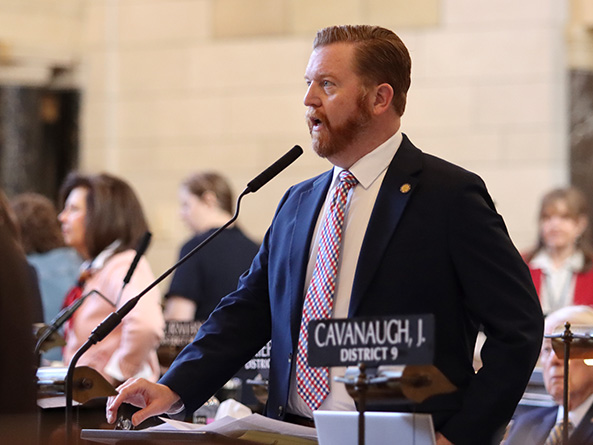
Legal protections advanced for medical cannabis recommendations
Lawmakers amended and advanced a bill March 20 that would provide legal protections to health care practitioners who recommend medical cannabis to qualified patients.

Currently, the Nebraska Medical Cannabis Patient Protection Act prevents qualified individuals from facing legal penalties for possessing and using medical cannabis when recommended by a health care provider. LB933, sponsored by Omaha Sen. John Cavanaugh, would provide the same type of protection to practitioners who provide medical cannabis recommendations.
Under the measure, health care providers would be protected from arrest, prosecution, penalty or denial of any right or privilege — including civil penalties or professional disciplinary action by the state Department of Health and Human Services or a licensing board — solely for recommending medical cannabis or stating a professional opinion that a qualified patient would benefit from medical cannabis to treat or alleviate a condition.
Cavanaugh said despite medical cannabis being legal in Nebraska for nearly two years, health care providers have not felt comfortable recommending it to qualified patients out of fear of penalty or disciplinary action.
He said 16 of the 17 states with medical-only cannabis programs offer protections to providers who recommend medical cannabis, and that LB933 would provide a lower level of protection than any of those states.
A Health and Human Services Committee amendment would clarify that a health care practitioner who fails to properly evaluate a patient’s medical condition or otherwise violates the standard of care would not be protected from civil penalties or disciplinary action.
Gering Sen. Brian Hardin, committee chairperson, said the amendment would protect providers from penalties for the sole act of recommending medical cannabis while still requiring that they conduct a thorough and appropriate patient evaluation prior to the recommendation.
Cavanaugh offered an amendment to the committee amendment, adopted 35-4, that would remove protections against civil penalty or disciplinary action for physicians who engage in malpractice or professionally negligent behavior as currently defined in state law.
He said doing so would ensure that medical cannabis recommendations are held to the same clearly defined standard as that used in other areas of medicine to determine if a practitioner has followed the standard of care.
Blair Sen. Ben Hansen supported the bill and both amendments. Physicians are trusted to use their professional judgement, he said, and are held accountable through professional standards and malpractice laws — rather than strict oversight measures — to prescribe countless other medications, including weight-loss and cholesterol drugs, opioids and medications with high-risk warnings for hospitalization and death.
Hansen said medical providers who fail to meet professional standards when recommending medical cannabis would face the same consequences as with any other medication, such as loss of licensure.
Sen. Danielle Conrad of Lincoln also supported the proposal, noting Nebraska providers would have data and research from 40 other states with medical cannabis programs to guide their standard of care.
“This isn’t a revolutionary concept, we have an opportunity to learn a lot from our sister states,” Conrad said. “[LB933] is a very … narrow [proposal] … to facilitate the will of the people and ensure there is clarity and protection for medical providers.”
Whitman Sen. Tanya Storer opposed the bill and both amendments. Providing physicians with “blanket immunity” for a medical cannabis recommendation would threaten patient safety and undermine accountability, she said, by allowing providers to initiate access to medical cannabis without responsibility for patient outcomes.
“This is not a question of whether we support or oppose medical marijuana, it is about whether we are willing to compromise the principles of accountability, patient safety and professional responsibility,” Storer said.
Also speaking in opposition, North Platte Sen. Mike Jacobson claimed LB933 would provide unique protections to physicians that do not exist in other areas of health care. He noted medical cannabis recommendations do not include the same dosage, usage, oversight and regulatory provisions required for traditional prescriptions.
Sen. Jared Storm of David City offered an amendment that would specify the standard of care a practitioner must meet to recommend the use of medical cannabis.
Under his amendment, a health care practitioner could recommend medical cannabis only if their professional judgment and a preponderance of current scientific evidence indicate that the potential benefits outweigh the potential harms for alleviation of a patient’s medical condition.
Storm said the amendment would protect patients and prevent the “overprescription” of medical cannabis, which he said was a contributing factor in the opioid epidemic.
“[The amendment] is a very simple, straightforward and commonsense addition to LB933 to protect patients,” Storm said.
While opposed to the underlying bill, Lincoln Sen. Beau Ballard supported the Storm amendment, which he said would provide important guidance for the standard of care for medical cannabis and ensure patients and caregivers understand the potential risks and benefits before receiving a recommendation.
Sen. John Fredrickson of Omaha opposed the Storm amendment and expressed concern that the proposal would set a dangerous precedent of legislating medical providers’ prescriptive authority.
The Storm amendment was rejected 22-19. Twenty-five votes were needed.
Following the 38-4 adoption of the committee amendment, senators advanced LB933 to select file on a 30-7 vote.

