
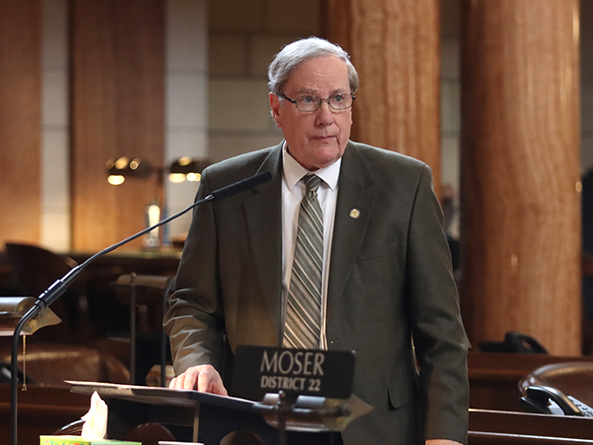
Transportation omnibus measure amended, advanced
Lawmakers gave first-round approval March 17 to a bill that would allow Nebraska cities and counties to apply for state loans to build transportation infrastructure projects.

LB1126, sponsored by Columbus Sen. Mike Moser, would create an infrastructure development investment program administered by the State Highway Commission with assistance from the state Department of Transportation.
The program could provide loans or other financial assistance to political subdivisions and certain other entities to construct, improve or enhance roads, bridges and other eligible transportation infrastructure.
Moser said the revolving loan program is intended to give cities and counties access to state and federal funding for local projects.
LB1126 would authorize the investment program to issue bonds that would be payable solely from revenue and assets of the investment program and that would not be general obligations of the state.
The commission would prioritize applications for assistance based on criteria including economic impact, safety and local support of the project.
An independent accounting firm would audit the program annually, and the program would submit an annual report to the Legislature.
Among other changes, LB1126 also would:
• authorize a public-private partnership delivery method for transportation projects deemed appropriate at the discretion of the department director;
• increase maximum fees for certain permits for oversized or overweight vehicles and create a superload vehicle category with associated maximum permit fees;
• allow the department to exempt certain routine repair and maintenance contracts from prequalification requirements;
• increase the damage threshold at which certain traffic accidents must be reported to the department from $1,500 to $2,000; and
• require bicyclists to follow traffic control signal requirements.
A Transportation and Telecommunications Committee amendment, adopted 35-0, replaced the bill with a modified version of the original proposal and provisions of three other measures considered by the committee this session.
As introduced, LB1126 would require the department to adopt procedures for receiving and evaluating unsolicited proposals. Under the amendment, the department would have to include the procedures in currently required guidelines for entering into certain alternative contracting methods.
The amendment also would allow political subdivisions to enter into public-private partnership contracts and receive unsolicited proposals under the Political Subdivisions Construction Alternatives Act.
The amended provisions of LB1073, introduced by Sen. Carolyn Bosn of Lincoln, would require commercial motor vehicle driver training to include at least 30 minutes of human trafficking training beginning in 2027.
The measure would require the state attorney general to prescribe the curriculum and training materials and to review and update them at least once every three years.
The provisions of LB1107, sponsored by Pender Sen. Glen Meyer, would update the Rural Road Improvement District Act. The proposal would require county resolutions on proposed road improvement projects to state whether the improvements will be a general cost to the county or paid for by levying special assessments.
Under Meyer’s proposal, a resolution could not be adopted by the board during the same meeting at which it is proposed.
The measure also would extend the maximum term of county road improvement bonds from 10 to 20 years.
Meyer offered an amendment, adopted 36-0, under which unpaid special assessments would become delinquent over a period of no more than 20 years rather than 10.
Sen. Wendy DeBoer of Bennington said the amended provisions of her LB1180 would reduce administrative burden by effectively reversing the current licensure process for carriers seeking to provide intrastate Medicaid nonemergency medical transportation services.
She said her proposal would allow the Nebraska Public Service Commission to issue licenses to those companies after they have been licensed and approved through a separate, more thorough process overseen by the state Department of Health and Human Services.
After adopting a technical amendment offered by DeBoer, senators voted 36-0 to advance LB1126 to select file.

