
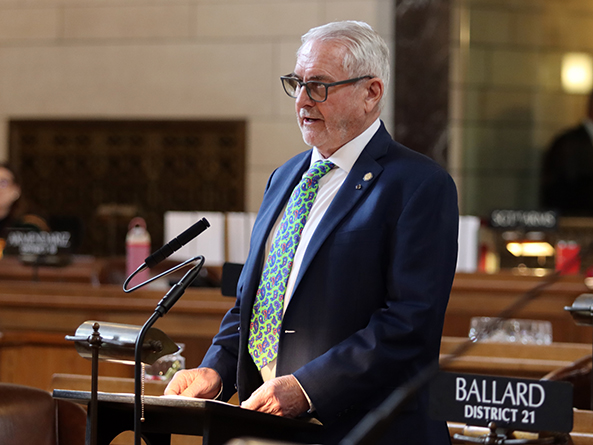
Omnibus education package clears first round
A measure containing several technical changes to education statutes received first-round approval March 17 after lawmakers amended it to include provisions from five other bills.
LB937, sponsored by the Education Committee, was introduced to simplify state law and remove outdated language to better align with current educational practices, said committee chairperson Glenvil Sen. Dave Murman.
Among other changes, he said, the bill would fix an issue in the Teacher Recruitment and Retention Act by ensuring teachers pursuing dual-credit coursework qualify for grants after a gap in the law left them ineligible.
The bill also would require option enrollment reports to include approved applications, remove obsolete language related to solar and wind energy funding, align College Pathway Program Act language with procurement processes and set Oct. 15 as the deadline for property tax authority requests and annual census reports.
As introduced, LB937 also would have revised dyslexia reporting requirements by limiting reporting to students in kindergarten through third grade. An Education Committee amendment, adopted 31-0, removed those provisions and added amended provisions from five additional bills.
Among those is LB1224, sponsored by Omaha Sen. Megan Hunt, which would prohibit a person subject to a substantiated child abuse or neglect report from transferring or disenrolling a student during an investigation.
The state Department of Health and Human Services would notify the student’s school and the education commissioner that such a transfer is invalid, with the restriction lifted once a juvenile court petition is filed or 14 days after notice to the subject of the report.
The measure also would bar individuals convicted of certain felonies from monitoring or instructing students at schools that do not meet state accreditation or approval requirements.
Hunt said the temporary restriction is intended to prevent individuals from isolating a child who may be experiencing abuse or neglect by removing them from the view of school staff and social workers, who often are in a position to intervene.
The committee amendment also includes provisions of LB1146, introduced by Sen. Danielle Conrad of Lincoln. Under current law, schools may refer a student for truancy to a county attorney after a student accumulates 20 or more unexcused absences in a school year.
Conrad said her proposal would retain that system while clarifying excused versus unexcused absences and protecting students from being marked truant for medical or mental health needs, pregnancy or parenting responsibilities, disabilities or homelessness if absences are excused by a parent or guardian and supported by medical or professional documentation.
Finally, the committee amendment also includes amended provisions of:
● LB1164, sponsored by Hastings Sen. Dan Lonowski, which would establish statewide guidelines for awarding college credit for prior learning exams and require the Coordinating Commission for Postsecondary Education to approve and publish a list of recognized exams and minimum passing scores by Sept. 1, 2026;
● LB1241, introduced by Murman, which would prohibit schools from hiring individuals for positions involving regular contact with students unless applicants disclose seven years of prior employment involving children, authorize the release of related records and report any past child abuse or sexual misconduct investigations, separations or license actions; and
● LB1243, also introduced by Murman, which would prohibit school boards from requiring students to enroll in more than the minimum district credit hours set by a national or state organization to participate in certain extracurricular activities, and extend that restriction to activities not governed by an athletics or activities association.
After adopting the committee amendment, senators voted 31-0 to advance LB937 to select file.

