
Proposal would ban street camping, direct unhoused to shelters
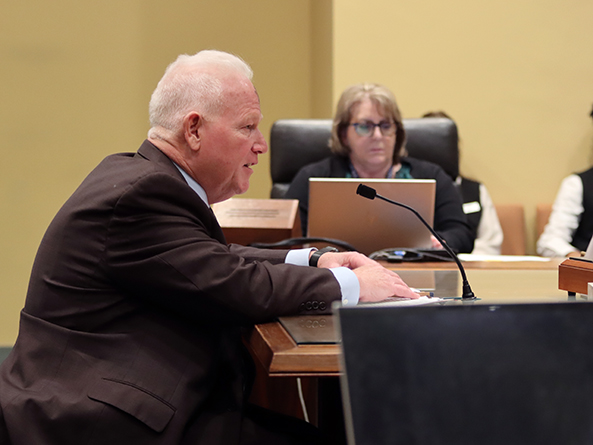
The Judiciary Committee considered a proposal Feb. 18 that would ban unauthorized camping on public property across Nebraska.

LB925, introduced by Sen. Bob Andersen of Omaha, would adopt the Safe Parks and Public Spaces Act and make unauthorized camping on public property and public rights-of-way a Class V misdemeanor unless the area is officially designated for such use. Law enforcement would be required to direct first-time offenders to the nearest appropriate shelter instead of prosecution.
The proposal also would bar cities and counties from allowing regular camping in public spaces or discouraging enforcement of the law. Residents, business owners and the Nebraska attorney general could sue local governments that fail to comply with the law after notice.
Under the bill, the state treasurer could withhold certain funds from jurisdictions that remain out of compliance for six months or more.
Andersen said the measure is not intended to criminalize homelessness, but to provide safer conditions for everyone.
“Those living on the streets are 10 times more likely to experience drug overdoses and nine times more likely to experience sexual assault than the general public,” Andersen said. “Unauthorized street camping is unacceptably dangerous for both the homeless and the local residents.”
Douglas County Sheriff Aaron Hanson testified in support of the measure, saying homelessness involves financial hardship, unstable housing, mental health challenges and addiction, problems local government alone cannot solve.
Under LB925, individuals experiencing homelessness would be directed to shelters, Hanson said, providing greater access to care while helping maintain community safety.
Chris Sharp also supported the proposal on behalf of Cicero Action, a nonprofit advocacy organization.
Sharp said that from 2013 to 2024, the most visible segment of Nebraska’s homeless population — those struggling with mental illness and addiction — grew from 40% to 85%. Closures of psychiatric beds and limited access to treatment programs have exacerbated the problem, he said, leaving many vulnerable people without options, which LB925 would help address.
“The reality is that the unsheltered homeless represent the most in need and the most abandoned by continuums of care,” Sharp said.
Tamara Dwyer, homeless services coordinator for the City of Omaha, testified in opposition to the measure, saying it would undermine local, data-driven efforts to address homelessness.
She said Omaha has implemented a coordinated encampment-response pilot program focused on outreach, housing navigation and connecting people to mental health and substance use treatment. Increased enforcement would be costly, she said, and would displace people without solving the underlying issues that lead to homelessness.
“Policies should address root causes like the lack of services — including health care services, mental health care services, job assistance — among many other things, instead of merely moving people or destroying encampments,” Dwyer said.
Chris Knauf also opposed LB925 on behalf of the Stephen Center, an Omaha nonprofit that provides emergency shelter, addiction treatment and transitional housing for individuals and families experiencing homelessness, poverty and addiction.
Knauf said emergency shelters are the primary entry point for stabilizing people experiencing homelessness and connecting them to case management and other supports.
Providers already are near capacity and have turned away thousands due to limited space, he said, warning that enforcing camping bans without expanding shelter availability would strain resources, increase instability and ultimately be more costly.
“Shelter is the entry point, it’s not the end goal,” Knauf said. “It is the most cost-effective path to housing available and it costs taxpayers a fraction of what even one day in jail costs.”
Michael Fletcher, a street outreach specialist, testified in opposition to LB925, saying he was born into homelessness and spent years living in unsafe conditions on the streets and in shelters. His survival would have been criminalized if the proposal had been law when he was homeless, he said.
“Punishing people for being without a home will not end homelessness,” Fletcher said. “It will only deepen trauma, increase instability and push people further away from the very supports that they need.”
The committee took no immediate action on the bill.

