
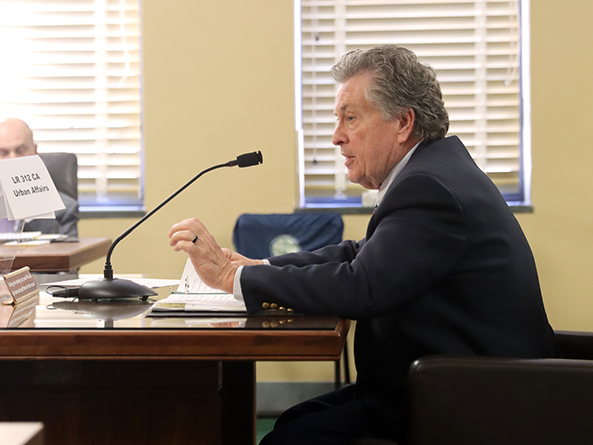
Constitutional amendment to expand TIF use considered
Nebraska municipalities would have greater flexibility to use tax-increment financing under a proposed constitutional amendment heard Feb. 17 by the Urban Affairs Committee.

Municipalities currently may use TIF to fund the redevelopment of areas designated as substandard and blighted. For a period of up to 15 years — or up to 20 years in extremely blighted areas — the property tax revenue from the redevelopment area is divided.
School districts and other taxing entities continue to receive property taxes based on a property’s original value. The “increment,” or new tax revenue generated by the property’s increased value after development, is dedicated to repaying bonds or loans used to cover certain costs, including land acquisition, site preparation and public infrastructure like streets and utilities.
Under LR312CA, sponsored by Kearney Sen. Stan Clouse, municipalities could use TIF specifically for residential development projects and related public improvements. Taxes could be divided for up to 30 years for residential development purposes and up to 20 years for redevelopment.
Clouse said the proposal also would eliminate the constitutional requirement that an area be designated as blighted and substandard before TIF could be used.
If approved by the Legislature, the measure would be placed on the November 2026 general election ballot.
Clouse said the changes would make TIF more suitable for residential development, helping to address Nebraska’s shortage of more than 120,000 housing units.
He said residential housing projects typically generate tax increments more slowly than commercial or industrial projects, making the current 15-year TIF limit insufficient to cover infrastructure costs. Extending the limit to 30 years would allow for better financing terms and lower annual repayment costs for developers, Clouse said.
“This translates into lower overall project costs and, ultimately, more attainable home prices,” he said.
Trevor Lee testified in support of LR312CA on behalf of the Development Council for Buffalo County and the Nebraska Economic Developers Association. He said eliminating the blighted and substandard requirement might be even more important than extending the allowable TIF term.
“Removing that language and that requirement eliminates the legal fiction of labeling healthy neighborhoods or growth corridors as blighted just to unlock much-needed housing development tools,” Lee said.
No one testified in opposition to the measure and the committee took no immediate action on it.

