
Early intervention system considered for at-risk students
A measure aimed at helping Nebraska schools identify and support students showing early signs of trauma, disengagement or other risk factors was considered by the Education Committee Feb. 10.

LB855, introduced by Omaha Sen. Terrell McKinney, would establish the Youth Early Intervention and Support Act and create a statewide framework for schools to identify and assist students experiencing chronic absenteeism, academic decline or other warning signs.
Under the bill, the state Department of Education, in consultation with the state Department of Health and Human Services, would develop an early support system for public school districts to identify students who exhibit two or more indicators, including:
- chronic or sudden changes in attendance;
- declining academic performance or incomplete work;
- persistent or unusual behavioral challenges;
- lack of classroom engagement;
- observable hygiene concerns, such as body odor or unwashed clothing; and
- documented or disclosed exposure to adverse childhood experiences.
School districts would establish youth support teams made up of counselors, teachers, community health workers, public health liaisons and family advocates to review data, assess needs, engage families, coordinate services and monitor interventions.
Additionally, LB855 would provide student privacy protections, require compliance with federal privacy laws and prohibit referrals to law enforcement or child welfare agencies based solely on early warning indicators unless there is imminent risk.
McKinney said signs of distress such as chronic absenteeism, falling grades and behavioral changes frequently go unaddressed, and LB855 would encourage earlier support that could help keep some youth out of state systems.
“Too often our response doesn’t come until those warning signs escalate into juvenile justice involvement or child welfare intervention,” McKinney said. “By that point, the harm is deep, the response is more expensive and the outcomes are worse.”
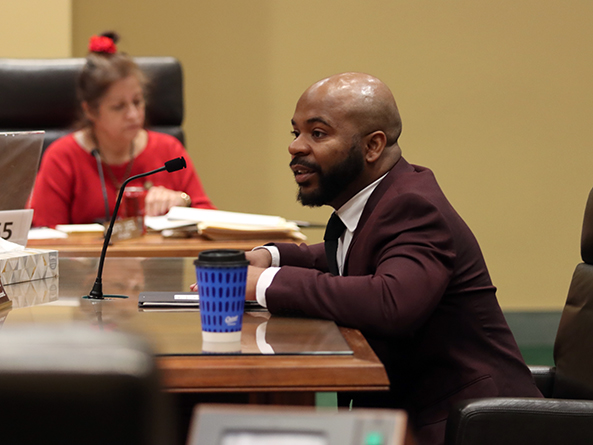
Chloe Fowler testified in support of the measure on behalf of the Nebraska Children’s Commission, saying the bill would fill a critical gap in early intervention, since schools frequently are the first place that issues appear. Too often, she said, problems go unaddressed until families are in crisis, resulting in punitive measures rather than support.
“Children should not be punished for struggling,” Fowler said. “They ought to be supported by the systems provided by the government and from those in their community.”
Connor Herbert, representing the Nebraska Commission on African American Affairs, also testified in support of the bill. Black youth make up about 8% of Nebraska’s youth population, he said, but account for 28% of arrests and 24% of juvenile court filings, highlighting their disproportionate involvement in the justice system.
Earlier identification and support could help reduce that disparity and prevent unnecessary system contact, Herbert said.
“By investing earlier and responding to root causes, Nebraska can reduce later involvement in costly systems, support families more effectively and improve long-term educational and life outcomes,” he said.
No one testified in opposition to LB855 and the committee took no immediate action on it.

