
State budget adjustments offered
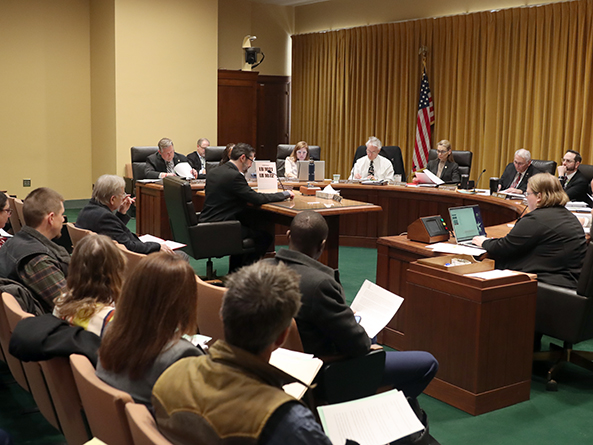
Mid-biennium adjustments to the state’s budget were considered by the Appropriations Committee Feb. 2. The state budget is structured on a two-year basis, with the budget passed in odd-numbered years and adjustments made during legislative sessions held in even-numbered years.
Two bills, introduced by Speaker John Arch of La Vista at the request of Gov. Jim Pillen, comprise the governor’s mid-biennium budget recommendations. The committee heard joint testimony on the proposals.

LB1071 would provide, change and eliminate provisions related to appropriations for the expenses of state government for the biennium ending June 30, 2027. LB1072 would provide for and change transfers from the Cash Reserve Fund and provide, change and eliminate provisions relating to fees, funds, fund transfers, agency powers and duties and various statutory programs.
The bills were presented to the committee by State Budget Administrator Neil Sullivan, who said Nebraka’s projected budget shortfall is a “spending issue.” The governor’s proposal would balance the state’s budget through reduced spending, he said, while also providing for additional investments in education, property tax relief, medical care and business growth opportunities.
“Many Nebraskans read headlines about a $471 million budget gap and worry about the state’s fiscal solvency,” Sullivan said. “I’d like to begin by clarifying that the state of Nebraska is in excellent fiscal shape.”
The state’s revenue growth trend is positive in spite of recent “historic” income tax rate reductions, he said, and Nebraska’s credit rating is higher than ever.
After reviewing 900 funds across 79 state agencies, Sullivan said, the governor’s proposal would transfer or reduce almost $358 million from 94 of those funds that have what he termed “excess balances.”
No one else spoke in support of the governor’s proposal.
Craig Beck of OpenSky Policy Institute pushed back on the suggestion that the budget shortfall is the result of general fund spending growth. He said the issue is not spending but rather transfers out of state revenues, particularly for property tax relief.
The percentage of revenues allotted to property tax relief has increased 650% since 2019, he said, while general fund expenditures have increased only 23%.
“With projected biennial revenues of $13.75 billion and general fund appropriations of just over $11 billion, Nebraska has more than enough revenue to cover general fund spending,” Beck said.
Several testifiers opposed specific aspects of the proposal, including provisions that would sweep dollars from more than a dozen funds related to the environment.
Katie Torpy of The Nature Conservancy, testified in opposition to both bills, which she said would represent a “system-wide swipe” at programs that protect the state’s wildlife, air, parks and public lands.
Sweeping those funds would push the state’s conservation system into crisis to solve a short-term budget problem, Torpy said, particularly a proposed $40.7 million sweep from the Nebraska Environmental Trust Fund in LB1072.
“[This sweep] strikes at the heart of the Nebraska Environmental Trust — a voter-created institution that has for decades powered conservation work in all 93 counties,” she said.
Also testifying in opposition to the fund sweep from the NET was Traci Bruckner, speaking on behalf of the National Audubon Society and Audubon Great Plains.
The NET is funded through a percentage of lottery revenue that Nebraska voters chose to have directed to it, she said, and those dollars are meant to provide grant funds to conservation projects across the state, not to replace general funds for recreational water projects prioritized by the governor.
“Recreational purposes [are] not in line with the Nebraska Environmental Trust,” Bruckner said, adding that over $18.4 million in funding from the NET to 53 separate projects has been put on hold at the suggestion that the governor intends to sweep money from the fund.
LB1072 also would transfer $2.5 million in each of the next two fiscal years from the Veterans’ Aid Fund to the state Department of Veterans’ Affairs Cash Fund.
Jeffrey Baker of the Veterans of Foreign Wars opposed that provision, while testifying in a neutral capacity on the rest of the bill. The Veterans’ Aid Fund was established after World War I to provide bonuses to veterans of that war, he said, and it should remain intact for the benefit of individual veterans.
“A one-time sweep won’t solve our budget challenge, but it will hurt our ability to help veterans,” Baker said.
The governor’s proposal also would reduce funding to the state’s Compulsive Gamblers Assistance fund by $650,000 in each of the next two fiscal years and move services currently provided by the Nebraska Commission on Problem Gambling to the behavioral health division of the state Department of Health and Human Services.
Mike Sciandra, executive director of the Nebraska Council on Problem Gambling, testified against those provisions. He said problem gambling is a public health crisis that is growing more severe as gaming becomes more normalized and widespread.
“At a time when gambling has significantly increased within Nebraska, surrounding states and in the entire country, it is highly illogical and irresponsible to tear apart a program that has given thousands of Nebraskans a new outlook on life,” Sciandra said.
Several opponents, including Christon MacTaggart of the Nebraska Coalition to End Sexual and Domestic Violence, also testified against a section of LB1071 that would prohibit the Legislature from appropriating funds in this budget cycle to any program for the purpose of diversity, equity and inclusion.
MacTaggart said the coalition receives government funding to carry out statutorily mandated work and that the DEI language in the budget proposal likely would result in all 24 coalition programs being out of compliance at the federal level.
“None of these programs could comply with both federal law and also this provision in LB1071 should it pass,” MacTaggart said.
The committee took no immediate action on either bill.

