
School funding formula overhaul considered
The Education Committee considered a measure Feb. 2 that would use existing property tax relief funds to overhaul Nebraska’s school funding formula with the aim of lowering property taxes statewide.

Under LB1038, introduced by Seward Sen. Jana Hughes, $1.2 billion currently allocated to property tax credit funds and an additional $110 million from the Education Future Fund would be redirected into the Tax Equity and Educational Opportunities Support Act. Rather than flowing through separate credit programs, the funds would go directly to school districts to provide property tax relief to homeowners and other property owners.
The measure also would lower the maximum school levy from $1.05 per $100 of valuation to 50 cents, resulting in all districts having general fund levies between 30 and 50 cents, compared with the current range of about 32 cents to $1.05.
Additionally, LB1038 would cut the local effort rate from $1 to 45 cents per $100 of valuation, making 242 of the state’s 245 districts eligible for equalization aid.
Hughes said despite Nebraska’s investment in property tax credits and other relief programs, the state still ranks among the highest in the nation for property taxes. She said this is in part because the credits do not directly lower school levies or appear on taxpayers’ bills in a way that reduces the effective tax rate households actually pay.
“None of these significant investments are designed to actually reduce property taxes — both are an apology,” Hughes said. “Property tax credits are an apology on behalf of the Legislature to our property owners for the state not adequately funding TEEOSA [and] foundation aid is an apology to our public schools for the same failure.”
Jack Moles testified in support of LB1038 on behalf of the Nebraska Rural Community Schools Association, saying bringing school levies closer together and increasing state funding for rural districts are both sound policy goals. However, some property owners could pay more than they do now with tax credits applied under the proposal, he said, and school boards may need to raise property taxes if the state fails to fully fund the formula in the future.
Also supporting the proposal was Connie Knoche on behalf of OpenSky Policy Institute. LB1038 would provide more predictable property tax relief for families by directing additional state aid through TEEOSA, she said, reducing reliance on local property taxes and ensuring more equitable support for rural and urban schools.
“Utilizing TEEOSA’s mechanisms for providing equalization aid will enable the state to target property tax relief to the areas of the state where valuations are not sufficient to meet the local needs in a manner better targeted than the state’s current efforts,” Knoche said.
Daniel Russell spoke in favor of LB1038 on behalf of Stand for Schools, saying the measure would move Nebraska toward a more transparent, state-driven school finance system.
“This approach recognizes that property tax relief and school funding stability are closely linked, and that addressing one without the other is unlikely to succeed,” Russell said.
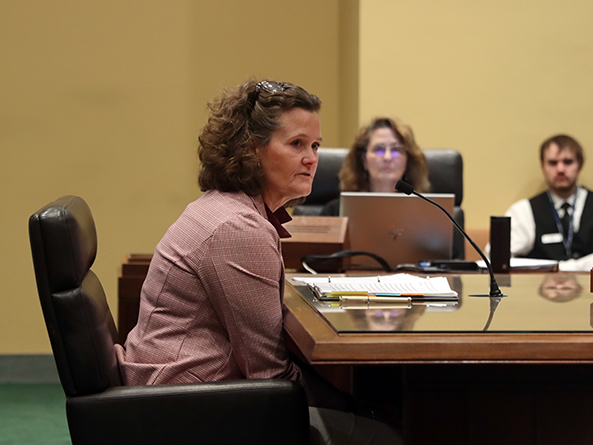
Liz Standish, associate superintendent for business affairs for Lincoln Public Schools, opposed LB1038. She said the measure would eliminate the averaging adjustment that helps districts with limited revenue capacity and could lead to property tax increases in higher-income areas.
Standish said lawmakers should preserve local taxing authority, take actual taxes levied into account rather than just valuation growth and conduct detailed modeling before making major changes to how Nebraska funds its schools.
Kyle Fairbairn, representing the Greater Nebraska Schools Association, also testified in opposition to the bill. While GNSA supports provisions in LB1038 that would standardize local school levies and allow districts flexibility to raise property taxes if the state fails to meet funding commitments, he said, changes to community reinvestment funding proposed in the measure could further reduce budgets for the state’s lowest-spending districts.
Additionally, Fairbairn said, proposed reductions of agricultural property values by 40% and residential values by 10% would be unfair.
“[GNSA members] don’t have a lot of school districts that have ag values,” he said. “So a 40% reduction in one and a 10% reduction in another, I think, is a bit much with the way property taxes have gone up on residential [property] in the past five years.”
The committee took no immediate action on the measure.

