
Municipal natural gas sales authorization clears first round
Certain Nebraska cities could contract with large-scale natural gas users to their mutual benefit under a bill advanced from general file Jan. 29.
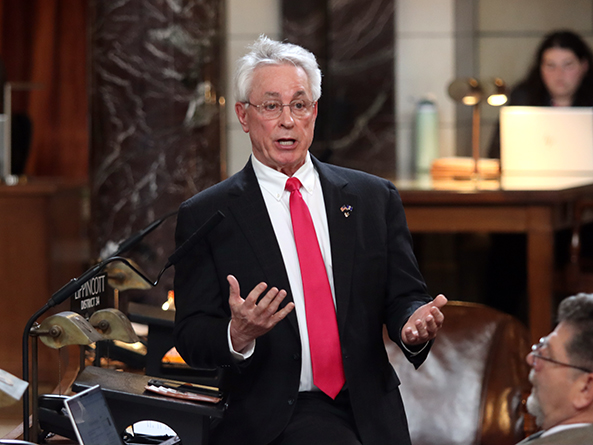
Sen. Loren Lippincott of Central City, sponsor of LB548, said the bill would allow 15 Nebraska political subdivisions that own natural gas systems to take advantage of a federal tax exemption to make discounted natural gas sales to certain large industrial users, including ethanol plants.
This would generate revenue for cities while cutting gas prices for businesses and helping Nebraska compete for new industries, he said.
Lippincott said a potential contract between Central City and a large industrial facility could generate $500,000 in annual revenue, which the city would use to make electrical infrastructure upgrades that otherwise would be funded with property taxes.
“LB548 gives cities a tool to fund city services while reducing their tax burden,” he said.
Under the bill, as introduced last session, the industrial user could not be a consumer of any investor-owned or governmentally owned gas system at the time the contract is entered into.
That provision would ensure that cities could not compete with private natural gas suppliers like Black Hills Energy, Lippincott said. Under LB548, he added, cities could contract only with large industrial consumers that already buy natural gas from interstate pipelines on the wholesale market.
A Natural Resources Committee amendment, adopted 28-1, replaced the bill with a modified version of the original proposal.
Under the amendment, the industrial consumer would have to be located in Nebraska within 200 miles of the political subdivision, and the facility would be considered within the natural gas distribution system’s service area for the term of the contract.
A contract could not “pose an unreasonable financial risk” to the political subdivision or its taxpayers as determined by the political subdivision’s governing board.
Seward Sen. Jana Hughes supported LB548. She called it a “creative way” for cities to generate extra revenue without undercutting private businesses.
“It’s very clear that we are not stealing away a customer from some … private entity,” she said.
Sen. R. Brad von Gillern of Elkhorn opposed the bill, saying he is philosophically against allowing a city to engage in private business. He also raised concerns about what could happen if a city becomes reliant on a new revenue stream only to have it dry up.
“Let’s say they’ve hired additional police officers… [and] they’ve built structures that now need to be maintained,” von Gillern said. “Are they still going to be able to do that?”
LB548 advanced to select file on a vote of 25-9.

