
Omnibus consumer protection measure amended, advanced
An omnibus banking measure was amended and advanced to the final round of debate March 18.
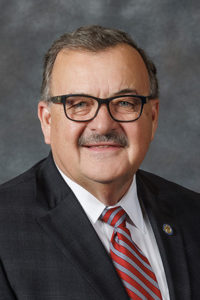
LB838, sponsored by Sen. Mike Jacobson of North Platte, would authorize an optional program for financial institutions under which a vulnerable or senior adult could designate an “authorized contact” to be notified by a financial institution in the event of an emergency, loss of contact with the customer or suspected financial exploitation.
The measure also includes amended provisions from the following bills:
• LB837, also introduced by Jacobson, which would address how merchants treat transactions involving physical currency now that the U.S. Mint has stopped producing pennies;
• LB875, sponsored by Syracuse Sen. Bob Hallstrom, which would prohibit suppliers from including clauses in contracts that waive compliance with the Equipment Business Regulation Act or mandate that legal disputes be resolved in out-of-state forums or by other state laws;
• LB1160, also introduced by Hallstrom, which would modernize Nebraska’s estate and trust laws by synchronizing the Uniform Probate Code with the Uniform Trust Code and strengthening the rights of surviving families;
• LB1063, sponsored by Sen. Eliot Bostar of Lincoln, which would modernize the Nebraska Money Transmitters Act to exclude influence from foreign adversaries and regulate informal transfer systems;
• LB1118, introduced by Lincoln Sen. Carolyn Bosn, which would update the state’s Uniform Deceptive Trade Practices Act to treat certain conduct by social media platforms that accept paid advertising as a deceptive trade practice; and
• LB1119, sponsored by Bosn, which would update the Age-Appropriate Online Design Code Act passed by lawmakers last year.

Bosn offered an amendment on select file to replace the provisions of her LB1118 with a modified proposal. She said the changes resulted from extensive conversation with Meta and would allow platforms five business days rather than the original seven calendar days to investigate reported fraudulent ads.
Additionally, she said, the requirement to remove fraudulent ads “immediately” was also changed to within five business days.
“This adjustment was requested to provide companies with reasonable flexibility, particularly when complaints are submitted over weekends and holidays,” Bosn said.
The amendment also would allow companies to share information regarding suspected fraudulent activities in ways similar to financial institutions, she said, and move the implementation date to Jan. 1, 2027, to give companies adequate time to comply.
The Bosn amendment was adopted 34-0.
Lawmakers also adopted an amendment from Lincoln Sen. Danielle Conrad to provide a severability clause, which would ensure that if any section of LB838 were declared unconstitutional, it would not impact any other section of the bill.
Conrad said the amendment was necessary, given the potential for the provisions involving social media to “become entangled” in lawsuits. The severability clause would prevent the rest of the important consumer protections in LB838 from being invalidated, she said.
The amendment was adopted 46-0.
A second amendment from Conrad that would have stripped out a section of what she called “unnecessary legislative findings” included in portions of the bill related to Bostar’s LB1063 was unsuccessful. She said the language, which includes references to Chinese law and White House memos, is not “pattern and practice” for how legislation normally is worded in Nebraska.
The amendment failed on a vote of 22-6. Twenty-five votes were needed.
Another amendment, brought by Sen. Kathleen Kauth of Omaha and adopted 33-3, added the amended provisions of her LB1174 to the package. As originally introduced, the proposal would have imposed a standard 2% tax on most international money transfers and a 20% tax on transfers destined for foreign adversary countries.

Her amendment instead would impose a 25% excise tax only on a remittance transfer by a licensee or authorized delegate to a resident of a foreign adversary country as determined by the federal government.
Kauth said the amendment would apply only to money transmitted out of the country using cash, money order or cashier’s check. She said $43.5 million was sent from Nebraska to foreign adversaries in 2025, the vast majority of which went to China, according to the state Department of Banking and Finance.
“Foreign adversaries, as defined by U.S. federal law and executive orders, are nations or nongovernment entities engaged in long-term actions detrimental to U.S. national security,” Kauth said, “and currently include China, Russia, Iran, North Korea, Cuba and the Maduro regime in Venezuela.”
The tax would not apply to remittance transfers to or from active-duty service members or their dependents or those funded with a debit or credit card issued in the U.S. A valid military ID would be required to qualify for the exemption. The proposal also contains an expedited refund process for active-duty members if they are charged the tax in error.
Remittance transfer providers who collect the tax would transfer it to the state Department of Revenue on a quarterly basis. All taxes remitted would be credited to the state’s General Fund.
Omaha Sen. Megan Hunt opposed Kauth’s amendment. She said it would not punish adversary nations but individuals who have escaped authoritarianism and other forms of repression to make it more difficult for them to send money back home.
“The people who are in these countries that are deemed as adversary nations … are not my adversaries, and they’re not your adversaries,” Hunt said.
Sen. Jane Raybould of Lincoln offered an amendment to exempt Cuba and Venezuela from the proposal. Nebraska has accepted a “tremendous” number of Cuban refugees, she said, and as a “resettlement hub” also has seen an influx of Venezuelans who were fleeing the Maduro regime.
It would be wrong to penalize people who may need to use money transfers to help family who remain in their home countries, Raybould said.
The Raybould amendment was adopted on a 25-4 vote.
Lawmakers then advanced LB838 to the final round of debate by voice vote.

