
Utility-scale battery storage framework amended, advanced
A proposed regulatory framework for privately developed battery energy storage facilities advanced to select file March 12 after it was amended to include three other energy-related measures.
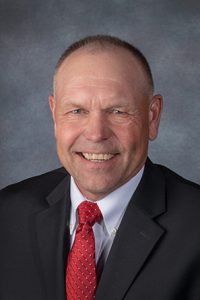
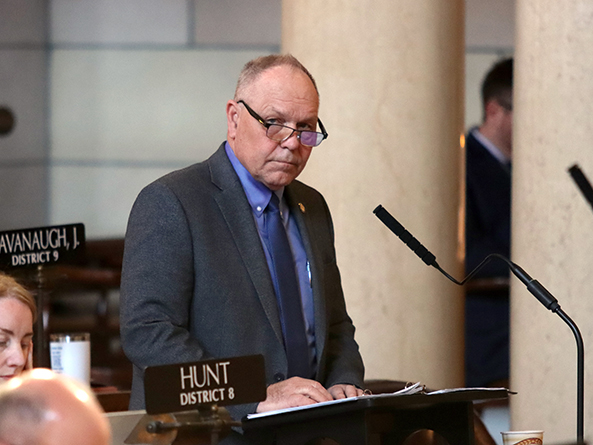
LB1010, sponsored by Plymouth Sen. Tom Brandt, would require private developers to apply to the Nebraska Power Review Board before constructing or acquiring an energy storage resource, which the bill defines as a facility that can receive electricity from the electrical grid or an associated generation source and store it for later injection into the grid.
Brandt said large-scale battery storage projects are becoming more common across the country and can provide certain benefits, including additional electrical capacity and higher grid reliability.
“[The bill] ensures that … Nebraska can welcome private investment while still protecting the public power model and ensuring these projects operate in a way that benefits our utilities, our infrastructure and ultimately the people of the state,” he said.
LB1010 would require a private electric supplier to show that they have:
• entered into, or will enter into, a power purchase agreement or other contract with a Nebraska public power supplier for the purchase of the ESR’s electric energy and capacity throughout its operational life;
• jointly filed the application with the public power entity;
• obtained written consent from affected electric suppliers; and
• entered into a joint transmission development agreement with the public power supplier that owns the transmission facilities that will interconnect with the ESR.
The proposal also would expand the existing eminent domain authority of public power districts to include property used in the storage of electrical energy.
A Natural Resources Committee amendment, adopted 26-0, replaced the bill with a modified version of the original proposal and provisions of two other measures considered by the committee this session.
Under the amendment, a private electric supplier seeking to build an ESR would not have to file a joint application with a public power entity. Brandt said the amendment also would exempt ESRs from the use of eminent domain by public power suppliers.
The amended provisions of LB1064, introduced by Sen. Eliot Bostar of Lincoln, would create the Large Load Customer Regulation Act. They would require public power suppliers to establish standards for interconnecting retail customers with a new or expanded load of more than 20 megawatts at a single site.
The standards would require large load customers to disclose whether they are pursuing a similar interconnection request and pay a fee to the interconnecting public power supplier for initial load studies.
Bostar said these provisions are intended to discourage “interconnection shopping” in which a developer applies with multiple utilities for a potential project. The practice makes it more difficult for public power suppliers to make accurate load forecasts, he said.
The measure also would authorize public power suppliers to establish rates, charges and operating standards for each large load customer and impose electric service requirements for those customers in addition to the proposed standards.
Finally, Bostar’s proposal would require public power suppliers to develop a procedure requiring large load customers to curtail their electricity use or deploy onsite backup generating facilities during times of grid instability or emergencies.
The amended provisions of LB1111, sponsored by Omaha Sen. Machaela Cavanaugh, would allow public power suppliers to impose certain requirements on large data centers, including terms or conditions requiring data centers to pay the full cost of providing their electric service.
The measure also would require the owner or operator of a data center to submit an annual report to the state Department of Water, Energy and Environment and the Natural Resources Committee. The report would include the data center’s size, location and annual electricity demand and water usage, among other information.
Brandt introduced an amendment, adopted 25-0, that included provisions of LB1193, introduced by Sen. Jason Prokop of Lincoln.
They would impose the annual nameplate capacity tax — currently paid by owners of private renewable energy generation facilities — on owners of ESRs with a nameplate capacity of 100 kilowatts or more. The measure also would exempt certain equipment used in ESRs from the tangible personal property tax.
Prokop offered an amendment he said was intended to protect Nebraska ratepayers by prohibiting public power districts from making certain “inappropriate” purchases, including sports tickets, country club memberships and private flights.
Niobrara Sen. Barry DeKay opposed the amendment, saying a private aircraft is “essential” to the operations of the Nebraska Public Power District, which has a large service territory. NPPD policies already prevent spending on most of the other items in question, he said.
After voting 7-15 to reject Prokop’s amendment, senators advanced LB1010 to select file on a vote of 27-0.

