
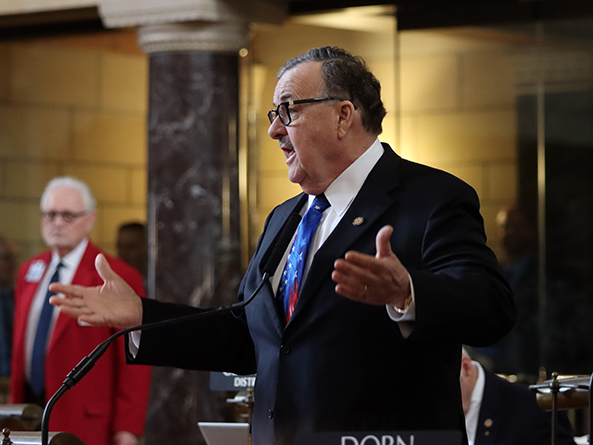
Omnibus consumer protection measure advanced to second round
A bill meant to strengthen banking protections for vulnerable consumers was amended to become an omnibus proposal and advanced from general file March 5.
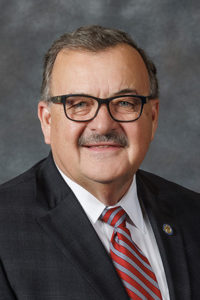
LB838, sponsored by Sen. Mike Jacobson of North Platte, would authorize an optional program for financial institutions under which a vulnerable or senior adult could designate an “authorized contact” to be notified by a financial institution in the event of an emergency, loss of contact with the customer or suspected financial exploitation.
Financial institutions would be shielded from liability regarding the administration of such programs or the actions of authorized contacts, including if a financial institution refuses to communicate with an authorized contact because they suspect that the person is involved in the exploitation or is not acting in the victim’s best interest.
It also would offer legal protection to the authorized contact person, ensuring they cannot be sued or prosecuted for cooperating in good faith with the financial institution or law enforcement.
“[The bill] provides clarity and reasonable protections for financial institutions that are often on the front lines of identifying suspicious activity,” Jacobson said.
A Banking, Commerce and Insurance Committee amendment would add provisions of Jacobson’s LB837 to address what he referred to as the “reality of the disappearing penny.”
In 2025, the U.S. Mint stopped producing new pennies, which Jacobson said has left merchants and consumers in a “no man’s land” when the price of goods and services does not end in a whole dollar amount.
“This [amendment] would provide guidance by establishing a uniform rounding standard for cash transactions,” Jacobson said, adding that the measure would apply only to transactions involving physical currency and not to those involving checks, electronic funds transfers or credit or debit cards.
If the final digit of the transaction ends in 1, 2, 6 or 7, the amount would be rounded down to the nearest multiple of 5 cents. If the final digit of the transaction ends in 3, 4, 8 or 9, the amount would be rounded up to the nearest multiple of 5 cents. For transactions totaling only 1 or 2 cents, the amount would be rounded up to 5 cents.
Jacobson said the measure would ensure that, over time, gains and losses would balance out and that the proposal would bring “much-needed clarity” to consumers, businesses and financial institutions.
The committee amendment also includes amended provisions from the following bills:
• LB875, sponsored by Syracuse Sen. Bob Hallstrom, which would prohibit suppliers from including clauses in contracts that waive compliance with the Equipment Business Regulation Act or mandate that legal disputes be resolved in out-of-state forums or by other state laws;
• LB1160, also introduced by Hallstrom, which would modernize Nebraska’s estate and trust laws by synchronizing the Uniform Probate Code with the Uniform Trust Code and strengthening the rights of surviving families; and
• LB1063, sponsored by Sen. Eliot Bostar of Lincoln, which would modernize the Nebraska Money Transmitters Act to exclude influence from foreign adversaries and regulate informal transfer systems.
Lincoln Sen. Carolyn Bosn offered an amendment, adopted 35-1, to add the provisions of her LB1118 to the committee package. Those provisions would update the state’s Uniform Deceptive Trade Practices Act to treat certain conduct by social media platforms that accept paid advertising as a deceptive trade practice.

A platform that knowingly permits fraudulent advertising or ignores credible reports would be guilty of a deceptive trade practice. A fraudulent advertisement is defined as one that misrepresents material facts or unlawfully impersonates another in order to induce a transaction or extract a benefit.
The measure also would require platforms, within seven days, to investigate and determine if a reported ad is fraudulent and remove it from the platform.
Bosn said social media platforms use sophisticated algorithms to target users, and those same systems easily could be used to target fraudulent advertisers.
Bosn’s amendment also would incorporate provisions of her LB1119, which would update the Age-Appropriate Online Design Code Act passed by lawmakers last year. Among other provisions, the amendment would:
• broaden the types of design features covered by the act;
• prohibit one-step privacy downgrades and repeated prompts to minors to reduce privacy protections; and
• require a clear tool for minors to request account deletion within 15 days.
Following the 34-2 adoption of the committee amendment, lawmakers advanced LB838 to select file 35-0.

