
Apprenticeship registry measure broadened, advanced
A bill that would create a registry for apprenticeships in Nebraska was broadened to become an omnibus business measure before being advanced to select file March 4.

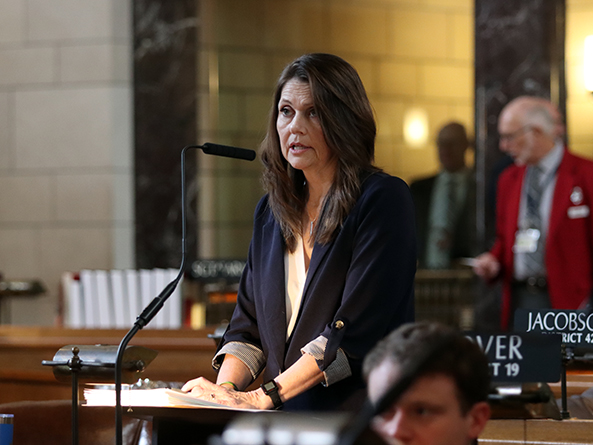
LB847, sponsored by Omaha Sen. Kathleen Kauth, would create the Nebraska Office of Registered Apprenticeship within the state Department of Labor to serve as the state apprenticeship registry.
The office would be responsible for establishing standards to create a nationally recognized state credential for the completion of a registered apprenticeship program. Additionally, the office would be required to establish a plan to provide reciprocal approval for programs that are registered in other states.
Kauth said the bill would shift oversight of apprenticeship programs from the U.S. Department of Labor to the state Department of Labor. She said the change would give DOL the ability to determine the shape of future apprenticeship programs.
“While we have had that ability to create this office for many years, we’ve never done it,” Kauth said, “and the time is right to move forward with the state guiding the workforce of Nebraska rather than the federal government.”
The measure also would create the Nebraska Apprenticeship Council to advise the office and provide community outreach and education regarding the benefits of apprenticeship.
Finally, LB847 would increase from 20% to 50% the amount of the unemployment combined tax rate that can be transferred to the Workforce Development Program Cash Fund to invest in workforce development initiatives.
Kauth said the State Unemployment Insurance Trust Fund, commonly known as SUIT, currently has a balance of approximately $584 million, which is far more than needed to provide unemployment benefits. SUIT is the repository for state unemployment taxes, which are paid by employers.
The Legislature lowered the unemployment tax rate last year, she said, but the fund continues to grow.
“No business will be paying more in taxes,” Kauth said, “some of the money will just be redirected to workforce development.”
A Business and Labor Committee amendment, adopted 39-0, replaced the bill with a modified version of the original proposal. Among other technical changes, the amendment would add definitions for small and large apprenticeship programs and expand the definition of an employee organization to include employee benefit plans and beneficiary associations.
It also would require that the governor-appointed apprenticeship council be composed of individuals with experience in small and large Nebraska apprenticeship programs.
The amendment would add provisions of four other measures considered by the committee this session, including LB747, sponsored by Elkhorn Sen. Tony Sorrentino.

Those provisions would establish uniform enforcement authority across multiple programs managed by DOL, including changing youth employment certification procedures, removing an infraction for failure to provide a wage statement and expanding DOL subpoena powers.
Provisions of LB864, introduced by Sen. Jason Prokop of Lincoln, would transfer responsibility for awarding and disbursing grants under the InternNE program from the state Department of Economic Development to DOL.
The two remaining bills in the committee amendment seek to change how funds are expended within DOL.
The provisions of LB1015, sponsored by Sumner Sen. Teresa Ibach, would create the Business Innovation Cash Fund within DOL and establish a mechanism to provide funding for the Business Innovation Act from a percentage of SUIT funds.
Under the proposal, the commissioner of labor would designate the percentage and proportion of the SUIT tax to be allocated to the Business Innovation Cash Fund. The measure also would add new reporting elements to improve the state’s ability to track outcomes.
“It establishes a stable, ongoing source of funding for two key areas of Nebraska’s economic strategy: workforce development and business innovation,” Ibach said.

Finally, the provisions of LB1173, introduced by Kauth, would change the name, filing fee and permitted uses of the Contractor and Professional Employer Organization Registration Cash Fund.
Kauth said the proposal would provide DOL with a reliable funding source to enforce state labor laws and administer statutorily required programs rather than having to rely on federal dollars, which she said often are not received in a timely manner.
The department normally is 98% federally funded, she said, but during the last government shutdown, DOL had to use emergency funds from the pandemic just to meet payroll. The measure would allow the DOL to become largely self-funded, she said.
The provisions would allow the department to assess fees for all employers under the Employment Security Act annually on a graduated scale based on gross wages paid out in the previous year, not to exceed a total of $15 million.
Kauth also offered an amendment to the committee amendment, adopted 25-0, to add the provisions of Prokop’s LB1044. Those provisions would require that at least $4 million in annual grants be awarded annually under the Business Innovation Act, which supports innovators and startups across the state.
Prokop said the fund provides early-stage firms with access to capital, technical support and opportunities to develop and commercialize new technologies, helping to grow Nebraska’s economy from within.

Independent impact analysis has shown that BIA-funded businesses have created more than 2,300 new jobs with annual wages exceeding $182 billion, he said.
“These results demonstrate not only a strong return on investment for Nebraska taxpayers, but also Nebraska’s growing competitiveness in attracting venture capital and commercial success for home-grown businesses,” Prokop said.
The provisions also state legislative intent to appropriate $15 million in fiscal year 2026-27 for the grants. Prokop said those dollars would not be general funds, but would be distributed from the Business Innovation Cash Fund created by the provisions of Ibach’s measure included in the committee amendment.
Omaha Sen. John Cavanaugh expressed some concern with the various redistributions of SUIT funds outlined in the proposal, even if the SUIT balance is far more than the department would ever need to pay out in unemployment benefits.
If SUIT is overfunded, he said, lawmakers should lower the unemployment tax rate charged to employers.
“If we’re charging employers more than it takes to provide [unemployment benefits], then we shouldn’t just use that as a slush fund to fund some other thing, no matter how meritorious,” Cavanaugh said.
Following the 39-0 adoption of the committee amendment, senators voted 38-0 to advance LB847 to select file.

