
Minimum wage limitations approved
After a second vote on the bill’s final passage, lawmakers approved a measure Feb. 5 that limits scheduled increases to the state’s minimum wage.
Nebraskans voted at the November 2022 general election to increase the state minimum wage incrementally to $15 an hour by Jan. 1, 2026. The minimum wage then was scheduled to adjust annually based on the Midwest Consumer Price Index to account for cost-of-living increases.

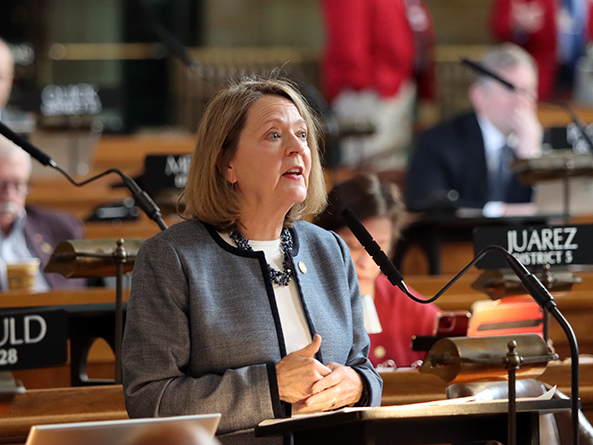
LB258, sponsored by Lincoln Sen. Jane Raybould, instead increases the state minimum wage by 1.75% annually.
The bill also establishes a youth minimum wage of $13.50 an hour for employees ages 14 and 15 and adjusts the 90-day training wage for new employees under age 20 to $13.50 an hour through Dec. 21, 2026. The training wage then increases by 1.5% annually.
The youth minimum wage, which does not apply to emancipated youth, also will increase by 1.5% every fifth year beginning Jan. 1, 2030.
LB258 failed to obtain final approval last session on a vote of 31-17. Laws that would alter voter-approved initiative measures require a two-thirds majority, or 33 votes, for final passage. Lincoln Sen. Beau Ballard filed a successful motion to reconsider that vote, but the bill was not rescheduled for final consideration last session.
During final round debate this year, Raybould said many businesses refrain from hiring young workers who lack experience and are prohibited by law from performing certain tasks and in the number of hours they can work during the school week.
“[Businesses] are making hard choices about how many people to hire and who to hire,” she said. “Allowing employers to … [hire] teenage workers at a lower minimum wage makes them more attractive despite possessing little to no work experience or job skills.”
Seward Sen. Jana Hughes supported the proposal, saying fixed-rate minimum wage increases would provide business owners with consistent and predictable labor costs.
“We want to grow our economy and the best way to do that is to grow our businesses — and make a healthy environment for businesses — who are going to hire more people,” Hughes said. “That consistency is good for workers and it’s good for business owners.”
Speaking in opposition, Sen. Danielle Conrad of Lincoln said LB258 defies the inflation-based increase approved by 58% of voters in 2022 during a time when Nebraskans are experiencing an “affordability crisis.”
Conrad said costs for utilities, groceries, child care and housing have increased much faster than the rate at which the minimum wage is scheduled to increase under the bill. In addition, she said, the majority of the 280,000 working Nebraskans who will be impacted by the proposal are women, people of color, young workers and those living in rural communities.
“The answer to addressing the affordability crisis is not to cut minimum wages,” Conrad said.
After two hours of debate, Raybould offered a motion to invoke closure, which ends debate and forces a vote on the bill. The motion prevailed 33-16 and lawmakers passed LB258 on a 33-16 vote.

