
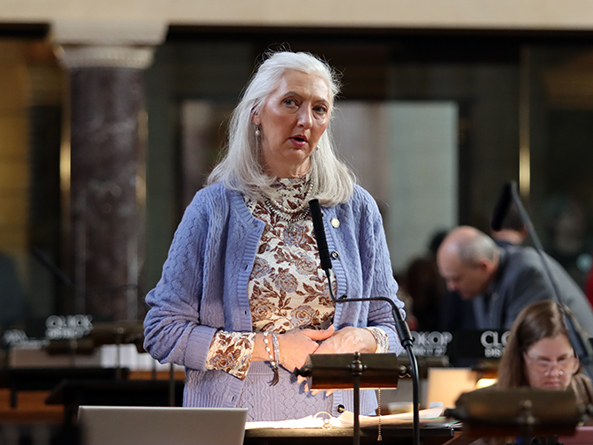
Abortion informed consent updates stall after cloture vote
Following four hours of debate spanning four days, a proposal to update the state’s informed consent laws for abortion stalled on general file Feb. 4 following a failed cloture motion.

LB669, introduced by Whitman Sen. Tanya Storer, would remove obsolete sections of state law regarding informed consent that were ruled unconstitutional and blocked from taking effect. Debate focused on another provision in the bill that would require abortion providers to screen patients for signs of coercion, abuse and trafficking.
Under those provisions, if a patient reveals being pressured or coerced into seeking or consenting to an abortion, or indicates that they are a victim of domestic violence or human trafficking, their provider would be required to supply phone numbers for the national domestic violence and national human trafficking hotlines and allow the patient to make a confidential phone call.
Storer said the measure would remedy constitutional issues and require abortion providers to screen for coercion, domestic violence and sex trafficking.
“The underlying goal here is to protect women and to give them a way out of an abusive situation where they’re being controlled by a trafficker,” Storer said. “If this saves one woman, it’s worth it.”
Hastings Sen. Dan Lonowski supported LB669, saying sex trafficking is a significant and growing problem in Nebraska, especially along the I-80 corridor. Trafficking victims often are controlled and coerced into acting against their will, he said, and Storer’s bill would offer victims a way to seek help.
“This bill gives [patients] a chance to speak privately with someone, to talk and let their feelings out, [and] maybe reveal who the sex trafficking people are that have forced them into this situation” Lonowski said.
Sen. Megan Hunt of Omaha opposed the measure and introduced a series of procedural motions to extend debate. LB669 would unfairly target abortion patients and characterize them as incapable of making medical decisions, she said, adding that the measure is opposed by medical organizations, including the Nebraska Medical Association.
The bill also overlooks the broader realities of domestic violence and reproductive coercion, Hunt said, and adds requirements — such as signing a written certification that they have been screened — that could actually deter abuse survivors from seeking help.
“For someone who is being abused, coerced or trafficked, a written record like that can feel very dangerous and it can make them much less likely to disclose those things in a conversation,” she said.
Omaha Sen. Ashlei Spivey also opposed the bill. While the measure is well-intentioned, she said, it focuses narrowly on one form of reproductive coercion and fails to address others, including women being forced to continue a pregnancy and contraception interference.
To address opponents’ concerns that the measure would unfairly target abortion providers and patients, Storer filed an amendment to require that screenings occur at all initial pregnancy-related visits, not just abortion appointments.
Hunt said that while she worked in good faith with Storer on the amendment, medical providers continued to raise concerns about placing obstetricians under abortion statutes and exposing them to new liabilities.
“Yes, I would like to fix this bill, but there’s no way that I’m going to be supporting an amendment that isn’t supported by the medical community,” Hunt said.
Sen. Danielle Conrad of Lincoln also opposed the bill and Storer’s amendment. Nebraska lawmakers have worked across party lines for more than 20 years to pass legislation addressing human trafficking, she said, often with support from law enforcement as well as domestic and civil rights groups.
Conrad said LB669, in contrast, is supported primarily by local and national anti-abortion advocacy groups and lacks backing from a diverse set of stakeholders.
“We want to have a victim-centered approach that doesn’t target reproductive health providers and doesn’t lean into junk science put forward at the committee hearing by these ideologically focused groups,” she said.
After four hours of debate, Storer offered a motion to invoke cloture, which ends debate and forces a vote on the bill and any pending amendments.
The motion failed on a 31-15 vote. Thirty-three votes were needed. LB669 is unlikely to be placed on the agenda again this session.

