
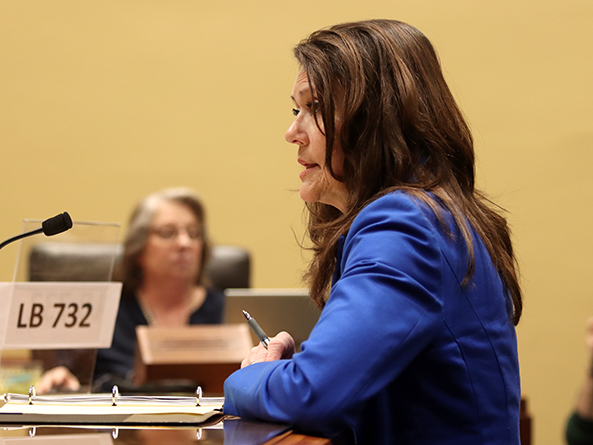
Puberty blockers, hormone therapy ban for gender dysphoria considered
The Health and Human Services Committee heard testimony Jan. 29 on a bill that seeks to prohibit access to hormones and puberty blockers for Nebraskans younger than 19 who are experiencing gender dysphoria.

Currently, Nebraska practitioners may prescribe approved puberty-blocking drugs and cross-sex hormones for patients younger than 19 only if the individual meets criteria established by the state Department of Health and Human Services, which include a minimum of 40 hours of gender identity focused therapy before treatment can begin and a number of ongoing requirements.
LB732, introduced by Omaha Sen. Kathleen Kauth, would prohibit a health care practitioner from prescribing cross-sex hormones or puberty-blocking drugs to individuals under age 19 except for treatment of a congenital defect, precocious puberty, disease or physical injury.
Individuals under age 19 currently receiving cross-sex hormones and puberty-blocking drugs for gender dysphoria would be permitted to continue care through Jan. 1, 2027, under the measure.
A health care practitioner who violates the bill’s provisions would be subject to a civil penalty of $25,000 per violation.
Kauth said she introduced LB732 following a U.S. Supreme Court ruling that state bans on puberty blockers and hormone therapy for minors are constitutional.
Such bans do not exclude individuals from medical treatment on the basis of sex or transgender status, she said, but rather remove the diagnoses of gender dysphoria, gender identity and gender incongruence from the range of treatable conditions.
“LB732 protects minors from irreversible, experimental medical interventions that carry significant, unresolved risk and lack high-quality, long-term evidence of benefit,” Kauth said. “Children and adolescents are developmentally incapable of providing informed consent for procedures that permanently alter sexual function, fertility and healthy bodily development.”
Merlin Wehling, an anesthesiologist from Kearney, testified in support of the measure.
Many parents are unaware of the potential risks of puberty blockers and hormone therapy, such as blood clots, infertility and scar tissue, he said, and “misrepresented” data can influence their decision to support a child’s transition as a way to alleviate depression, anxiety or suicidal ideation.
“All the problems we have are multiplied because the body is not designed to transition, especially at this early age,” Wehling said.
Proponent Jamie Reed shared her experience assisting in nearly 1,500 medical transitions as a social worker and clinical research coordinator at the Washington University Transgender Center in St. Louis.
Reed said there is an element of “social contagion” in the number of youth who identify as transgender. Over several years, she said, the clinic went from an average of four patients per month to approximately 60 patients per month, many of whom were influenced by social media, school and the lockdown that occurred as a result of the COVID-19 pandemic.
“Decades of developmental research shows that most of those children, if left alone, would grow up to be gay or lesbian,” she said. “We still have … kids who are still sucked into this contagion who are being medically harmed.”
Reed also said that more than 10 systemic reviews of the use of hormones, puberty blockers and surgery on transgender youth have found no evidence to support medical transitioning in children.
Speaking in opposition to LB732, social worker and therapist Braden Foreman-Black argued that several of those systemic reviews did not determine that hormones and puberty blockers are definitively bad treatment. In fact, he said, one study concluded that medical interventions are not a serious enough risk of harm to suggest the need for policies that restrict access to them.
“We have … lists of data and literature that do support the ethical treatment of puberty blockers or hormones for children under 19,” Foreman-Black said.
Elizabeth Constance also opposed the measure. Speaking on behalf of the Nebraska Medical Association, she said health care decisions should remain between a family and their medical team.
There are no one-size-fits-all solutions in medicine, Constance said, and physicians need to have the authority to tailor treatments to meet the unique needs of each patient.
“LB732 is a blunt-instrument approach to a deeply nuanced and complex area of health care … [and] replaces the expertise of medical professionals and the intuition of parents with a government mandate,” she said.
Meghan Oakes, a double board certified OB-GYN and reproductive endocrinologist, testified in opposition to the bill. She said the same hormones and puberty blockers used to assist in the transition process are considered safe and effective medical interventions for endometriosis, precocious periods, in vitro fertilization and birth control.
If the medications were harmful, Oakes said, the state would ban them for every use, not just for gender-affirming care.
Opponent Evelynn Freeman, a mental health provider, said she often wonders what her life would have been like had she had access to gender-affirming care sooner.
“Maybe I could have gotten into painting, made more friends or just wouldn’t have had to hurt so much,” Freeman said. “I want to protect other people from hurting like I did.”
The committee took no immediate action on LB732.

