
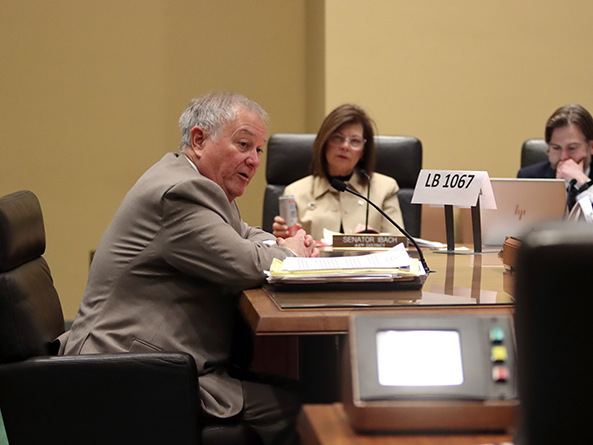
Tax increase to fund additional workforce housing considered
The Revenue Committee heard testimony Jan. 29 on a measure intended to create a stable funding source for two Nebraska workforce housing programs.

LB1067, introduced by Syracuse Sen. Bob Hallstrom, would increase the documentary stamp tax on the transfer of real estate from $2.32 to $3.82 for each $1,000 in value. The additional proceeds would be split between the Rural Workforce Housing Investment Fund and Middle Income Workforce Housing Investment Fund.
The state Department of Economic Development uses the first fund, created in 2017, to provide grants to nonprofit developers to build workforce housing in the state’s rural communities. Created in 2020, the middle income program serves the same purpose for Douglas, Lancaster and Sarpy counties.
Although both programs have had an “astonishing” return on investment, Hallstrom said, the Legislature has not consistently funded either in recent years. He said LB1067 would generate approximately $12 million in additional proceeds for each fund beginning in fiscal year 2026-27.
“Nebraska has a housing crisis for which an immediate, reliable funding source is needed,” Hallstrom said. “Without question, allocating resources to enhance our housing supply promotes both workforce development and the growth of our communities across the state.”
In addition to increasing the documentary stamp tax, Hallstrom said, LB1067 would eliminate a provision allowing the Legislature to transfer money from the Affordable Housing Trust Fund to the state’s General Fund and other funds that receive documentary stamp tax proceeds.
Carol Bodeen testified in support of the bill on behalf of the Nebraska Housing Developers Association, saying developers especially appreciate that proposed change. Despite the state’s lack of affordable housing, she said, lawmakers last year approved an $8 million transfer from the Affordable Housing Trust Fund to the General Fund to help balance the state budget.
Shannon Harner, executive director of the Nebraska Investment Finance Authority, also testified in support. She said the “modest” tax increase proposed in LB1067 — $600 on the sale of a $400,000 house — would create a dedicated funding source to help address Nebraska’s shortage of entry-level homes for working families, first-time homebuyers and moderate income households.
“Without LB1067, there’s no likely dependable source of state funding,” Harner said. “One-time appropriations and temporary programs don’t create the stable pipeline that communities need to plan, build and preserve attainable housing year after year.”
Testifying in opposition to the bill was Charles Chadwick on behalf of the Nebraska Realtors Association, Lincoln and Omaha homebuilders associations and the Welcome Home Coalition. He said LB1067 would increase closing costs, eroding a seller’s equity and limiting options for their next home.
“While this bill may appear modest on paper,” Chadwick said, “the real-world impacts are meaningful.”
He said lawmakers instead could increase Nebraska’s housing supply by eliminating regulations and reducing the taxes and fees associated with home construction and ownership.
The committee took no immediate action on the bill.

