
Renewable energy designation for counties considered
Solar and wind energy companies would pay additional taxes to counties in exchange for standardized permitting requirements under a bill heard Feb. 19 by the Revenue Committee.

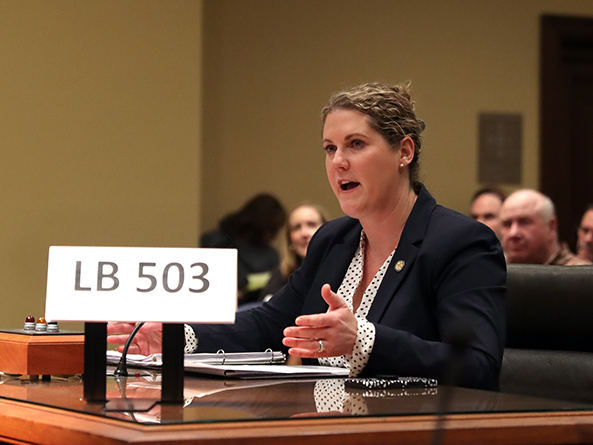
Under LB503, sponsored by Lincoln Sen. Carolyn Bosn, a county board could apply to the state Department of Revenue for an “American energy friendly” designation. A board also could submit the question of whether to apply to voters.
To qualify, a county’s regulations would have to meet setback, sound, height, decommissioning and other requirements related to privately developed renewable energy generation facilities.
A county would have to permit the facilities by right in all zoning areas that allow structures of any type by right and could not require a conditional use permit or other discretionary zoning approval for a facility’s installation or operation.
The owner of a facility operating in an American energy friendly county would pay a nameplate capacity tax of 1.5 times the rate set for other renewable generation facilities, which currently is $3,518 per megawatt.
Bosn said the measure is intended to reduce property taxes by generating additional nameplate capacity tax revenue for counties that receive the designation.
“Nothing in LB503 requires counties to become American energy friendly counties,” she said. “Additionally, the zoning standards proposed in LB503 are consistent with what many Nebraska counties already require.”
David Levy, an Omaha attorney who represents wind and solar energy developers, testified in support of the bill. He said the designation would help attract investment to rural Nebraska communities by giving developers the “regulatory certainty and timing certainty that are fundamentally important in making investment decisions.”
“The setbacks and other metrics in the bill protect nonparticipant property rights while also providing opportunities for landowners who want to put their land into a wind or solar project,” Levy said.
Also in support was Al Davis of the Nebraska chapter of the Sierra Club. By easing the permitting process for renewable energy development, he said, LB503 would end “divisive zoning hearings, which have torn apart many Nebraska communities and shut down worthy projects based on flimsy fictional claims with no scientific basis.”
Testifying in opposition to the bill was Sandy Hermesch. She said LB503 would prevent local input and control over the siting of projects like a proposed utility-scale solar facility in southern Lancaster County.
“The people who live and vote in these communities that are having these solar structures built in their backyards should have a say about the companies who build them and where they are placed,” Hermesch said.
Also in opposition was Gregory Kratz of Fairbury. He said many Nebraska counties recently have adopted more restrictive zoning regulations related to renewable energy development than those outlined in LB503.
“This bill … attempts to bypass the democratic process of applying for special use permits and silences the voices of the people who have to live with these structures on a daily basis,” Kratz said.
Jon Cannon testified in opposition to LB503 on behalf of the Nebraska Association of County Officials. He said county officials would prefer that counties be able to seek the designation only after holding an election.
Counties also are concerned that the bill would allow development without a public hearing, Cannon added.
“Boards across the state value their public input,” he said. “They might not always be thrilled when they get the input, but they value that all the same because it’s a vital part of the process.”
The committee took no immediate action on the bill.

