
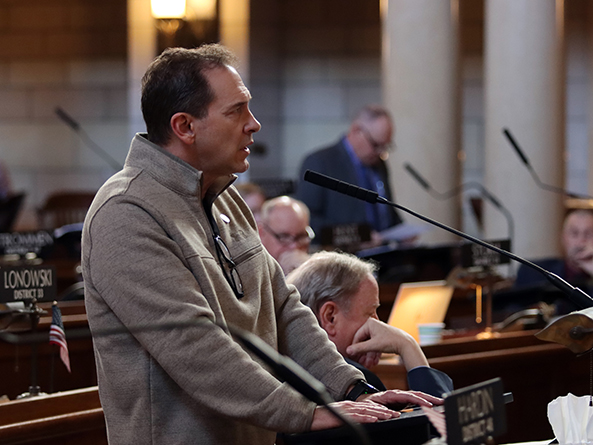
HHS omnibus bill given first-round approval
A measure that would establish an endorsement process for community health worker training programs was amended to become an omnibus proposal and advanced to the second round of debate March 12.

LB912, as introduced by Gering Sen. Brian Hardin, would create the Community Health Worker Training Endorsement Act.
Under the bill, the state Department of Health and Human Services would be required to establish a statewide process to endorse community health worker training programs that meet minimum standards of quality and ensure services provided by community health workers are eligible for reimbursement by Medicaid and private insurers.
The department also would be responsible for establishing rules and regulations required for training programs to receive endorsement, including:
• setting reasonable fees;
• identifying core competencies;
• approving programs and training providers; and
• defining the application, approval, denial, suspension, revocation and renewal process for training endorsements.
The completion of a community health worker training program would not constitute licensure, certification or credentialing under the Uniform Credentialing Act.
Hardin said community health workers improve access to care by serving as liaisons between community members in need and the systems that provide nonclinical health, behavioral health and social services, such as health education, outreach, patient navigation and care coordination.
Creating endorsed training programs would ensure community health workers receive instruction in the skills needed to effectively provide nonclinical services and work appropriately alongside licensed professionals within the health care system, he said.
“Supporting community health workers through consistent training standards can lead to improved health outcomes, a stronger workforce and more efficient use of our health care resources,” Hardin said.
A Health and Human Services Committee amendment replaced the bill with a modified version of the original proposal and would require DHHS to establish the rules and regulations for community health worker training programs no later than July 1, 2027.
The committee amendment also includes amended provisions from the following bills:
• LB735, sponsored by Bellevue Sen. Victor Rountree, which would adopt the Respiratory Care Interstate Compact to allow licensed respiratory care therapists to practice across participating states;
• LB736, also introduced by Rountree, which would adopt the Athletic Trainer Compact with the goal of improving public access to athletic training services;
• LB887, sponsored by Sen. Bob Hallstrom of Syracuse, which would allow accredited pharmacy programs to determine the date and time of the jurisprudence examination for pharmacy students and clarify that certified pharmacy technician requirements do not apply to pharmacist interns under the supervision of a pharmacist;
• LB891, sponsored by Blair Sen. Ben Hansen, which would update the Child Care Licensing Act to align state law with federal background check regulations, clarify how self-reported licensing investigations appear on public records, allow certain volunteers to be counted toward staff-to-child ratios and prohibit residency requirements for family child care homes; and
• LB892, also introduced by Hansen, which would prohibit a massage therapist from practicing in a location other than a licensed massage therapy establishment, except as permitted by DHHS.
Hansen offered an amendment to add provisions of his LB1012 to the committee amendment. The proposal, adopted 31-0, would allow a physical therapist to file a medical lien for damages awarded to an injured patient.
Hansen said medical liens — which provide repayment for medical treatment and allow patients to defer bill payment while they receive critical rehabilitative treatment — currently can be filed only by physicians, nurses, chiropractors, hospitals and EMS providers.
He said the amendment would allow physical therapists to provide prompt care to patients with a reasonable expectation of payment.
Sen. Beau Ballard of Lincoln also offered an amendment to the committee amendment that included provisions of his LB936.
The amendment, adopted 33-0, would allow a nurse practitioner who has completed the necessary education and training to perform fluoroscopy, and allow a licensed medical radiographer to use fluoroscopy in collaboration with a qualified nurse practitioner.
Ballard said a credentialing review report conducted by DHHS found that expanding fluoroscopy use to include nurse practitioners would improve access to care, especially for Nebraskans living in rural parts of the state.
An amendment brought by Ralston Sen. Merv Riepe, adopted 32-0, would add the amended provisions of his LB1211 to the committee package.
Those provisions would update the Automated Medications Systems Act to allow licensed pharmacies to operate automated pickup kiosks that securely store and dispense prescription medications to patients and caregivers.
Under the amendment, kiosks must be located on property owned or leased by the licensed pharmacy or at a hospital, health clinic, health care practitioner facility or rural emergency hospital where the licensed pharmacy operates. A licensed pharmacy would be prohibited from dispensing controlled substances through a kiosk unless it was located at an authorized hospital with proper oversight.
The measure also would require a licensed pharmacy to obtain annual licensure for each kiosk, designate pharmacist oversight, comply with all standard dispensing and labeling requirements and offer pharmacist consultation. The fee for license application or renewals could not exceed $50.
Riepe said automated pickup kiosks are authorized in 38 states and provide greater flexibility to patients who are not able to pick up their prescriptions during a pharmacy’s normal operational hours.
“[LB1211] is a great opportunity to let medical technology be utilized in Nebraska, expand access to medications and do so with clear accountability,” Riepe said.
Following the 31-0 adoption of the committee amendment, lawmakers advanced LB912 to select file on a vote of 31-0.

