
Expansion of victims’ rights, law enforcement epinephrine access advanced
Senators amended and advanced from general file two Judiciary Committee measures March 5, including a bill that would expand legal protections and notification requirements for victims of certain crimes.

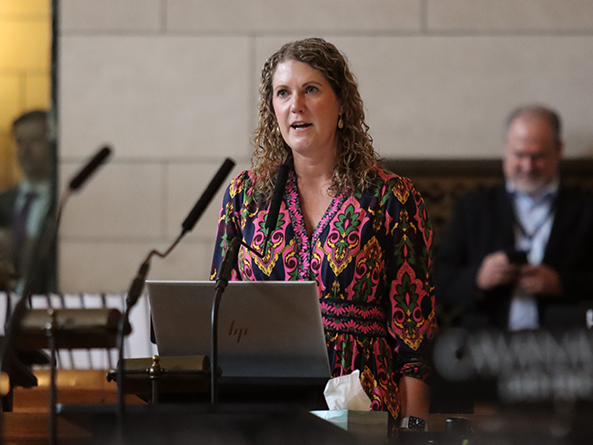
LB1181, introduced by Lincoln Sen. Carolyn Bosn, would broaden the definition of a homicide victim and clarify victims’ rights to participate in court proceedings, particularly in cases involving homicide, domestic violence and post-conviction proceedings.
Currently, benefits and rights tied to homicide cases generally are limited to immediate family members. Under the bill, the definition would be expanded to include additional relatives and others with a close relationship to the victim, allowing more people affected by a homicide to access protections and services available under the Nebraska Crime Victim’s Reparations Act.
The measure also would clarify victims’ ability to participate in court proceedings by allowing them to submit written impact statements describing how the crime affected them. Courts could consider those statements during sentencing and other stages of a case and, in some instances, allow them to be read aloud at sentencing.
Finally, the bill would require prosecutors or other authorities to notify victims in domestic violence cases when a defendant requests a modification of bond conditions.
Bosn said victims and their families often are overlooked in criminal cases despite experiencing significant pain and loss from crimes such as homicide. LB1181 would help ensure they receive information about cases that affect them, she said, and provide more opportunities for them to be heard during sentencing.
“A violent homicide impacts families generationally and throughout communities across the state,” Bosn said. “By expanding this definition of homicide victim, we support all victims of crime and give a voice to those who are grieving.”
A Judiciary Committee amendment, adopted 32-0, also would allow victims in domestic abuse cases to submit written statements during bond or bond-modification hearings and, subject to reasonable court limits, read their impact statements at sentencing or designate a representative to read them.
The amendment also would expand the definition of co-victims in homicide cases to include survivors who suffer severe emotional harm from the victim’s death, determined on a case-by-case basis.
Senators advanced LB1181 to select file on a 31-0 vote.

Senators also advanced LB727, introduced by Sen. Kathleen Kauth of Omaha, which would authorize law enforcement agencies — including municipal police departments, county sheriff’s offices and the Nebraska State Patrol — to obtain and maintain a supply of epinephrine for use when individuals experience severe allergic reactions.
Under the bill, the state Department of Health and Human Services, in consultation with law enforcement agencies, must approve one or more educational training programs. Officers would be required to complete an approved program and provide proof of training to their agency before administering epinephrine in the field.
Kauth said she introduced the measure after learning that law enforcement officers currently are not allowed to carry epinephrine devices, such as EpiPens, even though they often are first on the scene during severe allergic reactions. The bill would allow, but not require, officers to carry and administer the medication after completing training, she said.
Senators adopted a committee amendment 28-0 authorizing the use of nasal epinephrine in addition to autoinjectors before advancing LB727 to select file on a 32-0 vote.
