
Bill would allow campaign funds for security purposes
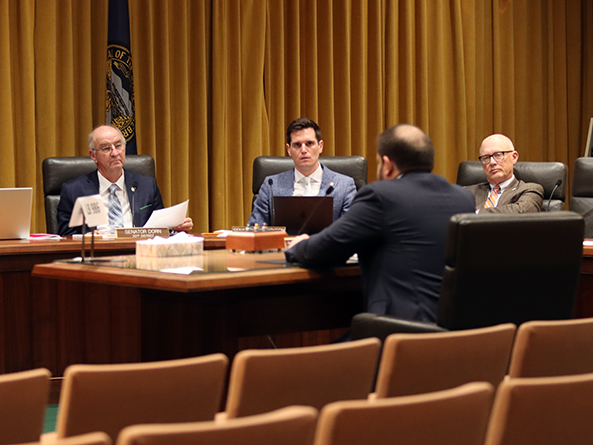
A proposal to allow candidates and office holders to use campaign funds for security purposes was considered Feb. 4 by the Executive Board.
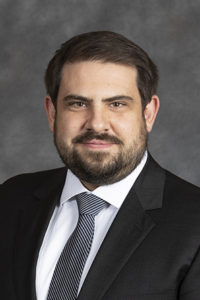
LB986, introduced by Sen. Eliot Bostar of Lincoln, would add security measures to the list of allowable expenditures of campaign funds under the Nebraska Accountability and Disclosure Act.
Under the bill, security personnel, hardware, software, electronic security equipment, installation, maintenance, monitoring and other physical and structural security measures and improvements would be considered allowable expenditures.
Bostar said the bill is a response to a “well-documented and growing reality” of increased threats, harassment and intimidation against candidates and office holders across the country. For example, he said, more than 40% of state legislators in the U.S. have experienced direct threats to their safety.
“LB986 is about safeguarding participation in the democratic process and protecting the people who serve our communities,” Bostar said.
He brought an amendment to the hearing, which he said was suggested by U.S. Rep. Mike Flood, to allow county assessors and registers of deeds to withhold candidate and elected officials’ home addresses. Current Nebraska law allows that consideration for judges and law enforcement officers, he said.
Bryan Waugh, head of the Nebraska State Patrol, testified in favor of the proposal. The State Patrol currently provides security for the State Capitol, he said, and all three branches of Neraska state government that have offices in the building.
“Any opportunity to strengthen our capability — which we believe LB986 would — we welcome and fully support,” Waugh said.
Todd Wiltgen, current Lancaster County Election Commissioner and a former Lancaster County commissioner, also supported LB986. Wiltgen said he was forced to increase security at his home in response to threats during the 2024 election cycle, and the inability to afford such actions could become a barrier to others seeking office in Nebraska.
Testifying in a neutral capacity was Scott Danigole, executive director of the Nebraska Accountability and Disclosure Commission. The commission does not oppose the proposal, he said, but the measure could benefit from more detail or inclusion of a provision allowing the commission to promulgate rules and regulations around security expenditures.
For example, he said, questions could arise regarding how long a campaign could pay for monitoring a security system or whether an office holder could pay travel expenses for a bodyguard to accompany them on an overseas trip.
“The committee may want to consider more limiting language related to allowable uses of campaign funds for security to ensure that campaign spending is related to the campaigning or the holding of public office and not of a more personal nature,” Danigole said.
No one testified in opposition to LB986 and the committee took no immediate action on the bill.

