
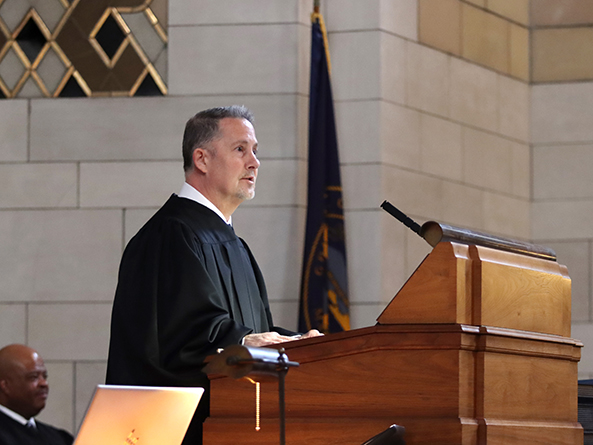
Chief justice notes successes, challenges amid budget pressures
In his State of the Judiciary address Jan. 22, Nebraska Supreme Court Chief Justice Jeffrey Funke praised lawmakers for funding the judicial branch during the last legislative session despite ongoing budget pressures.
“Last year’s budget process placed enormous pressure on this body,” he said. “You looked closely at the State’s expenditures, you weighed the impact of the work being accomplished and you saw the importance of funding the judicial branch.”
Funke also expressed gratitude to Nebraska judges for their dedication, noting that many leave higher-paying private practice to serve the public while managing heavy caseloads and emotionally charged matters.
“Doing this work comes with grave responsibilities and frequently intense criticism, yet our judges remain steadfast and committed to the rule of law and the protection of our democracy,” he said.
The chief justice noted a decline in judicial applications in recent years, calling it a challenge the legislative, judicial and executive branches must address together.
Speaking to recidivism, Funke said Nebraska’s overall rate stands at an “exceptional” 19%, with more than 80% of probationers successfully completing supervision. In addition, the judicial branch served nearly 2,400 juveniles daily last year, he said, while maintaining an all-time low juvenile recidivism rate of 17%.
Nebraska’s 35 problem-solving courts — including drug, mental health, veteran, reentry, juvenile and family courts — continue to offer cost-effective alternatives to incarceration, Funke said, with a 24% recidivism rate among participants. He said budget constraints are limiting the courts’ capacity, however, and he urged lawmakers to provide additional resources.
“Currently, our budget will not allow for the needed increase, and suitable problem-solving court candidates are being turned away,” Funke said. “Many of those turned away will languish in county jails or end up in our state’s already overcrowded prisons.”
Looking ahead to 2027, Funke said the judicial branch is working to replace its outdated JUSTICE case management system to streamline operations and improve electronic capabilities, data accuracy and communication.
First launched in 1994, the in-house system has saved taxpayers millions of dollars, he said. The modernization is expected to cost tens of millions, Funke said, and may require legislative appropriations in fiscal year 2027 if other funding options are exhausted.

