

Primary enforcement of texting while driving considered
Nebraska law enforcement officers could stop motorists for using handheld devices while driving under a bill heard Feb. 24 by the Transportation and Telecommunications Committee.
Current law prohibits drivers from using a handheld wireless communication device to read, type or send a written communication while operating a moving motor vehicle that is in motion.
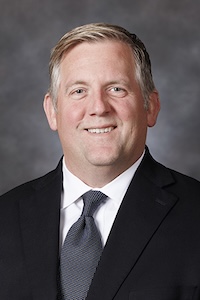
Lincoln Sen. Jason Prokop, sponsor of LB594, said crashes caused by distracted driving have jumped significantly in recent years despite the ban.
His proposal would prohibit drivers from holding or otherwise using a handheld device while operating a moving motor vehicle. The prohibition would not apply if a driver uses a device without touching it or initiates a function with a single touch.
Current law provides exceptions for first responders and emergency situations. LB594 would add an exception for employees or contractors of a utility service provider who are responding to an emergency.
Prokop said the bill also would make handheld device use while driving a primary offense, meaning that a law enforcement officer could stop a driver if they are seen using a phone. The current law may be enforced only as a secondary action when a driver has been cited or charged with a traffic violation or other offense.
“By making it a primary offense, we’re trying to change … behavior and instill in folks how important it is to keep your eyes on the road,” Prokop said.
Mark Meisinger testified in support of LB594 on behalf of the American Council of Engineering Companies of Nebraska. He said handheld device use causes inattentional blindness, decreasing drivers’ ability to avoid hazards and increasing red light violations and lane departures.
From 2014 to 2023, Meisinger said, 114 people died in crashes caused by distraction in Nebraska, and nearly 13,000 were injured. Without strong deterrence, he said, handheld device use while driving will continue to claim lives and cause preventable injuries.
“Treating … handheld device use as a primary offense is a crucial step in prioritizing public safety,” Meisinger said.
Testifying in opposition to LB594 was Spike Eickholt, who spoke on behalf of the ACLU of Nebraska and the Nebraska Criminal Defense Attorneys Association. He said law enforcement officers already may stop drivers who speed, change lanes without signaling or otherwise drive recklessly.
Additionally, Eickholt said, the bill could be interpreted to criminalize holding a phone while inside a moving car, even if the phone is turned off.
“The concern that we have is that this will essentially allow law enforcement to stop anyone at any time,” he said. “Because the reality is all of us have our phones with us at all times.”
Vicki Kramer, director of the state Department of Transportation, provided neutral testimony. Despite years of state education campaigns, she said, Nebraskans use their phones while driving more than the national average, making distracted driving the “most dangerous thing that’s happening on our roadways.”
“The department believes that higher phone usage while driving is influenced by the fact that Nebraska is one of five states without a … hands-free driving [law] or primary enforcement of texting and driving,” Kramer said.
In the more than two dozen states that have implemented hands-free laws, she said, instances of distracted driving have decreased by 6%.
The committee took no immediate action on the bill.

